
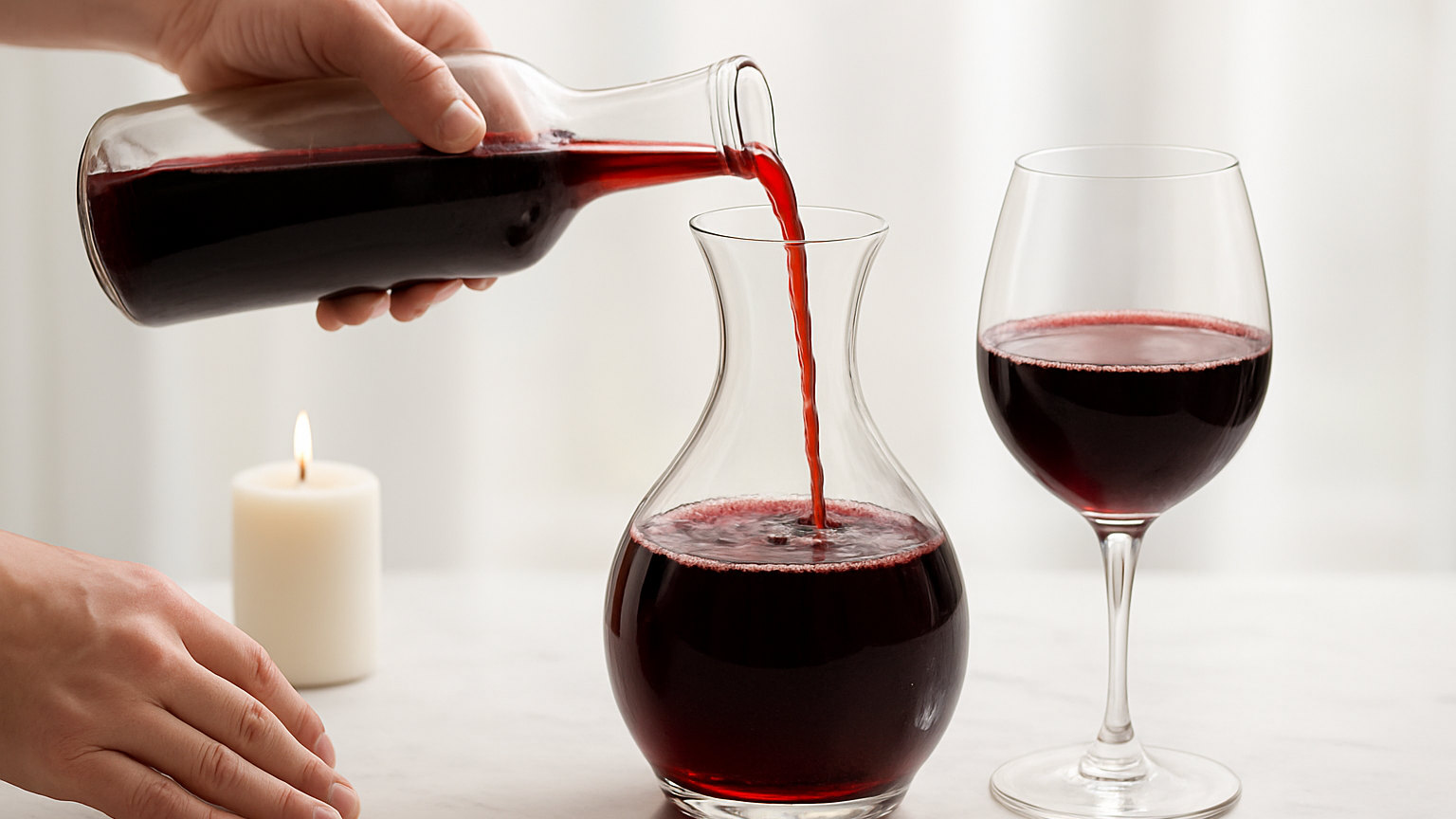
Decanting looks like ceremony and does two entirely practical things. They apply to different wines, and confusing them is why people sometimes decant a fragile old bottle into oblivion.
What are the two purposes?
- Aeration. Exposing young wine to oxygen to soften tannin and open aromatics.
- Separation. Pouring old wine off its sediment.
Young wine wants the first and can take hours. Old wine wants the second and should be poured shortly before serving.
Which wines benefit from aeration?
Young, tannic, structured reds. Barolo, young Bordeaux, northern Rhône syrah, Douro reds and young Rioja all open up noticeably.
Air accelerates the softening that would otherwise take years, and an hour in a decanter can make a closed young wine considerably more approachable.
How long should they have?
One to three hours for a young tannic red, and occasionally longer. Taste as you go rather than following a fixed time, since the point is to catch it when it opens rather than after.
Which wines should not be aerated?
Old and fragile ones. A mature wine has already softened, and its remaining aromatics are delicate and finite.
Twenty or thirty years in bottle can leave a wine that shows beautifully for half an hour and then falls apart. Decant it off the sediment and serve it.
How do you decant off sediment?
- Stand the bottle upright for 24 hours beforehand so sediment settles.
- Open it carefully without shaking.
- Pour slowly and steadily in one movement, with a light behind the neck.
- Stop when you see sediment reaching the shoulder.
A candle is traditional and any small light works. The last inch is usually sacrificed, which is normal.
What about white wine?
Rarely decanted and it sometimes helps. Young full-bodied whites, particularly white Burgundy and some Rhône whites, open up with air.
Reductive wines showing struck match or rubber notes also benefit, since the sulphur compounds blow off.
Do you need a decanter?
Any clean jug works for aeration. A wide-based decanter exposes more surface area and works faster, which is the only functional difference.
For sediment separation, any vessel does. The shape matters less than the pouring.
Does pouring hard achieve the same thing?
Partially. Splashing wine into a decanter aerates it fast, which suits a young wine and would damage an old one.
Swirling in the glass is the smallest version of the same idea and works over ten or twenty minutes.
Does opening a bottle early do anything?
Almost nothing. The surface area exposed at the neck is tiny, so a bottle standing open for an hour has barely changed.
If you want the effect of air, the wine has to be moved into something wider. Uncorking early is a common habit with very little behind it.
What is the practical rule?
Decant young tannic reds an hour or two ahead. Decant old reds immediately before serving, purely to leave the sediment behind. Leave everything else alone.
How long can wine sit in a decanter?
A few hours for a young red, and considerably less for an old one. Beyond that it begins to flatten, since the same air that opened it will eventually tire it.
Leftovers should go back into the bottle and into the fridge rather than staying in a wide decanter overnight.
Does it improve cheap wine?
Occasionally. A young, harsh, inexpensive red can soften a little with air, which is worth twenty minutes if the alternative is drinking it as it is.
It will not turn a thin wine into a good one, and no amount of air adds what was never there.
Should white wine be decanted?
Rarely, and it is worth trying with young full-bodied whites and anything showing reduction. Half an hour is usually enough, and delicate aromatic whites should be left alone.
Is any of it necessary?
For sediment in old red, yes, or you will pour grit into the last glasses. For aeration it is optional and often useful.
Nobody needs to decant an everyday bottle, and doing it for appearance rather than effect is where the practice earns its reputation for fuss.


