
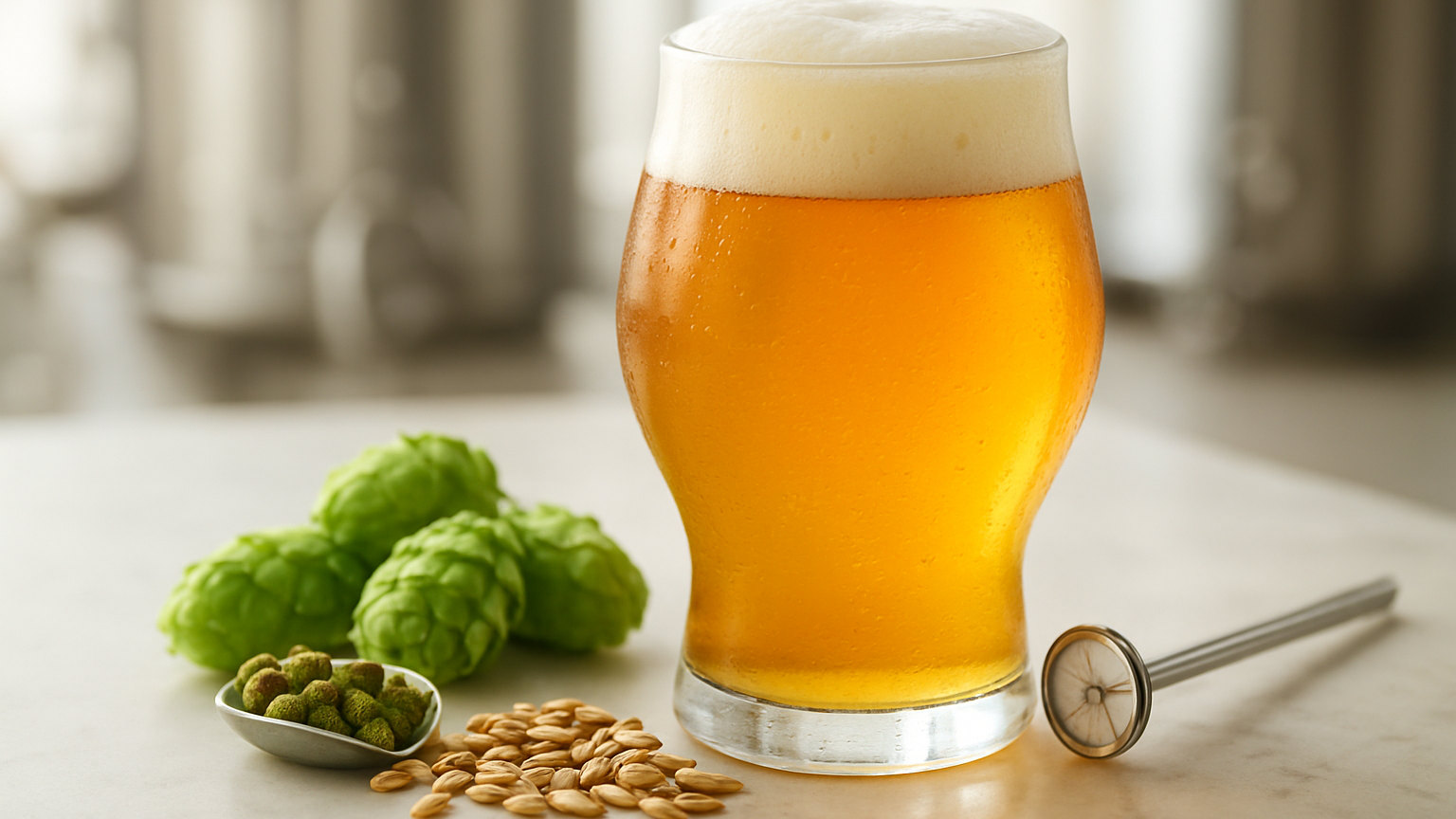
Pale ale is the sensible first recipe, and not because it is easy to brew. It is easy to judge. The flavours are open enough that a fault has nowhere to hide, so if something goes wrong you will taste exactly what it was. Brew a stout first and a fermentation problem disappears behind the roast.
What is the grain bill?
For 23 litres at around 5 per cent alcohol:
- 4.5kg pale ale malt
- 250g crystal malt, medium colour
- 150g wheat malt
Pale ale malt provides almost all the fermentable sugar. Crystal malt is not fully fermentable, so it leaves behind a caramel sweetness and body that stops the beer tasting thin. The wheat is there purely for head retention, and a beer without it pours with a foam that collapses in seconds.
How should you mash it?
Mash at 66 degrees for sixty minutes with around 12 litres of water, then sparge with a further 15 litres at 76 degrees. That temperature is the important number rather than the timing.
Mash hotter, at 68 or 69, and you produce more unfermentable sugar, giving a fuller and slightly sweeter beer. Mash cooler, at 64, and you produce more fermentable sugar, giving a drier beer with a touch more alcohol. Sixty-six sits in the middle and is a good place to learn from.
Can you brew this from extract instead?
Yes. Replace the pale malt with 3kg of light dry malt extract and steep the crystal and wheat in 4 litres of water at 68 degrees for twenty minutes before topping up and boiling. The result is close, marginally sweeter, and takes about two hours less.
What is the hop schedule?
A sixty minute boil, with hops added at three points:
- 60 minutes: 25g of a clean bittering hop around 10 per cent alpha acid.
- 15 minutes: 25g of an aroma hop such as Cascade or Amarillo.
- Flameout: 40g of the same aroma hop, left to steep for fifteen minutes as the wort cools.
The timing controls what you get. Early additions isomerise into bitterness and lose their aroma entirely. Late additions keep the volatile oils that carry citrus, pine and floral character. This is why a recipe with the same total weight of hops can taste completely different depending on when they went in.
Which yeast should you use?
A clean American ale yeast is the safest choice, since it ferments predictably and contributes very little flavour of its own, leaving the malt and hops to do the work. Pitch at 20 degrees and hold fermentation between 18 and 20.
Temperature control matters more than yeast choice for a first brew. A fermentation that runs hot, above 24 degrees, produces fusel alcohols and banana-like esters that will make the finished beer taste harsh regardless of how good the recipe was.
How long does it take from brew day to glass?
Roughly four weeks. Ferment for ten to fourteen days, until the gravity has been stable for three consecutive days rather than until a set date. Bottle with 120g of sugar dissolved in water for the whole batch, then leave the bottles at room temperature for two weeks to carbonate.
Resist opening one early. A beer at seven days in the bottle is flat and tastes unfinished, and it tells you nothing useful about the batch.
What should you change on the second attempt?
Change one thing, not several, or you will not know what caused the difference. The three most informative single changes are:
- Move the mash temperature by two degrees to see how body responds.
- Swap the aroma hop entirely and keep everything else identical.
- Add a dry hop of 50g for three days at the end of fermentation.
Keeping notes sounds tedious and is the single habit that separates brewers who improve from brewers who repeat the same beer for years. Record the gravity readings, the temperatures and the dates, and the pattern becomes obvious within a handful of batches.
Why does sanitation matter more than the recipe?
Because a contaminated batch tastes sour, cloudy and vaguely of vinegar no matter how carefully you weighed the grain. Anything that touches the wort after the boil must be sanitised, including the spoon, the hydrometer, the tap and your hands. Before the boil it does not matter, because boiling handles it.
If a batch smells wrong or grows anything fuzzy on the surface, pour it away rather than bottling it.


