
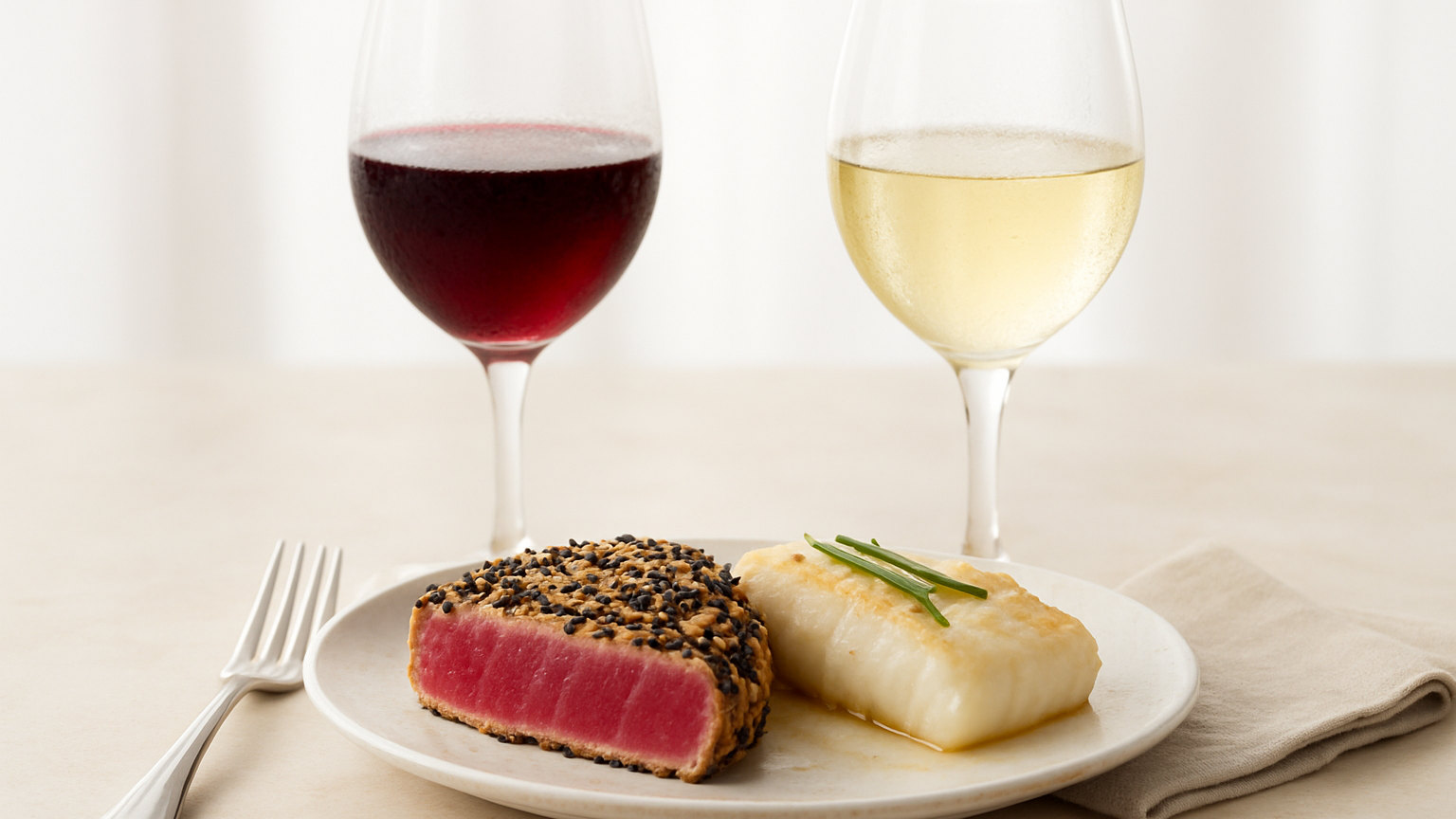
Red with meat and white with fish is the only wine pairing rule most people know. It is not wrong, exactly. It is a simplification of something more useful, and knowing what it is simplifying tells you when to ignore it.
What is it actually describing?
Weight, mostly. Red wines tend to be fuller and more tannic; white wines tend to be lighter and more acidic. Meat tends to be heavier than fish.
So the rule is a rough shorthand for matching the weight of the wine to the weight of the dish, which is the thing that genuinely matters.
Why does it work as often as it does?
Because the correlation is real. Most of the time, matching colour to protein does get the weight roughly right, and it also happens to align tannin with the protein and fat that soften it.
Where does it fail?
- Salmon and tuna. Oily and substantial. Pinot noir works better than a light white.
- Roast chicken. Handles a light red comfortably.
- Fish in red wine sauce. Where the sauce is the dominant flavour.
- Pork and veal. Sit between the two and take either.
- Rich fish dishes. Lobster with butter suits an oaked chardonnay, not a light white.
- Grilled vegetables and mushrooms. Often better with red than white.
- Cheese. White wine is frequently the better match despite the convention.
Why is cheese the biggest failure?
Because red wine tannin clashes with several cheeses, producing a metallic taste, and because cheese is salty, which accentuates tannin further.
White wine and cheese is generally the safer pairing, and sweet wine with blue cheese is one of the best pairings in either direction. The tradition of finishing a meal with red wine and a cheeseboard is convention rather than good matching.
What should replace the rule?
Match the weight first, then check the acidity and sweetness. Colour follows from that rather than leading it.
- Light dish, light wine. Either colour.
- Rich or fatty dish, high-acid wine. Either colour.
- Sweet dish, sweeter wine. Non-negotiable.
- Protein-heavy dish, tannin is welcome. Which usually means red.
- Delicate fish, avoid tannin. Which usually means white.
Where did the rule come from?
Nineteenth and twentieth century European service convention, at a time when meals followed a fixed order and the food was largely regional. Within that context it was reasonable guidance.
It travels badly to a modern table where a single meal might include Thai food, cheese and dessert.
Does the sauce matter more than the protein?
Very often, yes. Chicken in a cream sauce and chicken in a tomato sauce are different pairing problems entirely, and the fish or meat underneath is frequently the least dominant element.
Pair to what is actually on the plate rather than to the headline ingredient.
Is it worth keeping at all?
As a starting point when you know nothing else, yes. It is better than random, and it is a poor substitute for asking what the dish weighs and how acidic it is.
Is there a better single rule?
Match the weight of the wine to the weight of the dish. It is nearly as easy to remember, it works far more often, and it explains the colour rule rather than contradicting it.
Adding one refinement covers most of the rest: avoid tannin with fish, salt and anything sweet.
What about white wine with meat?
It works more often than the rule allows. A full oaked chardonnay handles roast chicken, pork and even veal comfortably, and a rich white with weight can stand up to a good deal.
What it cannot do is replicate what tannin offers with a fatty steak, which is the one place the colour rule is doing genuine work.
Why does the rule persist?
Because it is short, easy to remember and right often enough that following it rarely produces a disaster. Most simplified rules survive on exactly that basis.
The cost is that it discourages the pairings that would work better, particularly white wine with cheese and light red with fish.


