
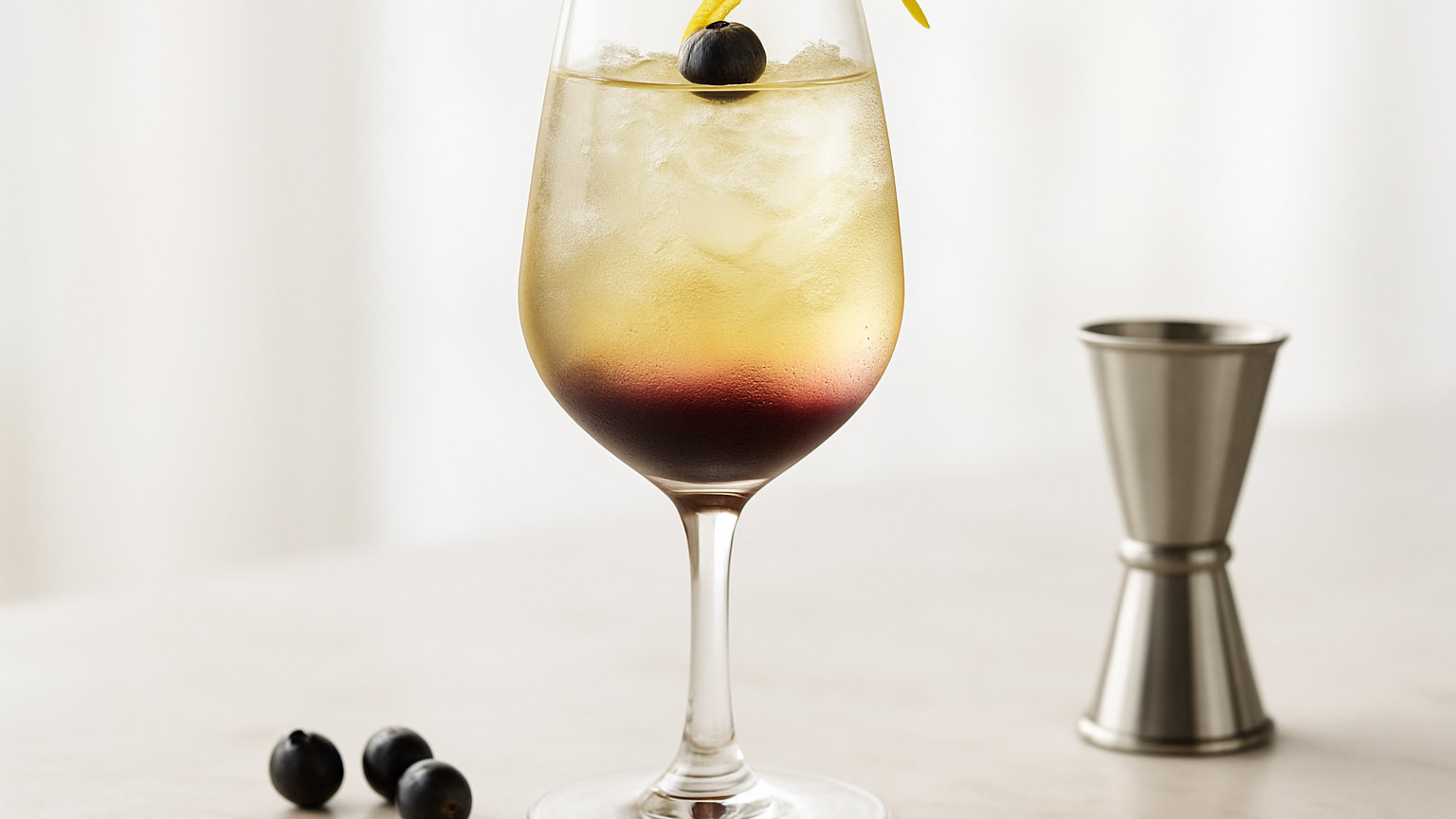
The kir is one of the simplest drinks in existence and among the easiest to overdo. Two ingredients, and the ratio between them is the entire skill.
What is the recipe?
Around 10 to 15ml of crème de cassis topped with 120 to 150ml of dry white wine. That is roughly one part cassis to ten parts wine.
Pour the cassis into the glass first, then add the wine, which combines the two without stirring.
Why does the proportion matter so much?
Because crème de cassis is intensely sweet and intensely flavoured. At the right proportion it lifts the wine and adds a blackcurrant edge; at double that it becomes a sweet blackcurrant drink with wine in it.
Most disappointing kirs are simply too heavy on the cassis. Start at 10ml and adjust upwards if you want more.
What is crème de cassis?
A blackcurrant liqueur, typically 15 to 20 per cent and heavily sweetened. The crème designation indicates a high sugar content rather than any dairy.
Quality varies considerably. A good one tastes of fruit rather than of sweetened syrup, and it is worth spending a little more given how long a bottle lasts at 15ml a drink.
Which wine should you use?
A dry, crisp, unoaked white with good acidity. Bourgogne aligoté is the traditional choice and the drink was built around it.
Any dry white in a similar style works: picpoul, muscadet, dry chenin or an unoaked chardonnay. Avoid oak and avoid anything off-dry.
What is a kir royale?
The same drink with sparkling wine in place of still. Champagne traditionally, and any dry sparkling wine works well.
Use slightly less cassis, around 10ml, since carbonation carries sweetness more insistently. Pour the wine gently down the side of a tilted glass.
What are the other variations?
- Kir royale. Sparkling wine.
- Kir pétillant. With a lightly sparkling wine.
- Kir communard or cardinal. Red wine instead of white.
- Kir normand. With cider, from Normandy.
- Kir breton. Also cider based, from Brittany.
The cider versions are excellent and considerably less known outside France.
Can you use a different liqueur?
Readily, and the drink is then named for it. Peach liqueur, raspberry, blackberry, mûre and violet all work on the same principle.
Whatever you use, keep the proportion small. The wine should still be recognisably the main component.
How strong is it?
Around 1.7 units for a 150ml glass of 12 per cent wine with 15ml of cassis. That is comparable to a small glass of wine, which is what it essentially is.
When should it be served?
As an aperitif, cold, before food. It is a French institution for exactly that role and it suits it: light, low in strength, and appetising rather than filling.
Serve the wine properly chilled, since a warm kir tastes flat and syrupy.
How should you store the cassis?
In the fridge once opened. It is a low-strength liqueur at 15 to 20 per cent with a great deal of sugar, and it keeps for months refrigerated and dulls faster at room temperature.
Buy a small bottle. At 15ml a drink, even a half bottle lasts a long time.
Why is it so often made badly?
Because the cassis is poured by eye, and a free pour of a thick syrupy liqueur is almost always more than 15ml. Measuring it once shows how little the drink needs.
A jigger or even a tablespoon is enough to get it right, and the difference is immediate.
What food does it suit?
Anything you would serve before a meal: olives, charcuterie, cheese straws, nuts. It is an aperitif rather than a drink for the table, and its job is to sharpen the appetite rather than accompany food.
Which glass should you use?
A small wine glass for the still version and a flute or tulip for the royale. Both should be chilled, since the drink is served cold and there is no ice to keep it that way.
Avoid a large glass, which encourages a larger pour and turns an aperitif into a full drink.


