
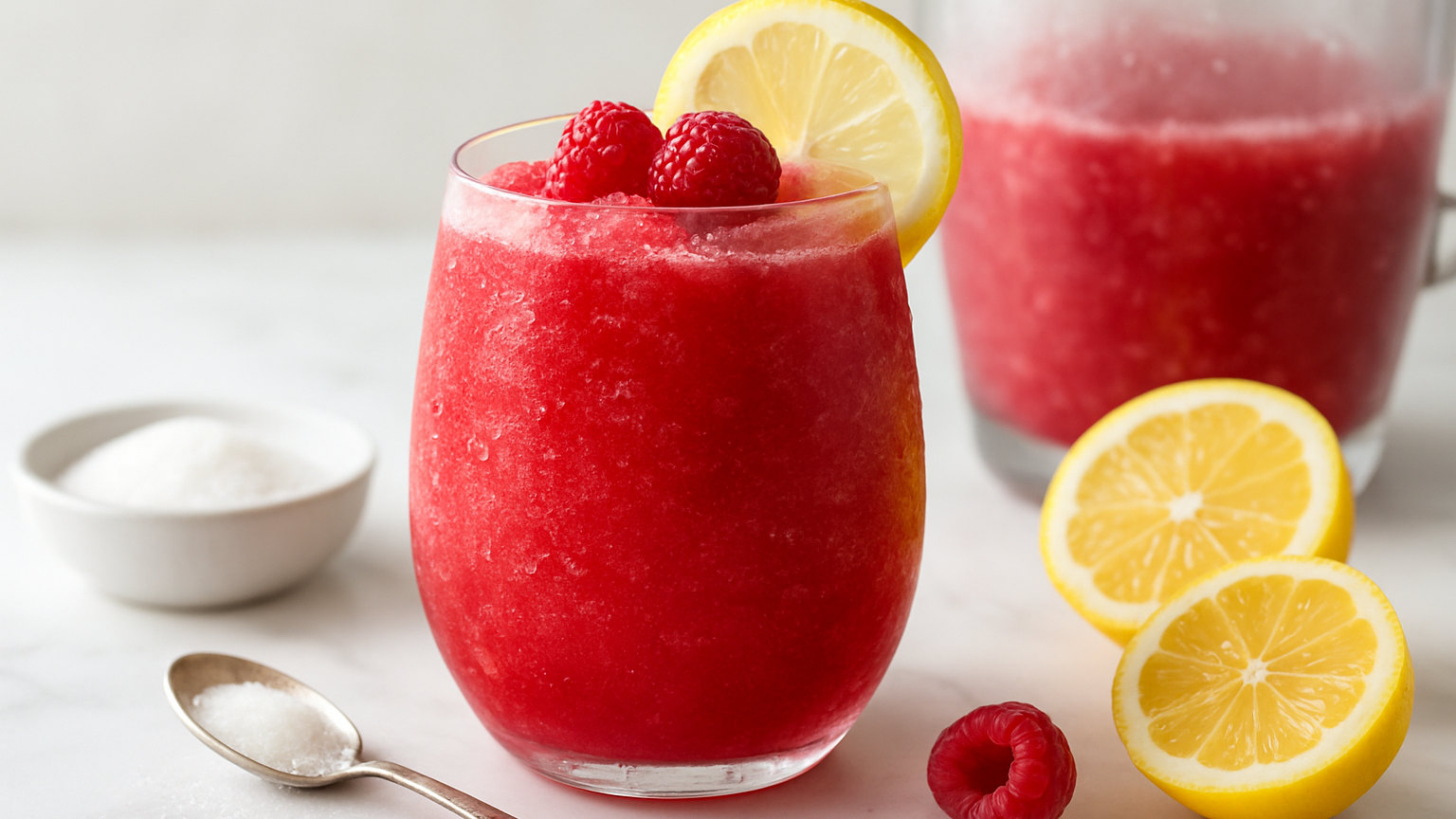
Frozen wine drinks look like the easiest thing in this section and involve one counterintuitive adjustment. A mixture balanced at room temperature tastes flat and thin once frozen, and the correction has to be made before it goes in the freezer.
Why does cold suppress flavour?
Because low temperatures reduce the volatility of aromatic compounds and dull the perception of both sweetness and acidity.
A mixture that tastes correctly balanced warm will taste watery and flat frozen. Overcompensate deliberately: make it noticeably sweeter and sharper than you would want to drink at room temperature.
How do you make frosé?
- Pour 1 bottle of dry rosé into a shallow freezer container.
- Freeze for at least six hours. It will not set solid because of the alcohol.
- Blend the frozen wine with 150g strawberries, 60ml sugar syrup and 30ml lemon juice.
- Add a handful of ice if it needs thickening.
- Blend until smooth and serve immediately.
Why will it not freeze solid?
Because alcohol lowers the freezing point. A 12 per cent wine in a domestic freezer forms a slush rather than a block, which is exactly what you want.
That also means a stronger wine freezes less. Anything above about 14 per cent stays too liquid to blend well.
Which wine works?
A dry rosé at 11 to 13 per cent, inexpensive and unoaked. Provence-style pale rosés work well, as do Spanish and Italian equivalents.
Sweet rosé makes the drink cloying once the added sugar is included. Dry is the right starting point.
How much sugar is needed?
More than seems right. Around 60 to 90ml of syrup per bottle, tasted after blending rather than before freezing.
Adjust at the blending stage, since that is when you can actually taste the finished texture and temperature. Adding syrup to an under-sweet blend is easy; removing it is not.
How do you get the texture right?
Freeze the wine in a shallow container rather than a deep one, since a large volume takes far longer and freezes unevenly.
Blend in short bursts, scraping down, rather than running the machine continuously. Continuous blending generates heat and turns the mixture to liquid.
If it is too thin, add ice. If it is too thick, add a splash of wine rather than water.
What other versions work?
- Frozen sangria. Blend frozen red wine with orange juice, brandy and syrup.
- Frozen white with peach. Light and good in hot weather.
- Frozen spritz. Frozen prosecco blended with bitter aperitivo. The carbonation is lost, which is fine.
- Wine granita. Freeze in a tray and scrape with a fork every half hour.
How strong are they?
Around 1.5 to 2 units per 200ml serving, less than a glass of wine because of the added fruit and ice. The cold and the sweetness disguise the alcohol, which is worth remembering on a hot afternoon.
Can you make them ahead?
The wine can be frozen days in advance. The blending happens at serving, since a blended drink separates and melts within fifteen minutes.
For a group, freeze the wine and set up the blender rather than making it all at once.
What equipment do you need?
A blender that can handle ice, and a shallow freezer container. A food processor works less well, since the blade shape does not circulate frozen mixture properly.
Nothing else is required, and no specialist machine is needed for a drink served immediately.
How long will it hold once blended?
Ten to fifteen minutes before it separates and starts to melt. These are drinks to blend and serve immediately rather than to make in advance.
For a group, freeze the wine ahead and blend in batches as people want them.
Why does the container shape matter?
Because a shallow layer freezes evenly and quickly, where a deep container freezes at the edges and stays liquid in the middle for many hours.
A wide plastic tub or a metal tray works far better than a jug.


