
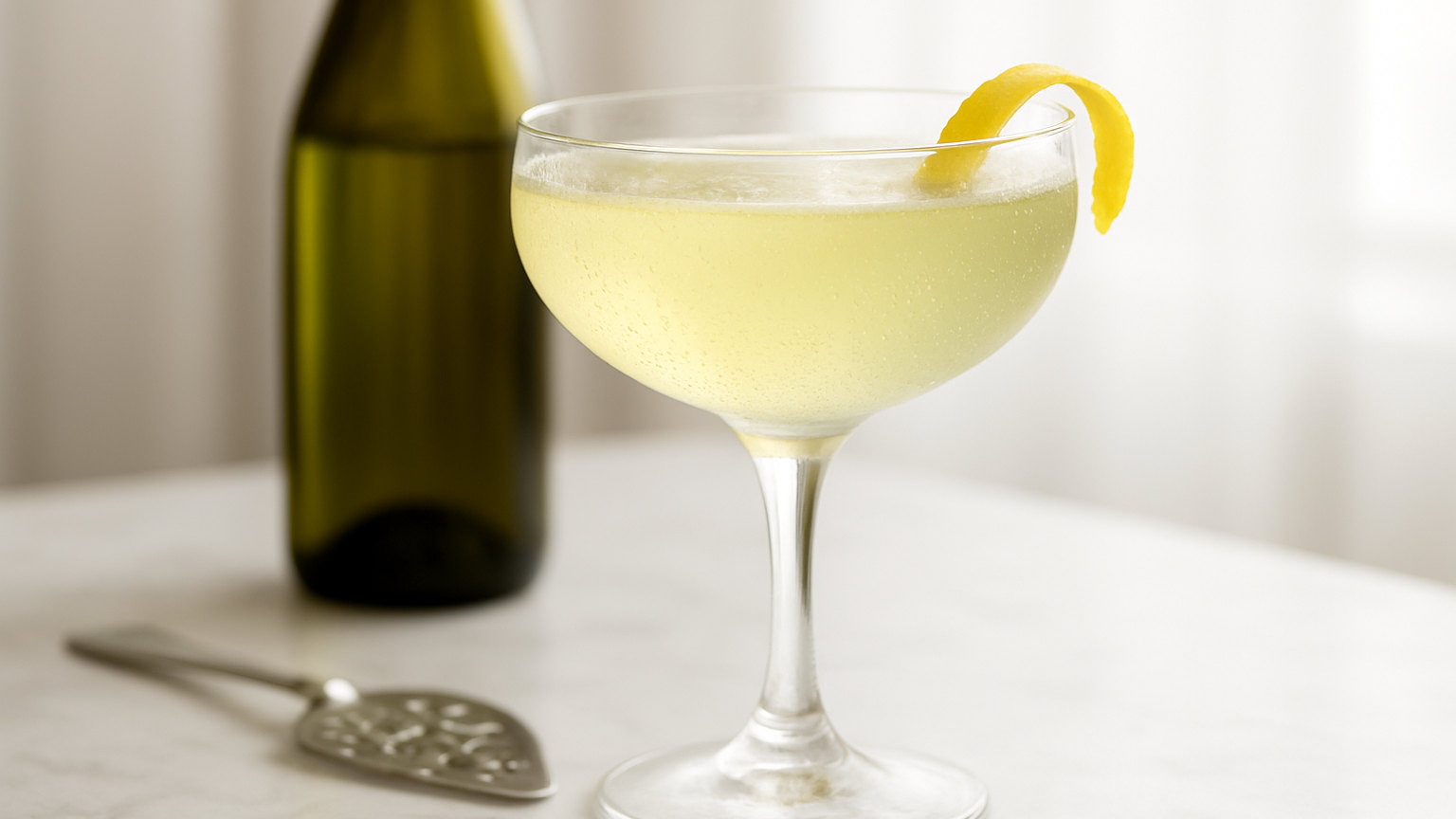
Death in the afternoon is absinthe topped with sparkling wine. It was published by Ernest Hemingway in a 1935 collection of celebrity cocktail recipes, with instructions to drink several slowly. That advice should not be followed.
What is the recipe?
- 20ml absinthe
- 120ml dry sparkling wine
Pour the absinthe into a chilled flute or coupe. Add the sparkling wine slowly until it turns opalescent. Do not stir.
Why does it go cloudy?
Because of the louche effect. Anise oils dissolve readily in strong alcohol and much less so once diluted, so they come out of solution as a fine emulsion when the wine goes in.
It is the same mechanism that makes limoncello cloudy, and it is a genuine indicator of naturally distilled anise rather than added flavouring.
How strong is it?
Around 2.5 units, and it can be considerably more depending on the absinthe. At 68 per cent, 20ml alone is 1.4 units before any wine is added.
The original recipe called for a full jigger of absinthe and three to five servings, which would be an extraordinary quantity of alcohol. Twenty millilitres is a sensible modern measure.
Should you reduce the absinthe further?
Fifteen millilitres makes a gentler drink and still louches properly. Anyone unfamiliar with absinthe is better starting there.
What is absinthe?
A distilled spirit flavoured principally with grand wormwood, green anise and fennel, typically 45 to 74 per cent. It is not sweetened, which technically makes it a spirit rather than a liqueur.
The hallucinogenic reputation does not survive examination. Analysis of pre-ban bottles found thujone at levels far too low to cause any such effect. What it causes at 68 per cent is intoxication.
Which sparkling wine?
Dry and inexpensive. Absinthe is powerful enough that the wine functions as dilution and carbonation rather than as a flavour contributor.
Cava or dry prosecco is entirely sufficient, and champagne is wasted.
Can you use pastis instead?
Yes, and it makes a gentler drink. Pastis is sweetened, usually 40 to 45 per cent, and it louches the same way.
The result is sweeter and less herbal, and it is a reasonable introduction for anyone who finds absinthe too intense.
How should you pour it?
Slowly, so you can watch the louche develop and stop when the balance suits you. Pouring fast means it either fails to cloud evenly or arrives already diluted past the point you wanted.
A chilled glass matters here as much as any sparkling drink.
Should it be garnished?
No. The cloudiness is the visual point, and a garnish adds nothing. A lemon twist is sometimes used and it is not traditional.
Is it a good drink?
Genuinely, if you like anise. The wine lengthens and lifts the absinthe in a way water alone does not, and the aromatic intensity is unlike any other sparkling cocktail.
Anyone who dislikes aniseed will dislike this, and no amount of technique changes that.
Can you batch it?
No. It is two ingredients poured to order, and the louche happens in the glass. Measuring the absinthe rather than free pouring is worth doing given the strength.
What glass should you use?
A chilled flute or coupe. The coupe shows the opalescence better; the flute preserves the carbonation slightly longer.
Should you follow the original instructions?
No. The published recipe calls for a full jigger of absinthe and three to five servings drunk slowly, which would be an extraordinary quantity of alcohol by any modern standard.
One drink made with 15 to 20ml is the sensible interpretation.
Which absinthe should you use?
A naturally coloured one that louches properly, since the cloudiness is the visual point of the drink. A vivid unchanging green usually indicates artificial colouring.
Strength varies from 45 to 74 per cent, so check the bottle before measuring rather than assuming.
What glass and temperature?
A chilled coupe or flute, with everything cold. Warm sparkling wine loses its carbonation on contact and the louche develops less cleanly.


