
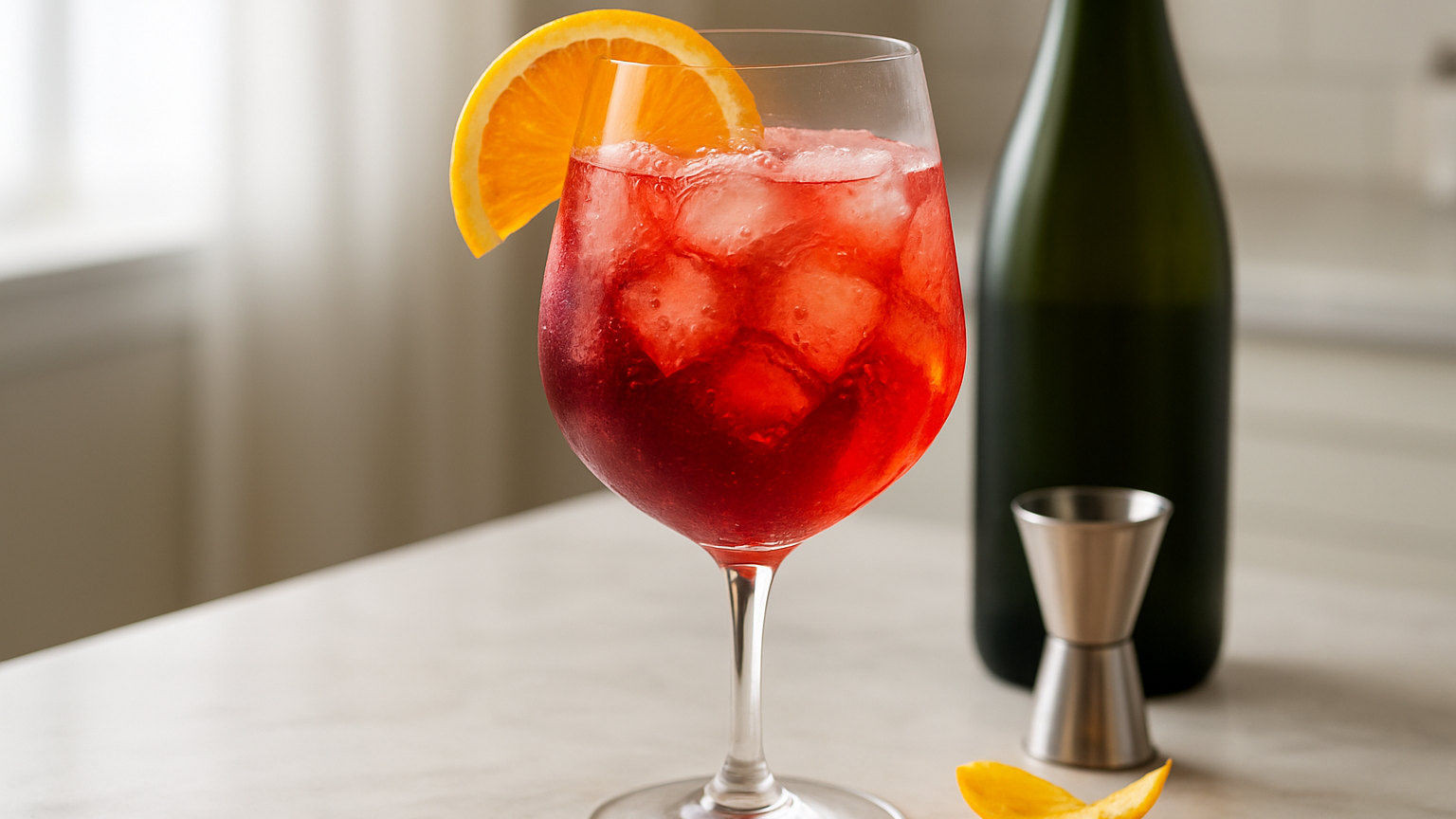
A campari spritz uses a full red bitter aperitivo in place of the lighter orange one. It follows the same build and it is considerably more bitter, which makes it a different proposition rather than an upgrade.
What is the recipe?
- 90ml dry prosecco
- 60ml red bitter aperitivo liqueur
- 30ml soda water
- An orange slice
Fill a large wine glass with ice. Add the bitter, then the prosecco poured down the side, then the soda. Lift once gently and garnish.
How does it differ from an aperol spritz?
Bitterness and strength. The orange aperitivo used in an aperol spritz is around 11 per cent and noticeably sweet; a full red bitter is around 20 to 25 per cent and considerably more bitter.
That makes this drier, more assertive and stronger, at around 1.9 units against 1.3.
Is one better?
Neither. The orange version is more approachable and suits people who dislike bitterness; the red version has more structure and rewards anyone who likes bitter aperitifs.
What if it is too bitter?
Reduce the liqueur to 45ml and increase the prosecco. Adding more soda also softens it without adding sweetness.
A splash of orange juice is another option, which makes it closer to a garibaldi and rounds it considerably.
Why does the order matter?
Because the liqueur is denser than the prosecco. Adding it first means one gentle lift combines everything; adding it last leaves it at the bottom and requires stirring that kills the bubbles.
Why fill the glass with ice?
Because a full glass reaches equilibrium quickly and then melts slowly, where a few cubes have to melt almost entirely to chill the drink and dilute it heavily in doing so.
Everything should be cold before it goes in, since warm prosecco loses its carbonation on contact with ice.
Which prosecco?
Dry and inexpensive. The bitter dominates completely, so check for brut rather than extra dry and spend nothing more than necessary.
When should you drink it?
Before food, which is what an aperitivo is for. Bitter compounds stimulate saliva and gastric secretion, and the tradition of drinking something bitter before eating rests on that.
It suits early evening and it is heavy going as a long afternoon drink.
What are the related drinks?
- Americano. Red bitter, sweet vermouth and soda. Around 1.1 units.
- Negroni sbagliato. With vermouth and sparkling wine.
- Garibaldi. Red bitter with fresh orange juice.
- Negroni. With gin and vermouth, and far stronger.
Can you batch it?
Pre-mix the bitter into a jug and keep it cold, then add prosecco and soda per glass. That is the practical approach for a group and it takes seconds per drink.
What glass should you use?
A large wine glass filled to the top with ice, which is the standard Italian serve for any spritz. A flute is the wrong shape entirely.
Why does the bitterness matter?
Because it is what an aperitivo is for. Bitter compounds stimulate saliva and gastric secretion, which is the traditional reasoning behind drinking something bitter before eating.
A sweeter drink does the opposite, which is why the bitter version suits the role better.
How much soda should you add?
Thirty millilitres, a splash rather than a top. It lengthens the drink and softens the bitterness slightly without diluting it into something thin.
How strong is it against the alternatives?
Around 1.9 units, against 1.3 for the orange aperitivo version and 1.1 for an americano. That is worth knowing, since all three look identical in the glass.
Can you batch the bitter component?
Yes, and it keeps indefinitely since nothing in it is perishable. Pre-measuring into a jug is the quickest way to serve several.
What ratio should you settle on?
Three parts prosecco, two parts bitter, one part soda, as with any spritz. Shift towards 4:2:1 if the bitterness is too much for you.
Does it work with other bitter liqueurs?
Very well, and the category is broader than the two best-known bottles. Rhubarb, grapefruit and gentian-based aperitivi all make good spritzes, each shifting the bitterness in a different direction.
Check the strength before pouring, since these run anywhere from 11 to 25 per cent and the unit count changes accordingly.


