
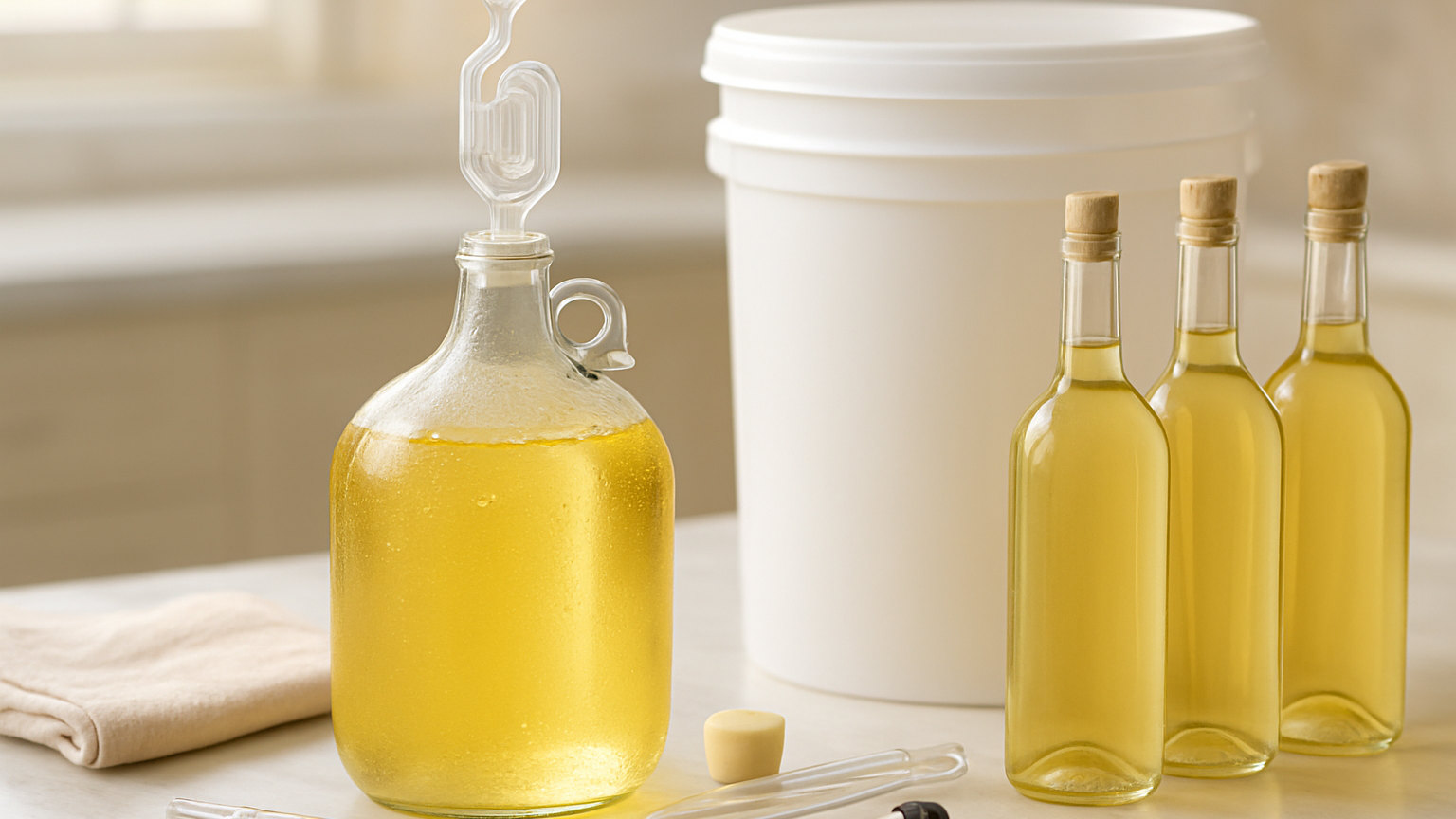
Home wine making has fewer genuine equipment requirements than home brewing beer, because there is no mash and no boil. Six items cover a one gallon batch from start to bottle, and most of them cost very little. Everything beyond that list makes the job easier rather than possible.
What do you actually need?
- Fermenting bucket, 10 litres or larger, with a lid. For the first few days on the pulp.
- One gallon demijohn. Glass or plastic. This is where the wine spends most of its life.
- Bung and airlock. Lets carbon dioxide out and keeps oxygen and insects out.
- Siphon tube. For racking, which cannot be done by pouring.
- Hydrometer and trial jar. The only way to know the strength or whether fermentation has finished.
- Sanitiser. More important than any of the above.
That is the complete list. A large pan, a sieve and a long spoon come from the kitchen.
Why is a hydrometer not optional?
Because it answers two questions nothing else can. It tells you how much sugar is in the must before fermentation, which determines the final strength. And it tells you whether fermentation has genuinely finished, which determines whether it is safe to bottle.
An airlock that has gone quiet means nothing. Fermentation can slow to the point where bubbles stop appearing while sugar remains, and bottling at that stage produces bottles that carbonate, push corks or in the worst case burst. A stable hydrometer reading across three consecutive days is the only reliable answer.
Glass or plastic demijohn?
Glass does not scratch, does not hold flavours and lets you see what is happening. It is heavy and it breaks, and a full one weighs about five kilograms.
Plastic is lighter and safer to handle but scratches easily, and scratches harbour bacteria. It is also slightly permeable to oxygen over long periods, which matters for a wine ageing for a year. Glass is the better long-term choice.
What can wait?
Useful but not necessary at the start:
- Straining bag. Makes getting the pulp out far less messy.
- Bottling stick. A tap that stops flow when lifted, which makes filling bottles clean.
- Corker. Only needed at bottling, and hand corkers are cheap.
- Second demijohn. Makes racking much easier, since you siphon from one to the other.
- Heat belt or mat. Worth having if your house drops below 18 degrees.
The second demijohn is the one most worth adding early. Racking into a bucket and back again introduces oxygen and doubles the handling.
What is the sanitising routine?
Anything that touches the wine after the initial Campden treatment must be sanitised: the demijohn, the airlock, the siphon, the spoon, the hydrometer, the bottles and your hands.
Use a proper sanitiser rather than washing up liquid, which leaves residues that kill head retention and taint flavour. Sodium metabisulphite solution or a no-rinse steriliser both work. Mix according to the instructions, contact for the stated time, and drain rather than rinsing with tap water.
This single habit prevents most failed batches. Wine that has gone sour, vinegary or grown a film on the surface is almost always a sanitation failure rather than a recipe failure.
What does the siphon actually do?
It moves clear wine off the sediment without disturbing it. Pouring cannot do this, because the sediment lifts and redistributes the moment the vessel tilts.
Place the full demijohn higher than the empty one, start the flow, and keep the intake end a few centimetres above the sediment layer. Stop when the sediment starts to lift rather than chasing the last hundred millilitres.
How much does the whole lot cost?
A starter kit covering everything above is inexpensive, and the consumables for a gallon of country wine are sugar, a sachet of yeast and whatever fruit you have. The economics only make sense if you enjoy the process, but the equipment lasts for decades with reasonable care.


