
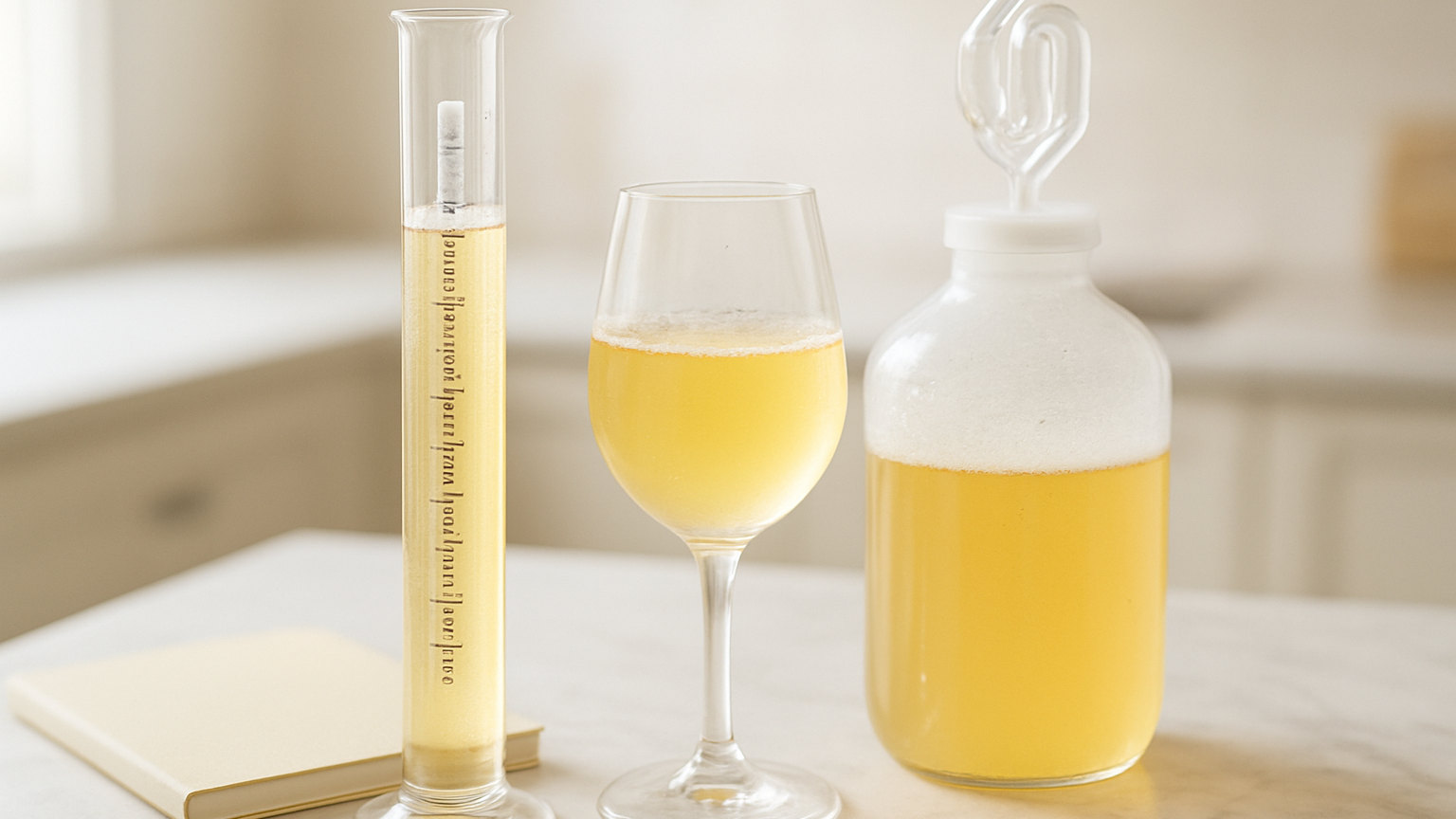
Deciding a wine has finished is the single most consequential judgement in the whole process, because everything after it is irreversible. Bottle a wine that is still fermenting and you have sealed a sugar solution and live yeast into a glass container. The test that answers the question properly takes three days and one instrument.
What is the reliable test?
Take a hydrometer reading, then another 24 hours later, then a third 24 hours after that. If all three are identical, fermentation has finished. If the figure is still falling, even by a single point, it has not.
Two readings are not enough. Fermentation slows unevenly and a wine can appear static for a day before dropping further. Three consecutive identical readings is the standard, and there is no shortcut.
Why is the airlock unreliable?
Several reasons, and any one of them is enough to mislead you:
- Fermentation can continue too slowly to produce visible bubbles.
- A bung that is not fully seated lets gas escape silently.
- Temperature changes cause the airlock to move without any fermentation at all.
- Carbon dioxide dissolved in the wine bubbles off for days after fermentation ends.
An airlock is a useful indicator that something is happening early on. It is not evidence of anything once activity has slowed.
What about the wine looking clear?
Clarity and fermentation are separate matters. A wine can clear beautifully while still holding fermentable sugar, and a fully fermented wine can stay hazy for months because of pectin. Neither tells you about the other.
What final gravity should you expect?
For a dry wine, below 1.000, typically between 0.992 and 0.996. That is lower than water because alcohol is less dense than water, and a reading under 1.000 is a good sign that the sugar has genuinely gone.
A reading stable at 1.010 to 1.020 means the wine has stopped with sugar remaining. That may be a stall you can restart, or the yeast may simply have hit its tolerance. Either way it is not a finished dry wine, and it needs stabilising before bottling.
How do you take a reading properly?
Draw a sample with a sanitised siphon or turkey baster into a trial jar rather than floating the hydrometer in the demijohn, where you cannot read it and cannot get it out.
Spin the hydrometer gently as you release it, which knocks off the bubbles that otherwise cling to it and lift it. Read at the bottom of the meniscus, at eye level. Check the calibration temperature printed on the stem, usually 20 degrees, and adjust if your wine is much warmer or colder.
Do not return the sample to the demijohn unless you are confident everything it touched was sanitised.
Why does bottling early matter so much?
Because a sealed bottle has nowhere for carbon dioxide to go. A wine bottled with even a small amount of fermentable sugar and active yeast will build pressure over weeks.
The usual result is corks pushing out or wine that fizzes and foams when opened. Occasionally a bottle fails, and wine bottles are not designed for pressure the way sparkling wine bottles are. Store any batch you are unsure about upright in a crate, somewhere a failure would be contained, rather than on a shelf at head height.
Should you wait longer than the test suggests?
Usually, yes. Even after fermentation genuinely finishes, most country wines benefit from several weeks in the demijohn to drop sediment and clear. Bottling the day the reading stabilises gives bottles with a deposit in them.
A sensible schedule is to confirm the finish, rack, leave a further month, rack again and then bottle. The wine is not doing nothing during that time.
What if you have lost the starting reading?
You can still tell whether fermentation has finished, since that only needs the three stable readings. What you cannot do is calculate the strength, because the figure depends on the difference between start and finish.
A rough estimate from the sugar added is possible, using around 17g per litre for each per cent of alcohol, though it ignores whatever the fruit contributed. Treat it as an approximation and label the bottles accordingly rather than guessing precisely.


