
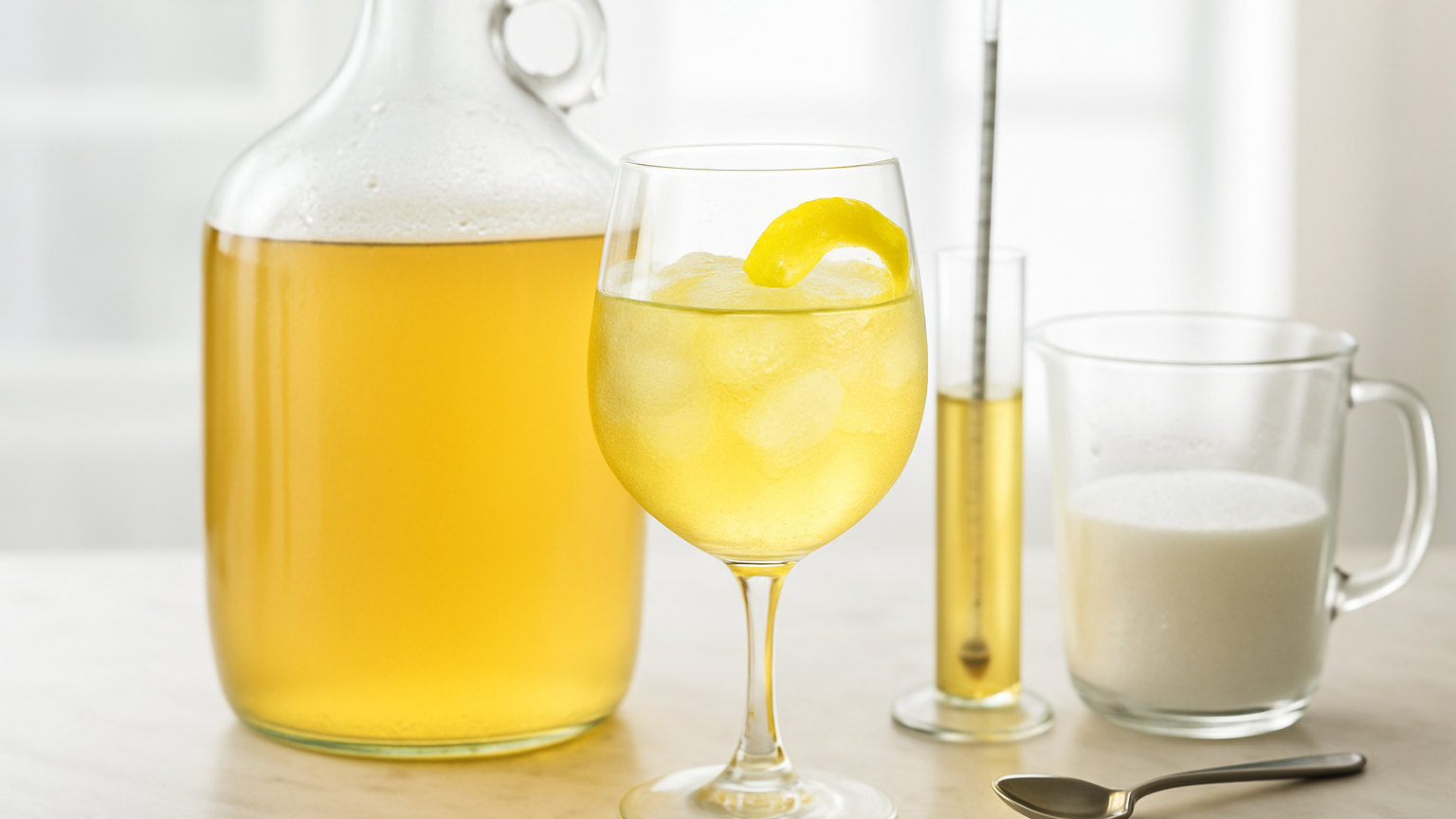
Sugar in wine making is not a matter of taste at the start. It is the fuel that becomes alcohol, and how much you add determines the finished strength almost entirely. Get it wrong upwards and the yeast dies before finishing, leaving a sweet, unstable wine. Get it wrong downwards and you have a thin drink at seven per cent.
How much sugar for one gallon?
For a dry wine at around 11 to 12 per cent, use 1kg to 1.1kg of granulated sugar in 4.5 litres, including whatever sugar the fruit itself contributes.
That last point matters. Grapes, apples and very ripe berries carry a good deal of sugar of their own, while rhubarb and gooseberry carry almost none. A recipe that specifies 1.2kg for rhubarb and the same for ripe blackberries will produce two quite different wines.
How does sugar convert to alcohol?
Roughly 17g of sugar per litre produces 1 per cent alcohol by volume. In a 4.5 litre batch, that means about 77g of sugar per percentage point.
So 1kg of total sugar in a gallon gives around 13 per cent if fermented completely dry. Since fruit rarely ferments fully out and some sugar is unfermentable, 11 to 12 per cent is the realistic result.
Why not just add more?
Because yeast has a limit. Most wine yeasts stop working somewhere between 14 and 18 per cent, and many give up earlier if conditions are poor. Sugar added beyond what the yeast can ferment simply remains in the wine as sweetness.
That is fine if a sweet wine is what you wanted, and a problem if it was not. It is also a risk at bottling, since residual sugar plus any surviving yeast is the recipe for bottles that ferment in storage.
How do you use a hydrometer to plan it?
A hydrometer measures the density of the liquid, which reflects how much sugar is dissolved in it. Take a reading before pitching the yeast:
- 1.070: around 9 per cent potential alcohol.
- 1.085: around 11 per cent.
- 1.090: around 12 per cent.
- 1.100: around 13 per cent.
Most one gallon country wines start between 1.085 and 1.095. If your reading is lower than intended, dissolve more sugar in a little warm must and stir it in. If it is higher, top up with water.
How do you calculate the finished strength?
Subtract the final gravity from the starting gravity and divide by 7.36. So a wine starting at 1.090 and finishing at 0.994 gives 96 points divided by 7.36, or roughly 13 per cent.
Note that a dry wine finishes below 1.000, often around 0.992 to 0.996, because alcohol is less dense than water. A reading stuck at 1.020 means fermentation has stalled with sugar remaining.
Should you add sugar all at once?
For a normal strength wine, yes. Dissolve it fully in hot water before adding, since undissolved sugar sits at the bottom and gives a false hydrometer reading.
For a strong wine above about 14 per cent, staged feeding works better. Start at around 1.080, then add 100g of dissolved sugar at a time once fermentation is well underway. High sugar concentrations stress yeast osmotically, and starting lower gives the colony a chance to establish before the work gets hard.
When would you add sugar at the end?
Only to sweeten a finished wine, and only after stabilising it. Adding sugar to a wine with live yeast in it restarts fermentation, and in a sealed bottle that produces pressure.
Stabilise first with potassium sorbate and a Campden tablet, wait a few days, then sweeten to taste. Skipping that step is the most common cause of exploding bottles in home wine making, and it is entirely avoidable.
Does the type of sugar matter?
Less than people expect. Ordinary granulated sugar is sucrose and ferments completely, and it is what almost every country wine recipe assumes.
Brown sugar and demerara carry molasses, which contributes colour and a faint caramel note. That suits a heavy fruit wine and gets in the way of a delicate one. Honey ferments too and makes mead rather than wine, with a much slower fermentation. Artificial sweeteners do not ferment at all, which makes them useful for sweetening a stabilised wine without any risk of restarting it.


