
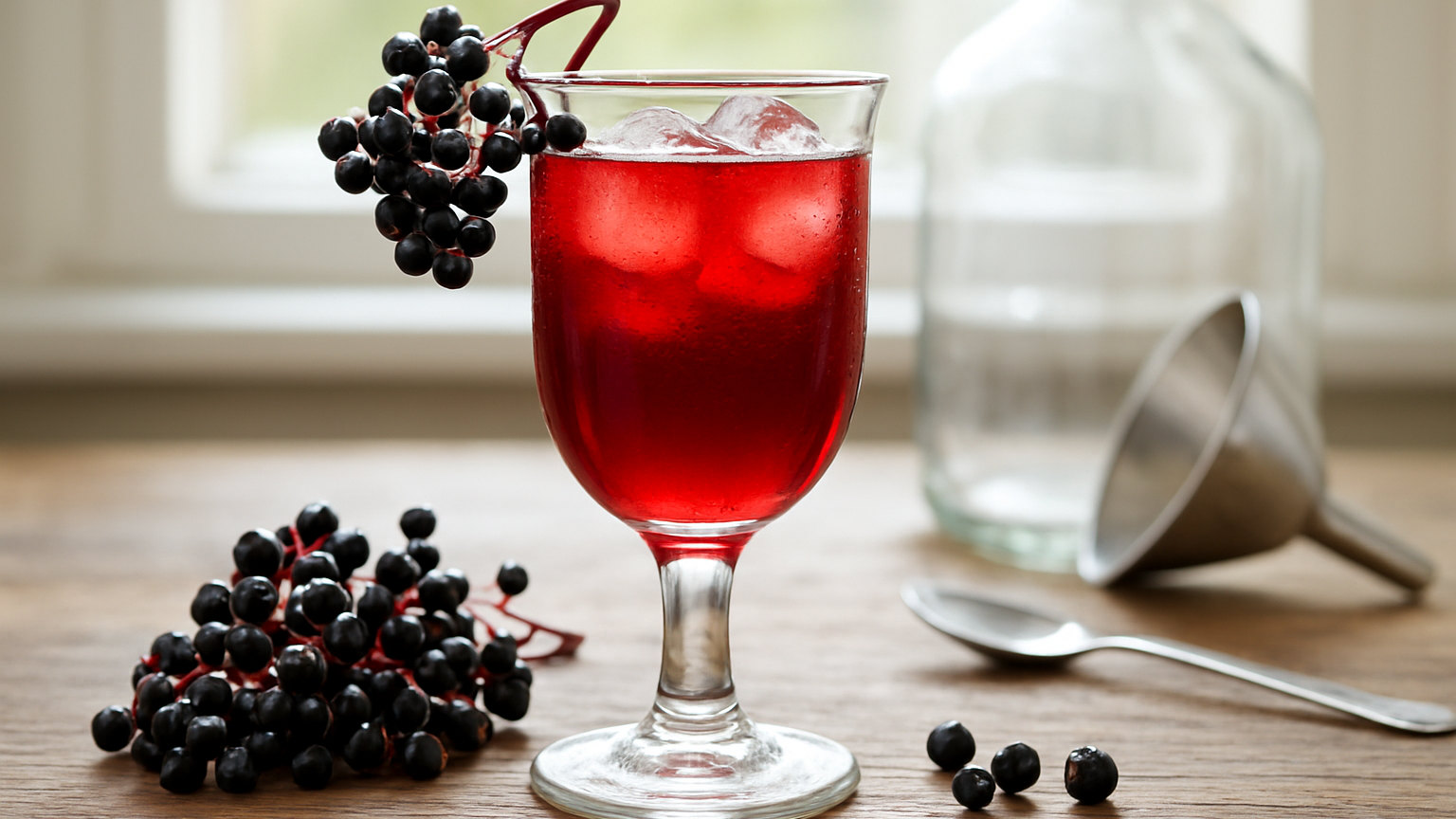
Elderberry produces the deepest and most wine-like of all the hedgerow wines, with real tannin and colour that other fruit cannot match. It is also the one country wine where the preparation instructions are not a formality. Raw elderberries will make you ill, and there are toxic plants that a careless forager can confuse with elder.
Why must the berries be cooked?
Raw elderberries, along with the leaves, stems and unripe fruit, contain cyanogenic glycosides. In practice that means eating them raw causes nausea, vomiting and stomach cramps, sometimes severely.
Heating destroys these compounds. Every reliable elderberry recipe either pours boiling water over the fruit or simmers it first, and that step is not there for flavour extraction alone. Do not be tempted by a cold-steep method.
How do you make sure you have elder?
Elder has opposite leaves in groups of five to seven leaflets with serrated edges, hollow stems with a soft pith, and berries carried in flat-topped umbels that hang downwards when ripe. The berries are small, deep purple-black and grow on reddish stalks.
Several plants can be confused with it, and some are toxic. If you are not completely certain of an identification, do not use the fruit. A field guide or a knowledgeable person is worth more than any description written here.
What about the stalks?
Strip them off. The stalks contain the same compounds as the leaves and they contribute a harsh green bitterness even after cooking. The quickest method is to run a fork down each umbel over a bowl, which takes the berries off cleanly.
What is the one gallon recipe?
- 1.4kg elderberries, stripped from the stalks
- 1.1kg granulated sugar
- Water to 4.5 litres
- Juice of two lemons, or 1 teaspoon citric acid
- 1 teaspoon pectic enzyme
- 1 teaspoon yeast nutrient
- 1 sachet red wine yeast
- 1 Campden tablet
Note the fruit quantity is lower than for most country wines. Elderberry is powerful and 2kg to the gallon produces something astringent and hard to drink for years.
What is the method?
Put the stripped berries in a bucket and pour 2.5 litres of boiling water over them. Crush lightly with a potato masher and leave to cool. Stir in the sugar dissolved in a little hot water, the lemon juice and enough cold water to reach 4.5 litres.
Once fully cool, add the crushed Campden tablet and leave covered for 24 hours. Add the pectic enzyme and leave a further 12 hours. Take a hydrometer reading, then pitch the yeast and nutrient.
Ferment on the pulp for four days only, pressing down twice daily, then strain into a demijohn and fit an airlock.
Why only four days on the pulp?
Because elderberry gives up its tannin fast. Seven days on the pulp, which suits blackberry, produces an elderberry wine so astringent it needs three or four years before it is pleasant.
Four days extracts plenty of colour and structure without going too far. If your previous batches have tasted like stewed tea, this is the change to make.
How long does it need?
Longer than any other country wine. Rack at three weeks, at eight weeks and again before bottling at around six months. Then leave the bottles for at least a year.
Elderberry at six months is harsh and tannic. At eighteen months it is a genuinely good wine, and at three years it is better still. It is the one country wine worth deliberately laying down, and the main reason to make a larger batch than you need immediately.
What strength should you expect?
Around 12 per cent from that sugar quantity. Take a reading before pitching and after fermentation stops, subtract the second from the first and divide by 7.36 for the alcohol by volume.
Do not be tempted to push it higher. Elderberry already has plenty of structure, and a stronger wine simply takes longer to soften into something drinkable.


