
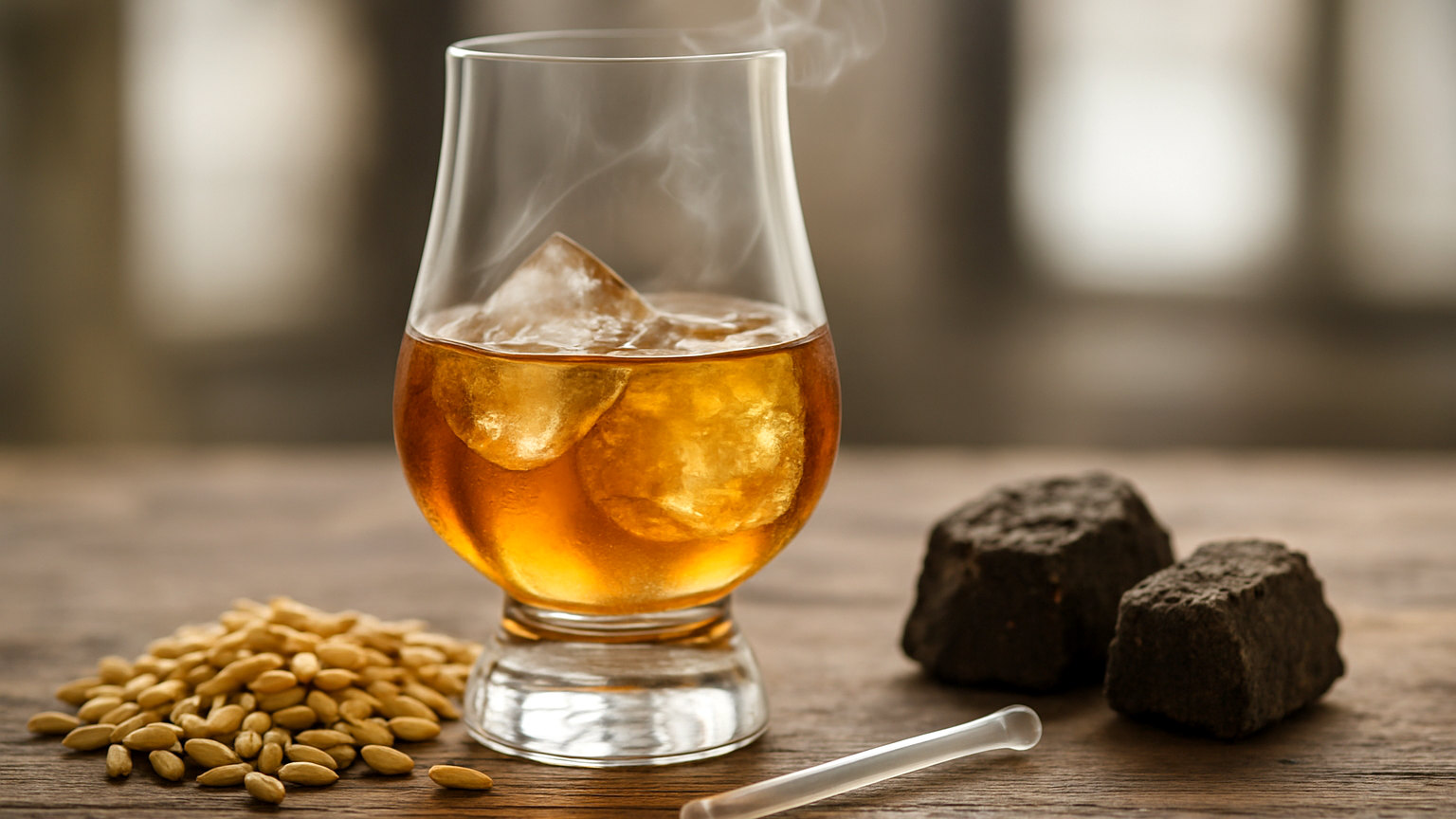
Peat is the most divisive thing in whisky. People either seek it out or actively avoid it, and there is very little middle ground. Understanding where the smoke comes from explains both the flavour and why the number on the label is less informative than it looks.
What is peat?
Partially decomposed vegetation accumulated in waterlogged ground over thousands of years. Mosses, heather, grasses and sometimes tree matter compress into a dense organic layer that can be cut, dried and burned as fuel.
It was the available fuel across much of Scotland and Ireland, which is how it entered whisky making in the first place. Its use is now a deliberate stylistic choice rather than a necessity.
How does it get into the whisky?
During malting, before fermentation begins. Barley is soaked to start germination, then dried in a kiln to arrest it. If peat is burned in that kiln, the smoke passes through the damp grain and phenolic compounds bind to it.
Those phenols survive mashing, fermentation, distillation and years in a barrel. That is the whole mechanism, and it is why peat character is decided before any spirit exists.
Does the local water contribute?
Very little, despite frequent claims. Water drawn across peat bogs may carry a trace of colour and organic material, and the smoky flavour comes overwhelmingly from the kiln.
What does ppm mean?
Parts per million of phenols, usually measured in the malted barley rather than the finished whisky. Figures typically run from around 2 ppm for lightly peated malt to 50 ppm or more for heavily peated.
The important caveat is that a substantial proportion is lost during distillation and maturation. A whisky made from 50 ppm malt might reach the bottle at 15 to 20 ppm, and producers do not always specify which figure they are quoting.
Treat it as a rough indicator of intensity rather than a precise specification.
What does it taste like?
- Smoke, from bonfire to ash to barbecue.
- Iodine and antiseptic, which some describe as medicinal.
- Seaweed and brine, particularly in coastal distilleries.
- Tar and creosote at the heavier end.
Regional peat differs. Island peat contains more marine matter and gives brinier, more medicinal character; inland peat is often earthier and more like woodsmoke.
Why is Islay associated with it?
Because the island is largely covered in peat bog and has little woodland, so peat was the only practical kiln fuel. Several Islay distilleries built their reputations on the style and kept it when alternatives became available.
It is not exclusive to Islay. Peated whisky is made across Scotland, in Ireland, Japan and elsewhere, and several Islay distilleries produce unpeated expressions.
How should you approach it if you are unsure?
Start lightly peated rather than heavily, and try it alongside something unpeated so you can identify what the peat is contributing.
It also works well in small quantities in cocktails. A 10ml float on a Penicillin, or rinsing a glass before building an old fashioned, gives smoke without commitment.
Can you learn to like it?
Frequently, yes, and the same is true of bitter beer and strong coffee. Tolerance builds with exposure, and many people who found their first peated whisky undrinkable come to prefer it.
Does peated whisky age differently?
Peat character softens over long maturation, so a heavily peated whisky at twenty years is noticeably gentler than the same spirit at eight. Some people prefer the younger, more aggressive version.
That is one reason peated whisky is often bottled young: the smoke is the point, and time reduces it.
Is peat sustainable?
A genuine and growing question. Peat bogs are significant carbon stores and take thousands of years to form, so cutting them is not renewable on any human timescale.
Distilleries use a small fraction of the peat extracted in Britain compared with horticulture and fuel, and several are working on sourcing and restoration. It is worth being aware of rather than a reason to avoid the category.


