
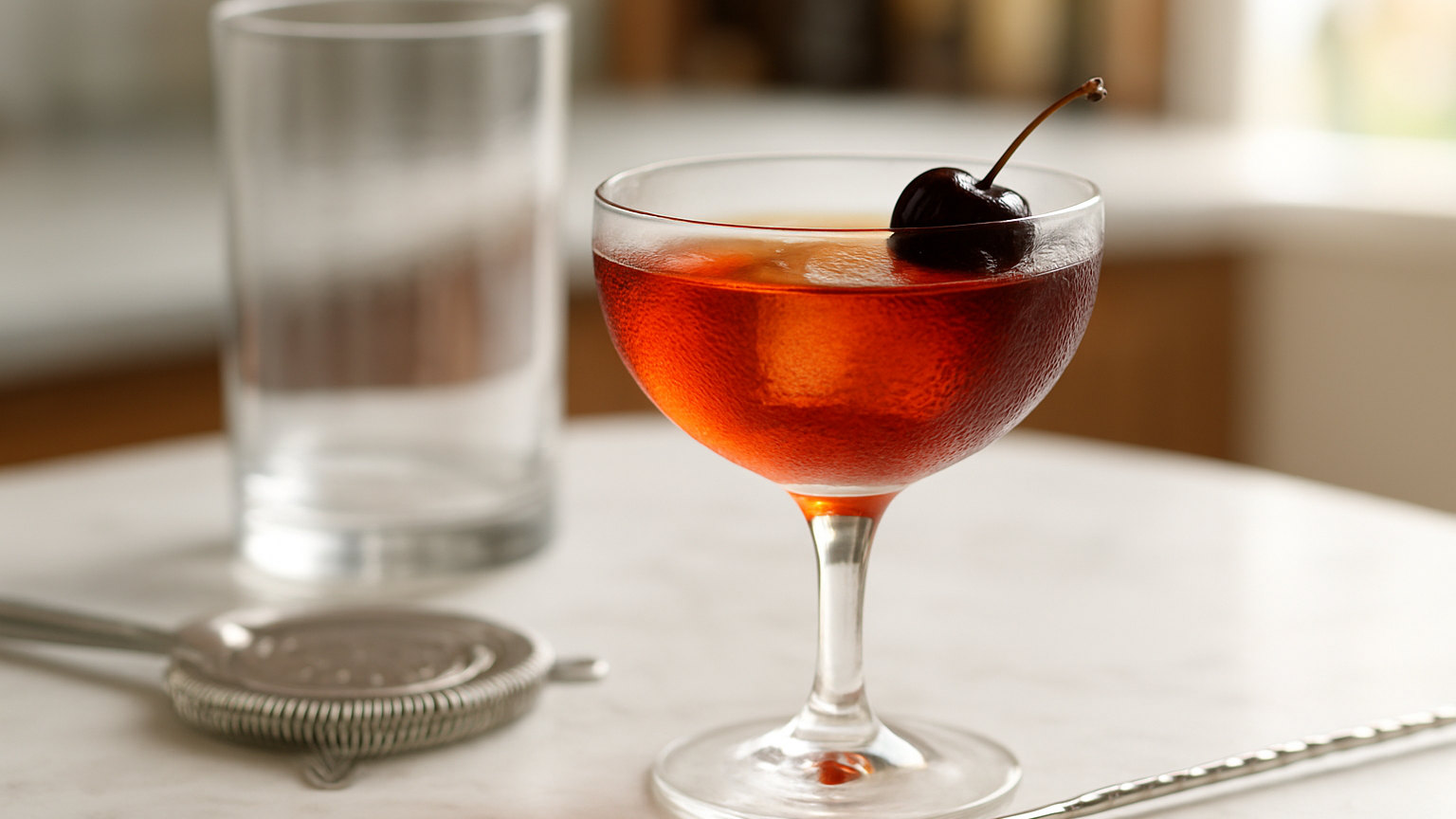
The manhattan is whiskey, sweet vermouth and bitters, stirred and served up. It is one of the great stirred classics and it depends entirely on one ingredient most people neglect.
What is the recipe?
- 60ml rye whiskey
- 30ml sweet red vermouth
- 2 dashes aromatic bitters
Stir with plenty of ice for 30 seconds. Strain into a chilled coupe. Garnish with a good cherry or an expressed orange peel.
Why rye rather than bourbon?
Because rye is drier and spicier, so it contrasts with the sweet vermouth rather than doubling up on sweetness. Bourbon plus sweet vermouth can become cloying.
Bourbon makes a rounder, softer manhattan that plenty of people prefer. It is a legitimate choice and the drink was built around rye.
Why does the vermouth matter so much?
Because it is a third of the drink and it is wine, so it oxidises after opening. Left at room temperature it goes flat and stale within two to three weeks.
Keep it in the fridge and buy small bottles. A tired vermouth is the commonest reason a home manhattan disappoints, and people almost always blame the whiskey.
How can you tell if it has gone?
Taste it alone. Fresh vermouth is bright and aromatic; tired vermouth is dull, flat and faintly sour. The difference is obvious once you have tasted both.
What ratio should you use?
Two to one is standard. Some prefer 3:1 for a drier, more whiskey-forward drink, and older recipes often used equal parts.
Start at 2:1 and adjust. Changing the ratio is a bigger lever than changing the whiskey.
What is a perfect manhattan?
Equal parts sweet and dry vermouth in place of all sweet, so 60ml rye, 15ml sweet and 15ml dry. It is drier and more herbal, and perfect refers to the split rather than to quality.
Why stir rather than shake?
Because there is no citrus or egg. Shaking clouds the drink, aerates it and over-dilutes, and a manhattan should arrive clear and silky.
What cherry should you use?
A proper cocktail cherry preserved in syrup rather than a bright red glacé one. The difference is substantial, since the cherry sits in the drink and leaches into it.
An expressed orange peel is an equally good garnish and considerably cheaper.
How strong is it?
Around 3.2 units after dilution, which is comparable to a large glass of wine in a small glass. Two is a substantial evening.
What are the variations?
- Rob Roy. Scotch instead of rye.
- Black manhattan. Amaro in place of the vermouth.
- Brooklyn. Dry vermouth, maraschino and a bitter aperitif.
- Boulevardier. With bitter aperitivo added, closer to a negroni.
Can you batch it?
Extremely well. Mix rye, vermouth and bitters, add around 20 per cent water for the dilution, and keep it in the fridge. Pour into a chilled glass and garnish.
What glass should you use?
A chilled coupe or a small martini glass. It is served without ice, so a glass from the freezer buys several minutes.
What ruins it?
Old vermouth, first and by a distance. Shaking rather than stirring is second, and a 40 per cent whiskey that disappears under the vermouth is third.
How long should you stir it?
Thirty seconds with plenty of ice. A Manhattan needs around 20 to 25 per cent dilution to soften the whiskey and integrate the vermouth, and that is what proper stirring delivers.
Should it be served with ice?
Traditionally not. It is stirred with ice and strained into a chilled glass, which makes it short, strong and undiluted from that point on.
Which bitters should you use?
Aromatic bitters are standard, and two dashes is right. Adding a dash of orange bitters alongside is a small change that brightens the drink noticeably.
Both keep for years, so neither is a significant purchase.
Where does the name come from?
New York, in the late nineteenth century, though the precise origin story is disputed. It is one of the oldest cocktails still made to essentially its original specification.


