
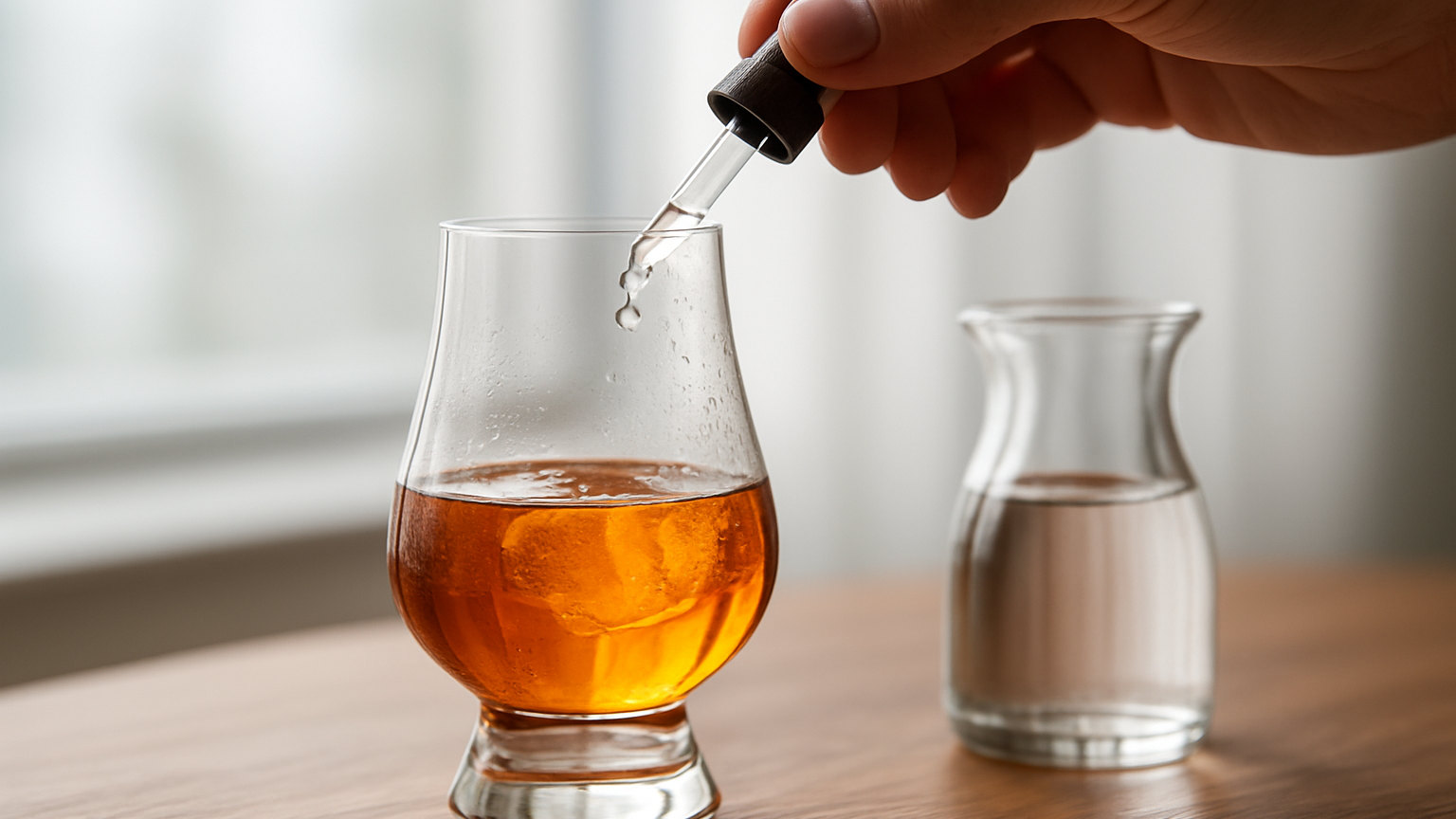
Drinking whisky neat has accumulated more ritual than it needs. Two things genuinely change what you taste, and one of them is free. The rest is preference and can be ignored.
Which glass should you use?
Something that narrows towards the top. A copita, a Glencairn or an ordinary small wine glass all work, and a straight-sided tumbler does not.
The reason is that aroma is most of flavour, and a narrowing glass concentrates the vapour above the liquid where a wide one lets it disperse. The difference is immediately obvious if you pour the same whisky into both.
A rocks glass is for whisky with ice, where the aroma is suppressed anyway and the shape matters less.
Should you add water?
Try it. A few drops genuinely changes the whisky, and the effect is chemical rather than a matter of taste.
Alcohol binds some aromatic compounds and keeps them in solution. Lowering the strength releases them, which is why a whisky can smell noticeably more complex after a small addition of water. Some compounds are also perceived differently at lower alcohol concentrations.
Add a few drops at a time, not a splash. At cask strength above 55 per cent, water almost always helps. At 40 per cent it often does not, since the whisky has already been reduced.
Does it have to be still water?
Room temperature and low in minerals is ideal, so bottled still water or filtered water. Tap water containing chlorine will contribute a faint chemical note, which is worth avoiding when the whole point is aroma.
What does ice do?
Two things, one useful and one not. It cools the whisky, which suppresses volatile aromatic compounds and mutes the flavour. And it dilutes as it melts, which does what adding water does but without control.
That makes ice a poor choice for tasting and a perfectly reasonable one for drinking. If you enjoy whisky cold, drink it cold. Use one large cube rather than several small ones, since it melts more slowly.
How should you taste it?
- Look. Colour suggests cask type and age, unreliably given caramel colouring is permitted.
- Nose gently, mouth slightly open, without inhaling hard. A deep sniff at 46 per cent burns the receptors and you lose the next few minutes.
- Take a small sip and let it coat the mouth before swallowing.
- The first sip always burns. The second tells you more.
- Notice the finish, which is what remains after swallowing.
Why does the first sip burn?
Because your palate has not adjusted to the alcohol. It is why professional tasters take a small preparatory sip and disregard it entirely.
Give it thirty seconds and the second sip will taste of considerably more. Rushing straight in and concluding a whisky is harsh is a common mistake.
Should the glass be warmed or covered?
Covering it briefly with a coaster or your palm concentrates the vapour and is worth doing before nosing. Warming it in your hands helps slightly with a heavier whisky and is not necessary.
How much should you pour?
25 to 35ml, which is a UK single or a little more. A large pour of a strong spirit warms in the glass and takes a long time to work through.
At 46 per cent, a 35ml pour is 1.6 units. Two of those with a small glass of wine reaches most of a day’s sensible drinking, which is easy to lose track of with a spirit sipped slowly over an evening.
Does the whisky need to rest in the glass?
A few minutes helps, particularly at higher strengths. The most volatile alcohol vapour disperses, leaving the aromatics easier to perceive without the burn getting in the way.
Five minutes is plenty. Leaving it for an hour lets the lighter aromas escape entirely.
What about food alongside?
Something plain and unsalted works best, since strong flavours overwhelm the whisky and salt shifts how bitterness reads. Plain oatcakes, bread or unsalted nuts are the usual choices.
Water between measures matters more than food, and it resets the palate more effectively than anything else.


