
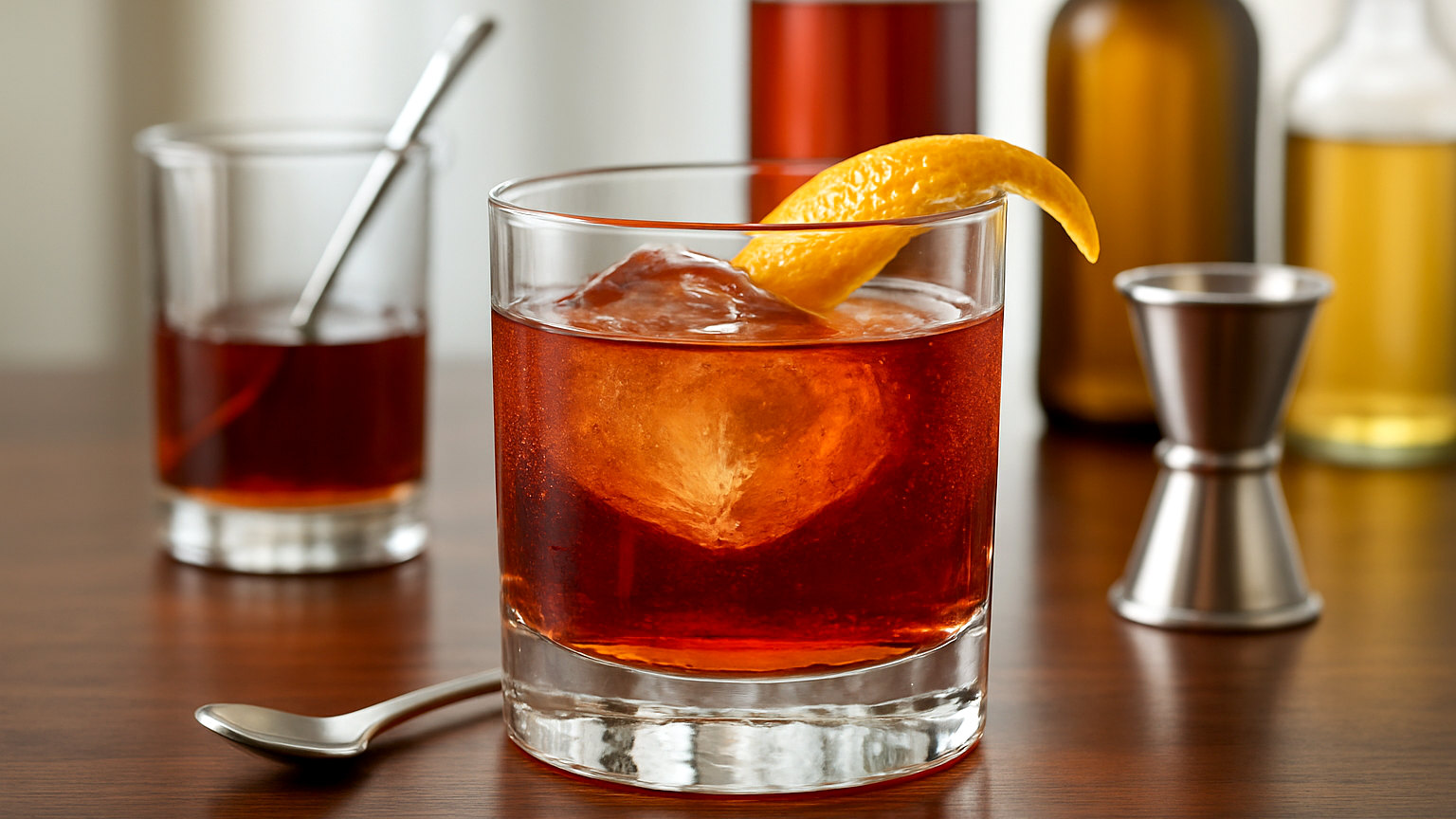
The boulevardier is bourbon or rye, sweet vermouth and bitter aperitivo. It is a negroni with whiskey in place of gin, and it predates most of the negroni variations by decades.
What is the recipe?
- 45ml bourbon or rye
- 30ml sweet red vermouth
- 30ml bitter red aperitivo liqueur
Stir with plenty of ice for 30 seconds. Strain over a large cube in a rocks glass, or into a chilled coupe. Express an orange peel over the surface and drop it in.
Why not equal parts?
Because whiskey has more body and sweetness than gin, so equal parts can taste heavy and slightly cloying. Increasing the whiskey to 45ml gives the drink more backbone.
Equal parts is perfectly good and it is the more common starting point in older recipes. Try both and see which you prefer.
Bourbon or rye?
Bourbon gives a rounder, sweeter drink where vanilla meets the bitter aperitivo. Rye gives a drier, spicier one that contrasts more sharply.
Rye is generally the better choice if you already find negronis sweet, since it pulls in the opposite direction to the vermouth.
Does the strength matter?
Yes. At 45 per cent or above the whiskey holds its own against two assertive modifiers. At 40 per cent it can disappear under them.
How does it compare to a negroni?
Richer and rounder. Gin brings juniper and a dry botanical edge; whiskey brings sweetness, oak and body. The bitter and vermouth are identical.
A negroni is sharper and more aperitif-like; a boulevardier suits later in an evening or colder weather.
Should it be served up or on the rocks?
Either. Over a large cube it stays cold and dilutes gently as you drink. Up in a chilled coupe it is more concentrated and warms faster.
Both are correct and neither is more traditional.
Why does the vermouth need to be fresh?
Because it is a third of the drink and it is wine, so it oxidises within weeks of opening. Keep it in the fridge and buy small bottles.
A stale vermouth is the commonest reason this drink disappoints, and the whiskey usually gets the blame.
How strong is it?
Around 3.1 units after dilution. It is a strong drink in a small glass and it tastes deceptively smooth.
What are the related drinks?
- Old pal. Rye with dry vermouth instead of sweet. Considerably drier.
- Black manhattan. Amaro in place of the bitter aperitivo.
- Negroni. Gin, equal parts.
- Rosita. Tequila, with both vermouths.
Can you batch it?
Very well. Mix the three in a bottle, add around 20 per cent water for the stirring dilution, and keep it in the fridge. It improves slightly over the first few days and keeps for weeks.
What glass should you use?
A rocks glass over a large cube, or a chilled coupe. Both are common and neither is more correct.
What ruins it?
Stale vermouth and a whiskey below 45 per cent. Between two assertive modifiers, a weak spirit simply disappears.
Where does the name come from?
A Paris magazine of the 1920s, where the recipe first appeared. It predates most negroni variations by several decades, which is often overlooked.
What ratio should you settle on?
Start at 45:30:30 and adjust the whiskey up if it tastes sweet. Equal parts at 30:30:30 is the older version and noticeably richer.
Anyone who finds negronis too bitter usually prefers this drink at 45ml of whiskey or higher.
Should you use the same bitter aperitivo as a negroni?
Yes, the red bitter liqueur is identical. Only the base spirit changes, which is what makes the comparison between the two drinks so instructive.
When should you drink it?
Later in an evening than a negroni, or in colder weather. The whiskey gives it more weight, which suits it to after dinner rather than before it.
Is it worth making alongside a negroni?
Very much so. Identical modifiers with a different base spirit, tasted side by side, shows exactly what gin and whiskey each contribute.


