
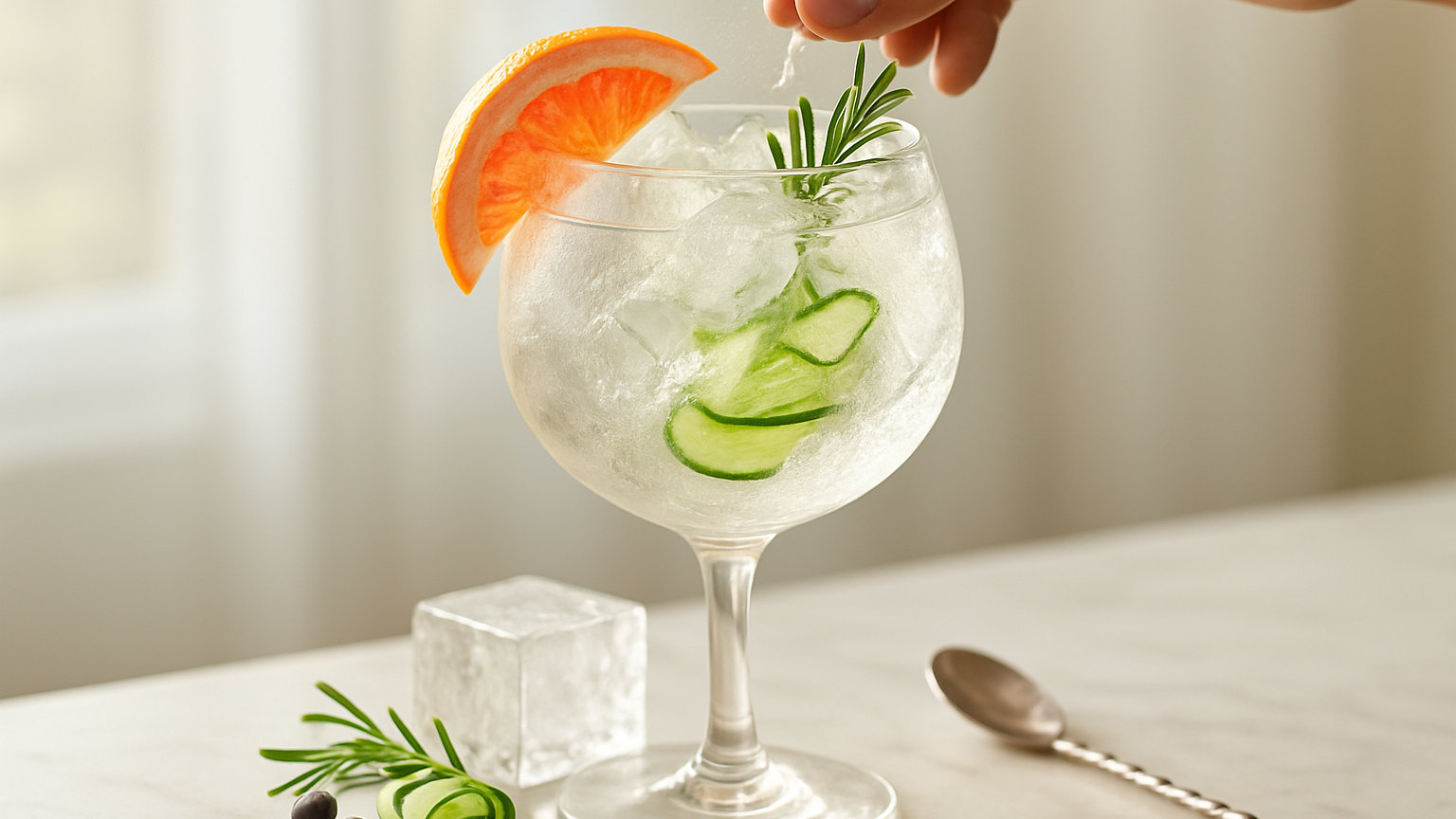
Garnish has become the most decorated part of a gin and tonic and it is frequently the least considered. A good one extends the gin; a bad one either does nothing or fights it.
What does a garnish actually do?
Mostly aroma. You smell the drink before and during every sip, and aroma accounts for the large majority of what you perceive as flavour.
A citrus peel expressed over the surface releases oils that sit on top of the liquid and reach you with every mouthful. A slice of fruit dropped in the glass contributes far less, since juice diluted into a long drink is barely detectable.
What does expressing mean?
Holding a strip of peel skin-side down over the drink and squeezing sharply so the oils spray across the surface. You can often see the mist. Then rub the rim with the peel and drop it in.
It takes two seconds and makes more difference than any other garnish decision.
How should you match the garnish?
To the gin’s dominant botanicals, extending rather than adding:
- Classic juniper-forward London dry: lemon peel. Sharp, clean, traditional.
- Citrus-led contemporary gin: grapefruit peel or orange.
- Floral gin: a strip of lemon, or a single edible flower if you must.
- Cucumber-led gin: a long cucumber ribbon.
- Spiced or peppery gin: orange peel, a few peppercorns, or a bay leaf.
- Coastal or savoury gin: a sprig of rosemary or thyme, lightly slapped.
Why slap herbs?
Because clapping a sprig once between your palms ruptures the oil cells and releases aroma. A sprig placed in a drink untouched contributes almost nothing.
One firm slap is enough. Crushing it releases bitter chlorophyll notes.
What about lime?
Fine, and less versatile than it is used. Lime is assertive and can flatten a delicate gin, which is why lemon is the safer default for most London dry.
Lime suits gins with strong citrus or coriander character, and it suits a gimlet more than a gin and tonic.
What should you leave out?
- Large quantities of fruit. Dilutes and chills the drink without adding aroma.
- Frozen berries. Look decorative, contribute nothing, water the drink down.
- Multiple competing garnishes. Three botanicals in the glass usually muddle rather than layer.
- Anything dried and dusty. Adds sediment more than aroma.
The elaborate garnish is largely a photograph rather than a drink. One well-chosen element beats five.
Does the peel need to be pith free?
Largely, yes. Pith is bitter and contributes nothing useful, so pare thin strips with a vegetable peeler rather than cutting wedges.
Unwaxed fruit is worth buying if the peel is going into the drink, and washing waxed fruit in warm water helps.
What is the simplest reliable approach?
A strip of lemon peel, expressed over the surface, dropped in. It suits the majority of gins, costs nothing, and improves almost every gin and tonic that arrives without one.
Does the garnish change the drink or the perception?
Both, and more of the latter than people expect. Aroma reaching you as you sip is genuinely part of the flavour, so a garnish that never leaves the glass rim still works.
That is why expressed citrus oil outperforms a wedge of fruit sitting in the liquid, despite contributing a fraction of the volume.
What if the gin is already complex?
Use less. A gin with a dozen assertive botanicals rarely needs help, and a plain strip of lemon or nothing at all lets it speak.
Should the peel go in the drink?
After expressing, yes. It continues releasing oil slowly and it costs nothing. What matters is that the oils were sprayed across the surface first rather than the peel simply being dropped in.
Does any of this apply to a martini?
The same principle, with more at stake. A martini has no mixer to carry aroma, so expressed lemon oil on the surface is a larger proportion of what you smell than it would be in a long drink.


