
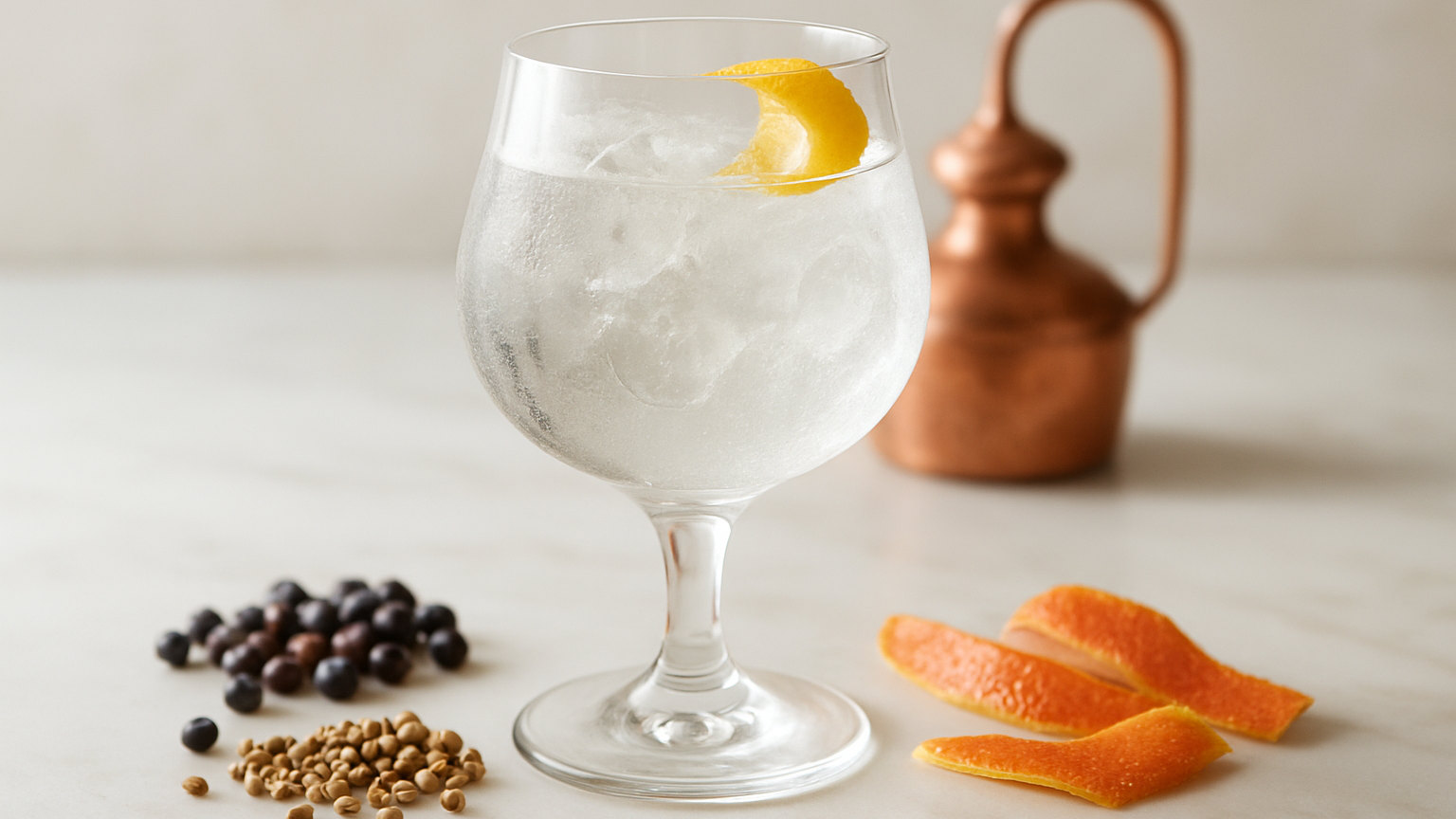
London dry is the most recognisable term in gin and the most misunderstood. It describes how the gin was made rather than where, and it is one of the few gin terms with real regulatory force.
What are the rules?
- Made from neutral spirit of agricultural origin, distilled to at least 96 per cent.
- Flavoured only by redistilling with natural botanicals, with juniper predominant.
- Nothing added after distillation except water and a very small quantity of sugar.
- No added colouring.
- Minimum 37.5 per cent in the UK and EU.
The sugar limit is 0.1 grams per litre, which is negligible and effectively means unsweetened. Dry refers to that absence of sweetening.
Does it have to come from London?
No, and most does not. London dry gin is made in Spain, India, the United States, Scotland and dozens of other places, entirely legitimately.
The name reflects where the style was developed rather than any protected origin. It is one of the clearest cases of a spirits term that sounds geographical and is not.
What terms are geographical?
Very few in gin. Plymouth gin was historically a protected designation, and the protection lapsed in 2015. Mahón gin from Menorca holds a protected status, as does a small number of other regional styles.
How does it differ from distilled gin?
Distilled gin also requires botanicals to be redistilled with the spirit, and it permits flavouring and colouring to be added afterwards.
So all London dry is distilled gin, and not all distilled gin is London dry. A gin with colour added, or with a botanical extract blended in after distillation, can be distilled gin but not London dry.
And plain gin?
The loosest category. Gin can be made by simply steeping or even adding approved flavourings to neutral spirit without redistillation, provided juniper predominates.
Compound gin made by steeping is honest and can be very good. The category also covers products where the flavour never met a still, which is where the term is doing the least work.
What does London dry taste like?
Juniper forward, dry, usually with citrus peel, coriander seed and angelica root behind it. Clean rather than sweet, and structured rather than soft.
Within the category there is real variation, since the rules govern method rather than recipe. Two London dry gins can differ substantially while both complying fully.
Does the term guarantee quality?
It guarantees process, which is not the same thing. A London dry gin has certainly been distilled with its botanicals and has not been sweetened or coloured afterwards.
Whether the result is good depends on the recipe and the distiller. The designation rules out several shortcuts and does not rule out a dull gin.
Is it the right style for cocktails?
For classics, yes. Martini, negroni, gimlet and tom collins were all built around this style, and a contemporary gin with juniper pushed back changes the balance noticeably.
Look for something at 40 to 47 per cent. The higher end holds up better against dilution, which matters in a stirred martini more than almost anywhere else.
Does it have to be strong?
The legal minimum is 37.5 per cent, and most quality London dry sits between 40 and 47. The higher figures are worth seeking out for cocktails.
A gin at 37.5 per cent in a stirred martini arrives in the glass around 30 per cent after dilution, which tastes noticeably watery. At 47 it lands nearer 38 and holds its shape.
How do you identify one on a shelf?
The words appear on the label, since producers who meet the standard say so. Anything labelled simply gin, or distilled gin, has either chosen not to comply or cannot.
Why does the category matter?
Because it is one of very few points in the spirits aisle where a term on the label guarantees something specific about production. Most of what appears on a gin bottle is unregulated.
Knowing that London dry rules out post-distillation flavouring, colouring and sweetening lets you narrow a shelf quickly, which is genuinely useful when a dozen bottles all promise craft and heritage.


