
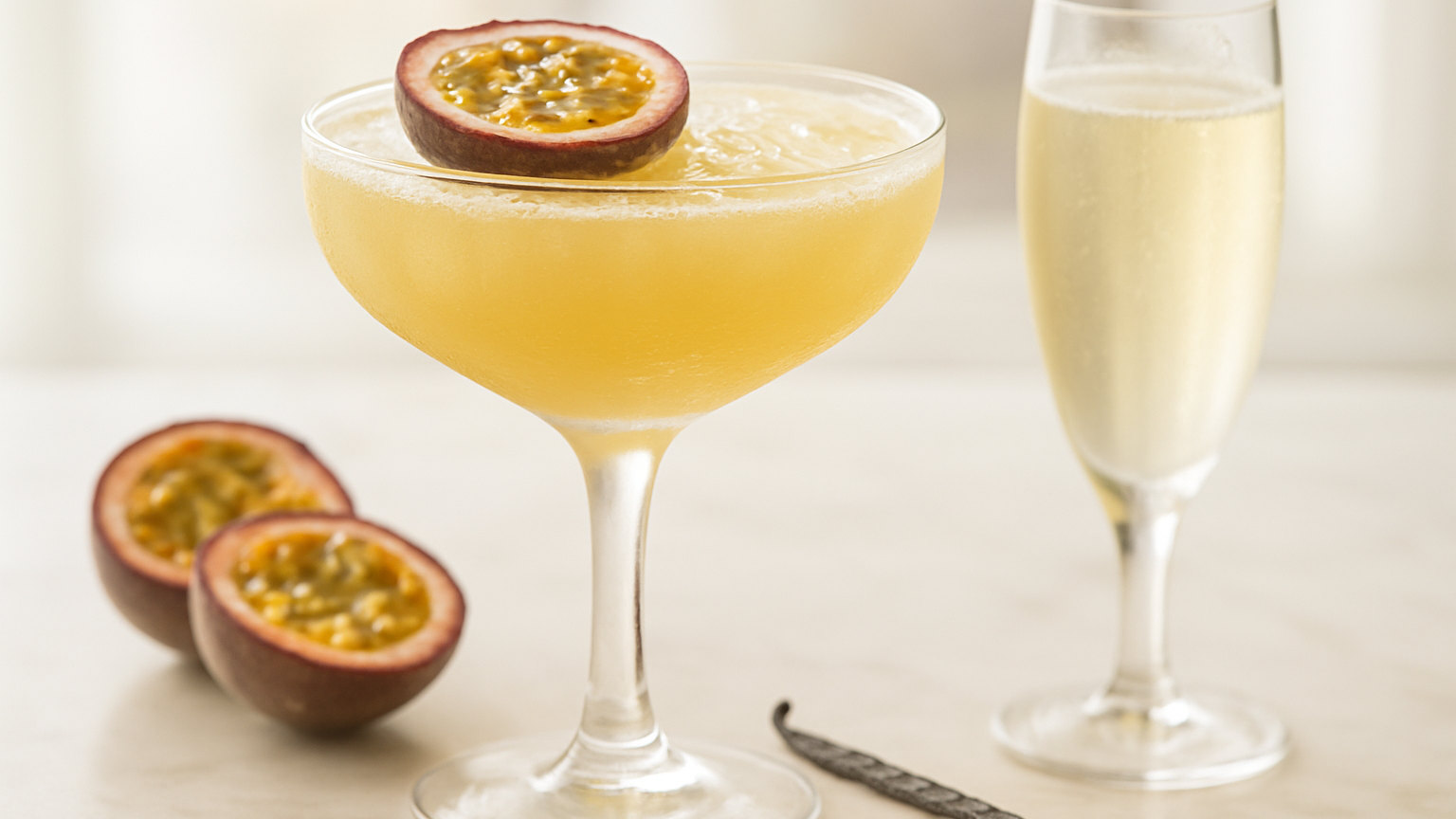
Among the most ordered cocktails in Britain, and one where the serve is as distinctive as the drink. The small glass of prosecco alongside is part of the recipe rather than a garnish.
What is the recipe?
- 50ml vanilla vodka
- 15ml passion fruit liqueur
- The pulp of half a passion fruit
- 15ml lime juice
- 10ml vanilla sugar syrup
- 60ml prosecco, served separately
Shake the first five ingredients hard with ice, double strain into a chilled coupe, and float half a passion fruit on top. Serve the prosecco in a shot glass on the side.
Why is the prosecco served separately?
Because pouring it into the drink would flatten it immediately and dilute the passion fruit. Served alongside, it is sipped between mouthfuls, which resets the palate.
Some people pour it in anyway, which is their prerogative and makes a different drink.
Where does the foam come from?
Passion fruit pulp contains natural compounds that foam when shaken, and the seeds and fibres help stabilise it. That is why fresh pulp works and passion fruit juice from a carton does not.
Shake hard for 12 to 15 seconds. Double strain to keep the seeds out while letting the foam through.
Should you strain out the seeds?
Mostly yes, since a mouthful of seeds is unpleasant. A fine sieve holds them back and lets the foam and pulp through.
Do you need vanilla vodka?
It is the traditional choice and it is easy to substitute. Plain vodka with 10ml of vanilla syrup gives the same result and gives you control over the sweetness.
Making a vanilla vodka at home is trivial: two split pods in a bottle for a month, no straining difficulty.
How sweet should it be?
Balanced rather than sugary, which is where most commercial versions go wrong. Passion fruit is sharp, so it needs sweetness, and beyond about 15ml of syrup it becomes cloying.
Taste before straining and adjust with syrup or lime.
What if passion fruit is out of season?
Frozen passion fruit pulp works well and is usually better than out-of-season fresh. Bottled purée is the next option, and it lacks the seeds that help the foam.
How strong is it?
Around 2.3 units for the cocktail plus 0.7 for the prosecco shot, so roughly 3 units in total. That is more than it looks, since it arrives as a small coupe and a small glass.
Can you batch it?
The vodka, liqueur, syrup and lime can be pre-mixed and refrigerated. Add the fresh pulp and shake per serve, since the foam will not survive batching.
Lime juice should be squeezed on the day, as it dulls within a few hours.
What glass should you use?
A chilled coupe for the cocktail and a small shot glass for the prosecco. Both should be cold, since the drink is served without ice and the fizz goes flat quickly in a warm glass.
Why is it so popular?
Because it is sweet enough to be approachable, sharp enough not to cloy, and the two-glass serve makes it feel like an occasion. It is consistently among the most ordered cocktails in British bars.
How do you cut the passion fruit half?
Slice it across the middle rather than lengthways, so the half floats cup-side up on the foam. A ragged cut sinks and looks poor.
Can you make it less sweet?
Reduce the syrup first, then the liqueur. Adding 5ml more lime is the quickest correction if it is already made and tasting cloying.
Which prosecco should you use?
Dry, and inexpensive. It is drunk as a small shot alongside a strongly flavoured cocktail, so nothing subtle would survive the comparison.
What ruins it?
Bottled passion fruit juice, which produces no foam, and too much syrup, which turns a sharp drink into a sweet one.
What is the history of the name?
Created in London in the early 2000s by Douglas Ankrah, originally under a different name before the current one took hold. It was designed as a deliberately indulgent drink and the two-glass serve was part of that from the start.


