
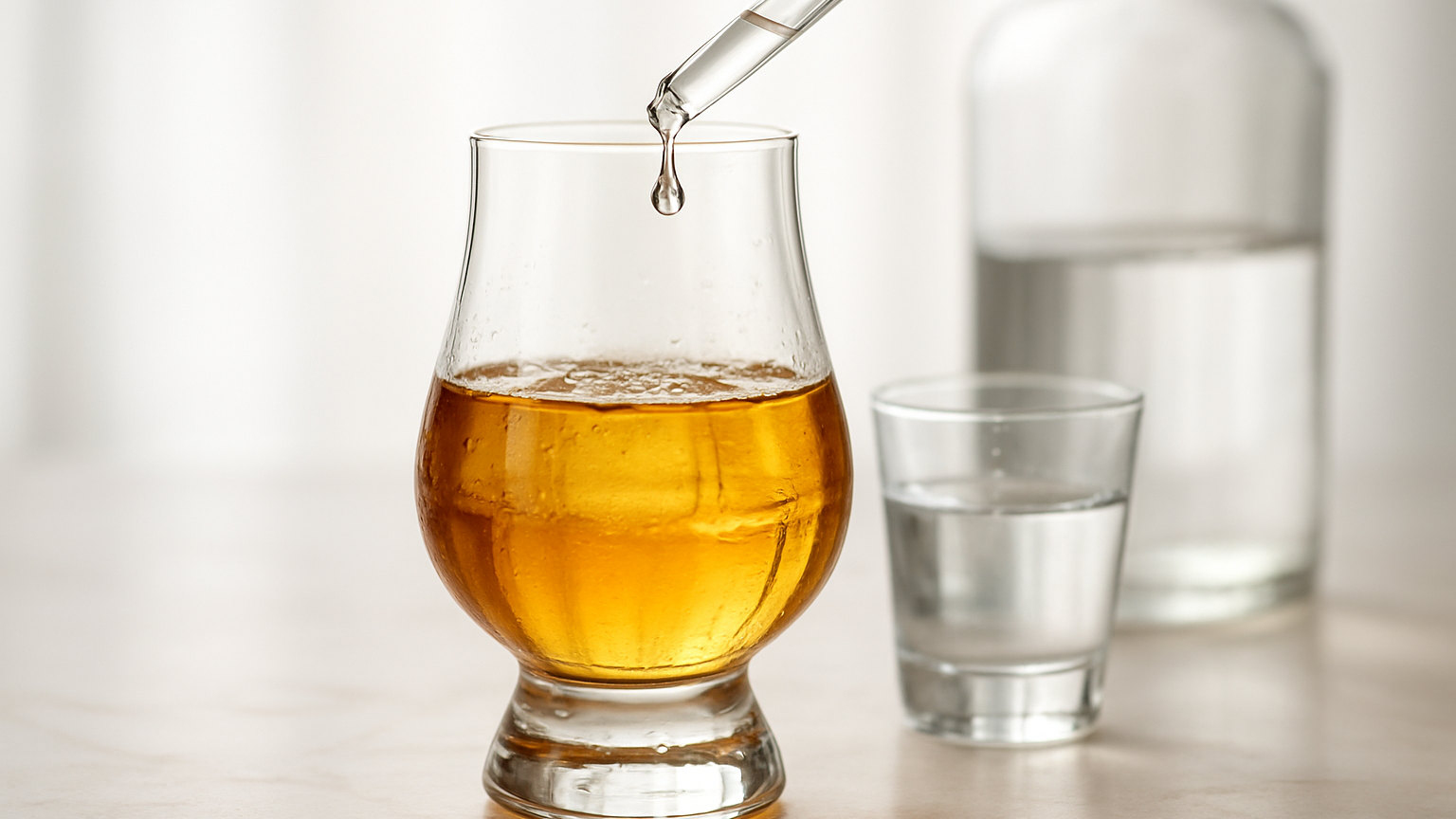
A good spirit drunk neat from the wrong glass at the wrong temperature gives up perhaps half of what it has to offer. None of the fixes cost much, and the two that matter most are the shape of the glass and a small amount of water.
Why does the glass shape matter?
Because aroma is most of flavour, and the glass controls how much aroma reaches your nose. A tumbler with straight sides lets the volatile compounds disperse into the room. A glass that narrows at the top concentrates them.
A copita or a tulip-shaped nosing glass is the standard for this reason. A small wine glass works almost as well and most kitchens have one. The heavy square tumbler is comfortable to hold and the worst possible shape for tasting.
How much should you pour?
Around 25 to 35ml, which looks meagre in a large glass and is the right amount. A small pour in a wide-bowled glass gives a large surface area relative to the volume, which is exactly what you want for aroma.
It is also a sensible measure. A 35ml pour of a 45 per cent spirit is 1.6 units, and the UK guideline is no more than 14 units a week across three or more days. Tasting several spirits in an evening adds up faster than most people expect.
Why does adding water help?
Alcohol binds aromatic compounds and holds them in the liquid. Reducing the strength releases them, which is why a spirit often smells noticeably more expressive after a few drops of water than it did before.
Add water a few drops at a time and smell between each addition. There is a point where the aroma peaks and a further point where the spirit thins and goes flat. That window is different for every bottle and finding it is most of the exercise.
Does it matter what water you use?
Use still water at room temperature, and preferably filtered or bottled if your tap water is heavily chlorinated. Chlorine is detectable at very low concentrations and will sit on top of everything else. Sparkling water changes the texture and is a different decision.
Should you add ice?
It depends what you want. Ice chills, and cold suppresses aroma considerably, particularly at the delicate end. A heavily peated whisky or a rich aged rum loses much of its complexity below about 10 degrees.
Ice also dilutes progressively rather than to a fixed point, so the drink changes as you go. For a spirit you want to examine, water is better. For a spirit you want to relax with over half an hour, one large cube is entirely reasonable and there is no reason to feel apologetic about it.
What temperature should a spirit be?
Room temperature for most aged spirits, around 18 to 20 degrees. Colder than that and the aroma closes down.
The exceptions are spirits designed to be served cold, such as aquavit, some vodkas and certain unaged fruit brandies, where chilling suppresses harshness that is genuinely there. Chilling an expensive aged spirit is mostly wasting what you paid for.
How do you avoid palate fatigue?
Your ability to distinguish aromas drops sharply after three or four samples, particularly at high strength. Practical steps:
- Taste no more than four spirits in a sitting.
- Work from lightest to heaviest, since a peated whisky will dominate everything after it.
- Smell in short sniffs with your mouth slightly open rather than deep inhalations.
- Drink water and eat something plain between samples.
Sticking your nose deep into a glass of 50 per cent spirit and inhaling hard numbs your sense of smell almost immediately. Hold the glass a few centimetres away to begin with.
Does the bottle change after opening?
Slowly, and mostly once it is more than half empty. Spirits do not spoil the way wine does, since the alcohol content prevents it, but oxidation gradually flattens the aroma of an open bottle with a large air space above the liquid.
A bottle with a third left will taste noticeably duller after a year than it did on opening. Keep bottles upright, out of direct sunlight, and finish the interesting ones rather than saving them indefinitely.


