
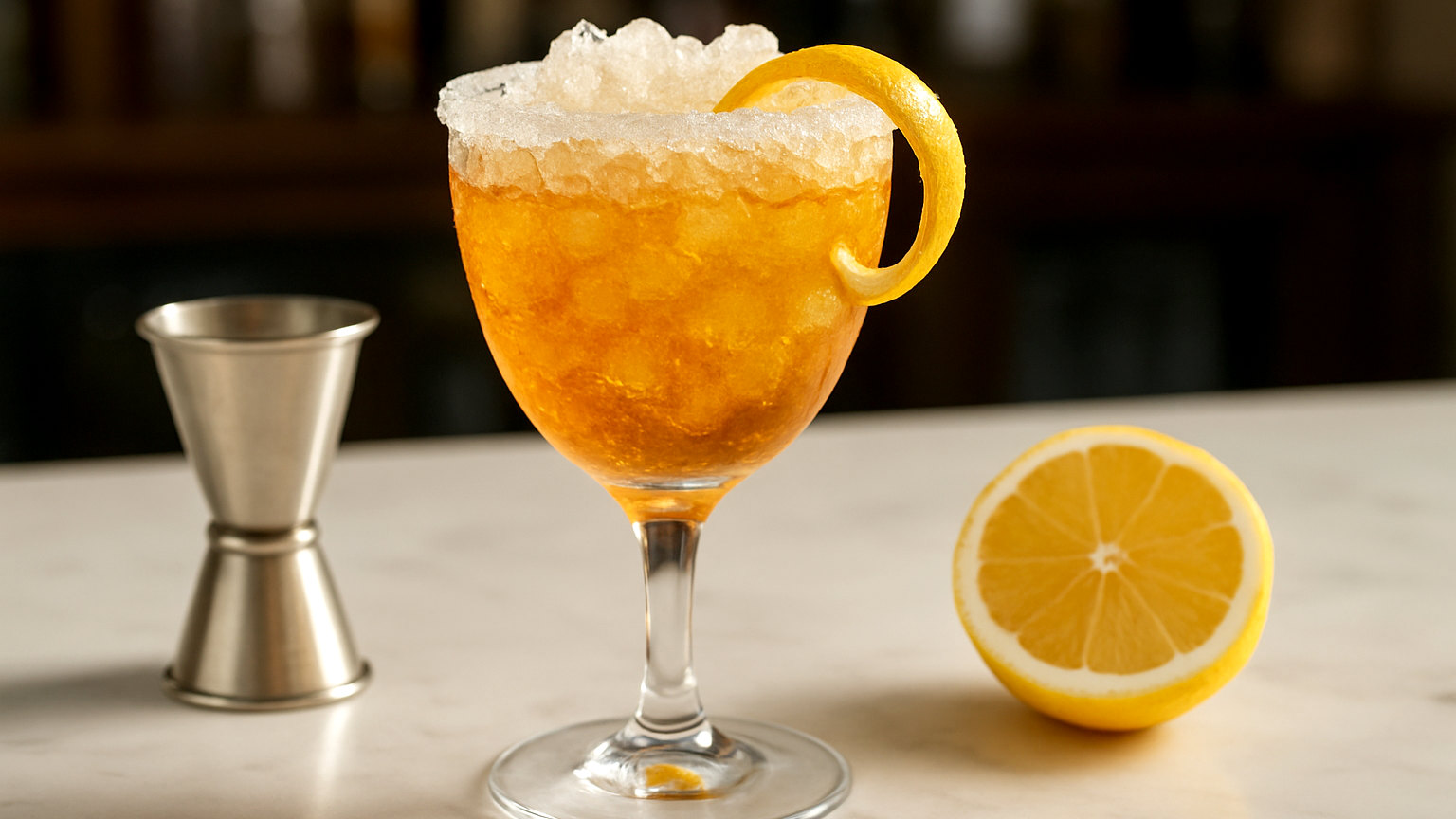
The brandy crusta dates from New Orleans in the 1850s and is one of the earliest cocktails to use an elaborate garnish. It is also the ancestor of the sidecar and several other spirit and citrus drinks.
What is the recipe?
- 50ml cognac
- 10ml orange liqueur
- 5ml maraschino liqueur
- 10ml fresh lemon juice
- 5ml sugar syrup
- 2 dashes aromatic bitters
Prepare the glass with a sugared rim and a lemon peel spiral. Stir or shake the ingredients with ice and strain into the prepared glass.
How do you cut the lemon spiral?
Cut the top and bottom off a lemon, then pare the peel away in one continuous strip using a knife or peeler, working around the fruit.
Curl the strip inside the glass so it lines the inner wall. It should sit against the sides rather than floating in the drink.
Practice on a lemon or two. The technique is the main difficulty of the recipe and it takes a few attempts.
Why line the glass?
Because the peel releases oil into the drink continuously as you go, so the aroma builds rather than arriving only at the start. It is also the feature the drink is named for.
How do you sugar the rim?
Rub a lemon wedge around the outside of the rim only, then roll the outside through caster sugar on a plate. A thick crust is traditional here, unlike the light dusting on a sidecar.
Salting or sugaring the inside means it falls into the drink and makes it progressively sweeter.
Why so little lemon juice?
Because the drink is not a sour. Ten millilitres lifts it without turning it into one, and the sugared rim and peel are contributing citrus character too.
Early recipes vary and some use considerably more. Around 10 to 15ml keeps it in the spirit-forward style it belongs to.
What is maraschino liqueur?
A clear cherry liqueur made from marasca cherries including the stones, which gives it a dry, almond-like character quite unlike a sweet cherry brandy.
Five millilitres is enough. It is powerful and easily dominates.
How did the sidecar come from it?
By simplification. Take the crusta, drop the maraschino, bitters and the elaborate garnish, increase the lemon and the orange liqueur, and you have a sidecar.
The family runs from the crusta through the sidecar to the margarita, all built on spirit, orange liqueur and citrus.
How strong is it?
Around 2.4 units. It is spirit-forward with very little dilution beyond the stir.
What glass should you use?
A small wine glass or a coupe, which is what the peel spiral needs to sit against. A wide glass makes the spiral harder to place.
Can you batch it?
The liquid batches well with 20 per cent water added. The rim and spiral happen per glass and take a minute each.
Is it worth the effort?
Once, certainly, to see where the sidecar and margarita came from. The spiral takes practice and the drink itself is excellent.
Should it be shaken or stirred?
Either is defensible. There is citrus in it, which argues for shaking, and the small quantity means a hard stir also works and gives a clearer drink.
What ruins it?
Too much maraschino, which takes over entirely, and a peel spiral that floats loose in the drink rather than sitting against the glass.
How much sugar should the rim have?
A thick crust, which is what the drink is named for. This is unlike the light dusting on a sidecar, and the crust is meant to be substantial.
Which cognac should you use?
A decent VS or VSOP. It is most of the drink and there is little to hide behind, so quality shows more here than in a citrus-heavy sour.
How strong is the maraschino?
Around 32 per cent, which is high for a liqueur and part of why 5ml is enough. Its intensity comes from the flavour rather than the strength.


