
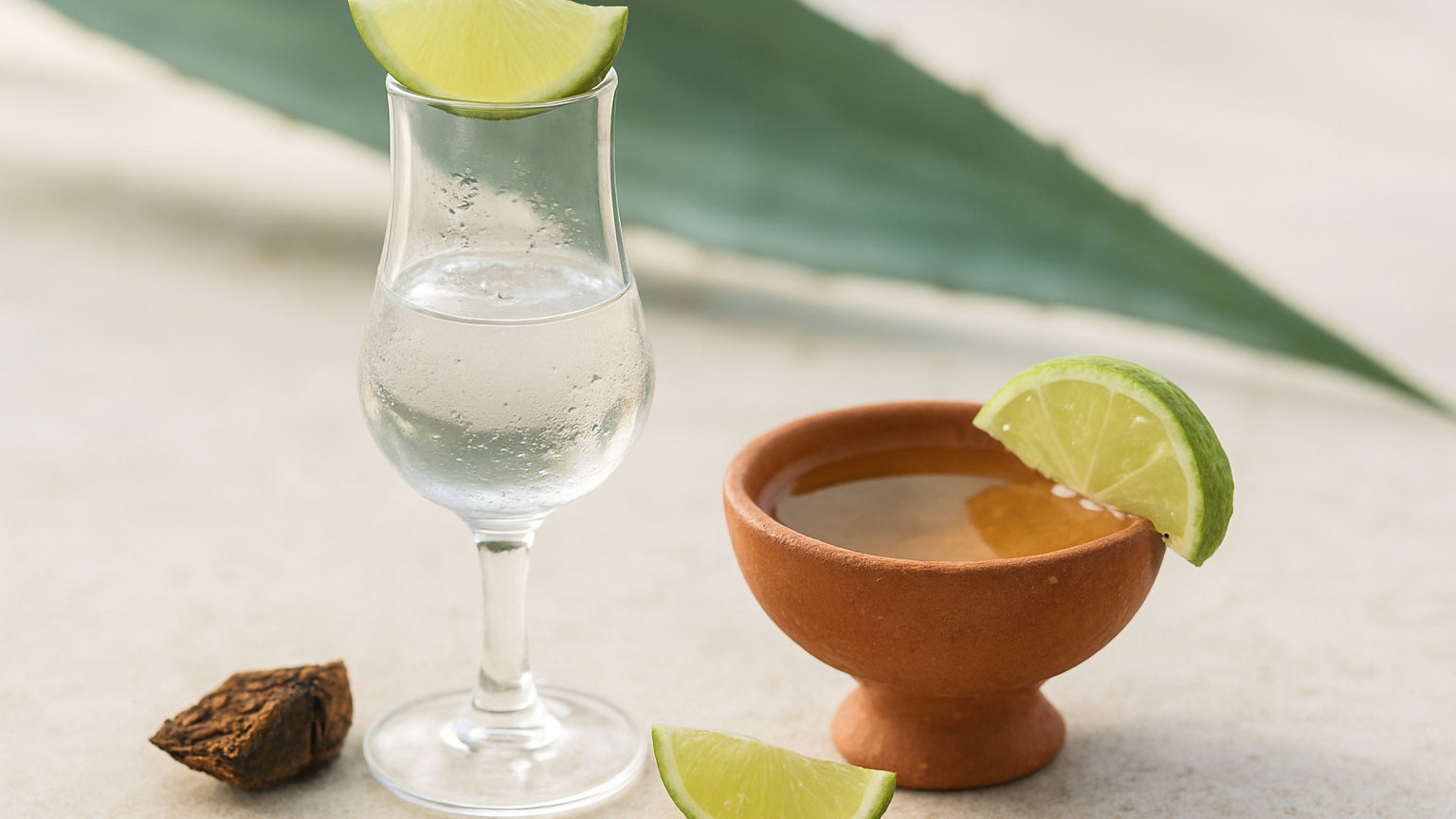
Tequila and mezcal are frequently presented as opposites. They are closer to a category and a subcategory, and the practical differences between them come down to three things.
What is the relationship?
Mezcal is the broad term for any spirit distilled from cooked agave. Tequila is a specific type, made from one agave species in a defined region.
In that sense all tequila is mezcal, though legally each has its own denomination of origin and neither is labelled as the other.
What defines tequila?
- Blue weber agave only. One species.
- Produced in Jalisco and limited municipalities in four other states.
- At least 51 per cent agave sugars, with the remainder permitted from other sources.
- Minimum 35 per cent alcohol, commonly 38 to 40.
That 51 per cent rule matters enormously and is covered properly below.
What defines mezcal?
Any of around thirty permitted agave species, produced in nine Mexican states with Oaxaca dominant. Mezcal must be 100 per cent agave, with no mixto equivalent permitted.
Espadín is the most common species, since it matures in six to eight years. Wild varieties such as tobalá and tepeztate take far longer and are correspondingly expensive.
What is a mixto?
A tequila made with the legal minimum of 51 per cent agave and the rest from other sugars, usually cane. It is what most inexpensive tequila is, and it is the reason tequila has a reputation it does not deserve.
Look for the words 100 per cent agave on the label. If they are absent, it is a mixto. That single check is the most useful thing to know about buying tequila.
Why does mezcal taste smoky?
Because of how the agave is cooked. Mezcal producers roast the piñas, the hearts of the plant, in earth pits lined with hot rocks and covered over, often for several days.
Wood smoke permeates the agave during that time and carries through fermentation and distillation. It is the same principle as peat in whisky: the flavour is created before any spirit exists.
Tequila producers use above-ground brick ovens or industrial autoclaves, which cook without smoke. That is the single largest reason the two taste different.
How else do they differ in production?
Mezcal is more often made at small scale with traditional methods: stone tahona wheels for crushing, open-air fermentation with wild yeast, small copper or clay pot stills.
Tequila is more industrialised, with column stills and diffusers used at volume. Both categories contain traditional and industrial producers, and the tendency runs the way described.
Which should you drink neat?
Both, and mezcal more often. A good 100 per cent agave blanco tequila is excellent neat, and mezcal is almost always drunk that way rather than mixed.
Serve at room temperature in a small wide glass, sipped rather than shot. A 35ml measure at 40 per cent is 1.4 units.
Which for cocktails?
Tequila for margaritas, palomas and anything citrus led. Mezcal works in the same drinks and changes them substantially, so use it deliberately rather than as a substitute.
Does mezcal have age categories?
The same three names as tequila, and they are used far less. Joven, reposado and añejo exist, and most mezcal is sold unaged because the smoke and agave character is the point.
Ageing mezcal covers exactly what people buy it for, which is why the aged expressions are a small part of the market.
What about the worm?
A marketing invention from the 1940s rather than a tradition. The larva is added to some cheap mezcal and appears in no serious bottling.
It is not a quality marker and never was. A bottle containing one is telling you about its intended market rather than its production.
Which is better value?
Tequila, generally, since production is larger and more industrialised. Good mezcal is expensive because small producers work at tiny scale with wild or slow-maturing agave.
A bottle of artisanal mezcal represents a great deal of manual labour, which is worth knowing when comparing shelf prices between the two.


