
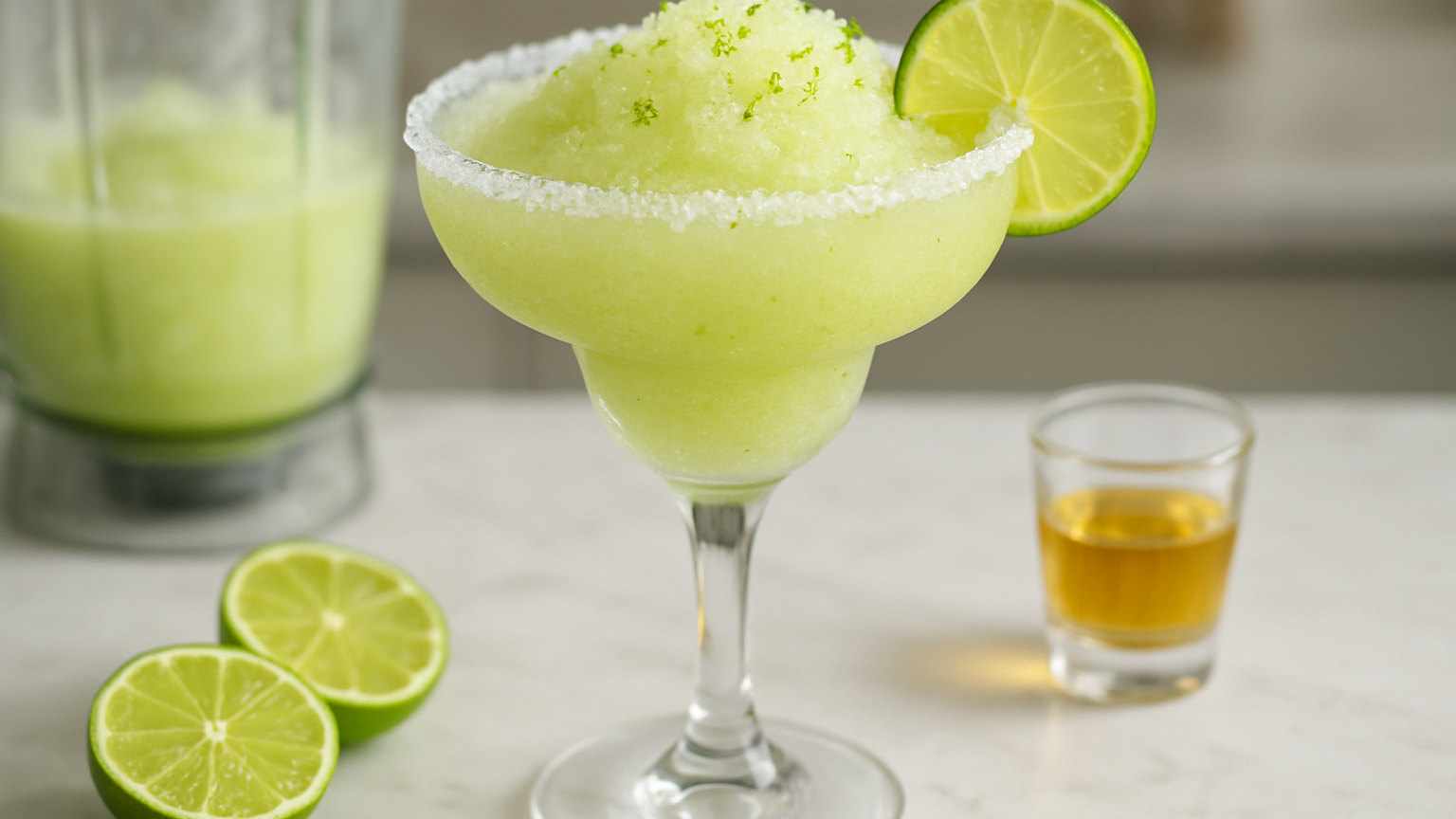
A frozen margarita is not simply a margarita with ice in it. Freezing changes how the drink is perceived, and a mixture balanced at room temperature tastes flat and watery once blended.
What is the recipe?
- 60ml blanco tequila, 100 per cent agave
- 30ml orange liqueur
- 30ml fresh lime juice
- 15ml agave syrup or sugar syrup
- A generous cup of ice
Blend until smooth and pour into a chilled glass. Salt half the rim and garnish with a lime wheel.
Why more sugar and lime than a shaken margarita?
Because low temperatures reduce the perception of both sweetness and acidity. What tastes balanced warm will taste thin and dull frozen.
Make it noticeably sweeter and sharper than you would want to sip at room temperature, then taste after blending and adjust.
When should you taste it?
After blending, which is the only point at which the temperature and texture are what they will be in the glass. Adding syrup afterwards is easy; removing it is not.
How do you get the texture right?
Blend in short bursts rather than running the machine continuously, which generates heat and turns the mixture liquid. Stop as soon as it is smooth.
If it is too thin, add more ice. If it is too thick, add lime or tequila rather than water.
Why does it come out watery?
Usually too much ice for the liquid, or over-blending. Both dilute the drink without thickening it.
Using frozen lime juice cubes instead of some of the ice is a useful trick, since it chills without diluting.
Which tequila should you use?
Blanco, 100 per cent agave. The blending and the cold both mute the spirit, so a mixto shows through as harshness more than it would in a shaken drink.
Mid-range is entirely sufficient; nothing subtle survives the blender.
How long does it hold?
Ten to fifteen minutes before it separates and starts to melt. Serve immediately and blend in batches for a group rather than making a large quantity at once.
How strong is it?
Around 2.8 units with these measures. Frozen margaritas served in large glasses can be considerably more, since the measures usually scale with the glass rather than staying fixed.
The cold and the sweetness disguise the alcohol effectively, which is worth knowing on a hot afternoon.
Do you need a special machine?
No. Any blender that handles ice will do it. Frozen drink machines hold texture longer and are unnecessary for a few drinks at home.
What fruit versions work?
Strawberry, mango, watermelon and passion fruit all work on the same base. Use frozen fruit in place of some of the ice, which chills without diluting, and reduce the syrup since the fruit brings its own sugar.
What glass should you use?
Chilled, and not enormous. Large glasses encourage scaling up the measures, which is how a 2.8 unit drink quietly becomes a 5 unit one.
Can you use a shop-bought mix?
You can, and the result is invariably sweeter and flatter than a version made with fresh lime. The mixes exist for speed at volume rather than for flavour.
Fresh lime and agave syrup take an extra minute and improve the drink substantially.
How much does it make?
These measures give one large drink or two small ones. Doubling works fine in most blenders; beyond that the machine struggles and the texture suffers.
Blending in batches gives a better result than overloading the jug.
How does it differ from a shaken margarita?
Texture and balance. A shaken margarita is sharp, cold and concentrated; a frozen one is softer, sweeter and more diluted by the ice it is blended with.
Neither is more authentic. They are different drinks that share a name and a set of ingredients.
What is the commonest mistake?
Balancing it before freezing. A mixture that tastes right at room temperature will taste flat and thin once blended, and the correction has to be made after tasting the finished drink.


