
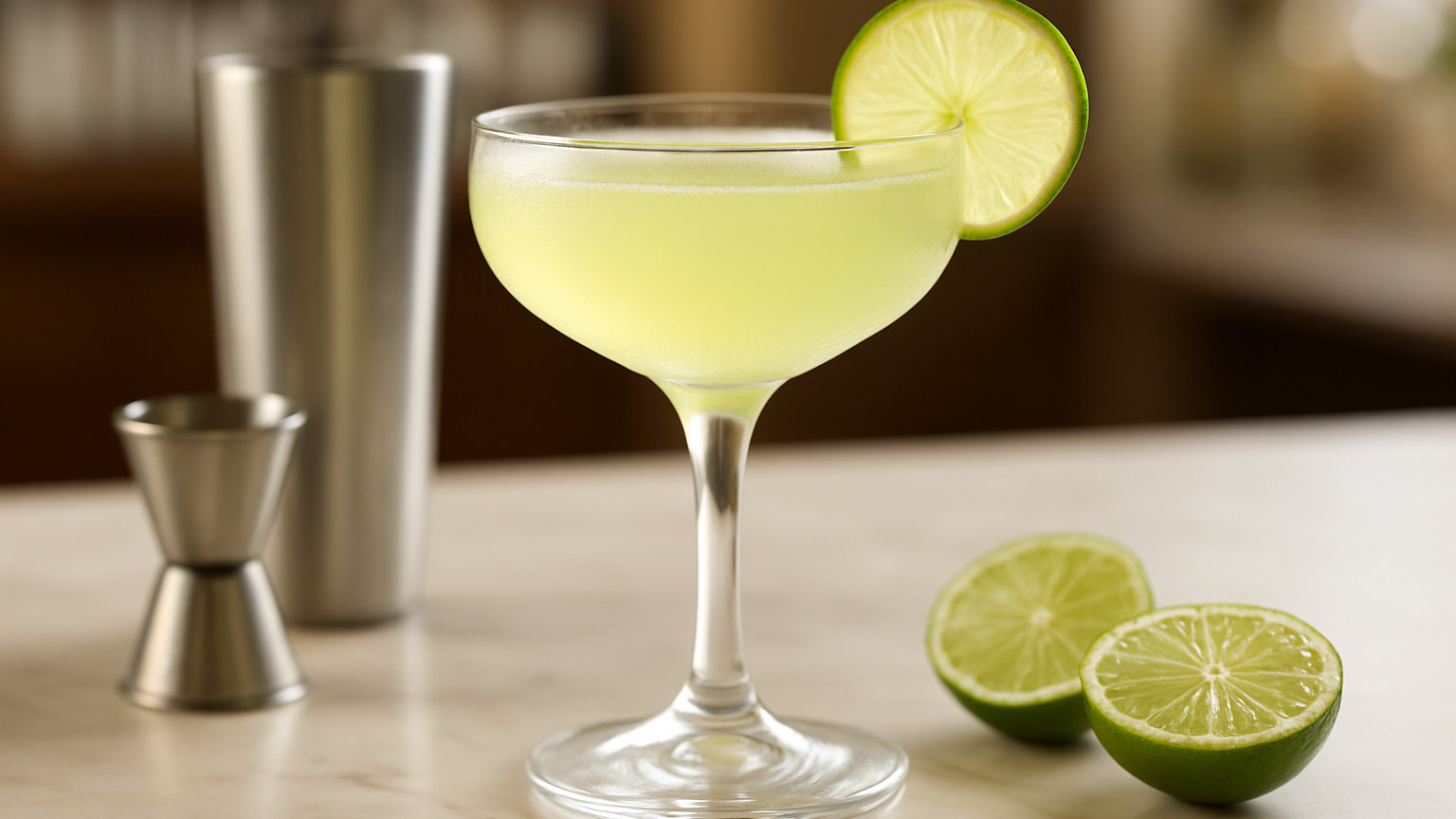
The daiquiri is three ingredients with no bitters, no vermouth and no mixer. Every element is exposed, which makes it both the simplest classic and the least forgiving.
What is the recipe?
- 60ml white rum
- 25ml fresh lime juice
- 15ml sugar syrup
Shake hard with ice for 12 to 15 seconds. Double strain into a chilled coupe. No garnish is needed, though a lime wheel is common.
Why is fresh lime non-negotiable?
Because bottled lime juice is pasteurised and preserved, which leaves it flat, slightly bitter and vaguely chemical. In a three-ingredient drink there is nowhere for that to hide.
Fresh lime also loses brightness within a few hours of squeezing, so juice it on the day rather than the night before.
How much juice from one lime?
Around 25 to 30ml, so roughly one lime per drink. Rolling it firmly on the worktop before cutting increases the yield noticeably, and room temperature limes give more than cold ones.
What ratio should you use?
Sixty, twenty-five and fifteen is the standard. Some prefer 20ml lime and 20ml syrup for a rounder drink, and the balance is genuinely a matter of taste.
Adjust the syrup rather than the lime, since acidity is doing structural work that sugar cannot replace.
Which rum should you use?
A decent white rum at 40 per cent or above. Spanish style whites are clean and let the lime lead; a Jamaican white brings esters and funk and makes a more assertive drink.
Blending two is common practice and worth trying, since a small proportion of a heavier rum adds depth without taking over.
Why shake so hard?
Because the shake chills, dilutes and aerates, and all three are part of the recipe. Use large cubes rather than crushed ice, which melts too fast and over-dilutes.
Why chill the glass?
Because a daiquiri is served without ice and warms quickly. A glass from the freezer buys several minutes, and five minutes is enough if you have forgotten.
How strong is it?
Around 2.4 units once dilution is accounted for. It goes down easily for something that strong, which is worth noting when making a second.
What if it tastes wrong?
Too sharp means more syrup. Cloying means more lime. Thin and watery usually means over-dilution from crushed or wet ice. Flat and dull almost always means bottled lime.
What variations are worth making?
- Hemingway. Grapefruit and maraschino, no sugar.
- Frozen. Blended with ice, needing more sugar and lime.
- Strawberry, mango or passion fruit. Fruit muddled or blended in.
- Rum blend. Half Jamaican for funk and depth.
- With a few drops of bitters. A small change that adds real structure.
What glass should you use?
A chilled coupe. It is served without ice, so a glass from the freezer buys several minutes at the temperature the drink is meant to be.
Why is it a test of a bar?
Because three ingredients leave nowhere to hide. Any shortcut in the lime, the shake or the rum shows immediately, which is why bartenders order one to judge a place.
How much should the ice matter?
Considerably. Large hard cubes chill efficiently with controlled dilution; small hollow cubes from a domestic tray shatter and over-dilute before the drink is properly cold.
If your daiquiris taste watery, the ice is the likeliest cause rather than the recipe.
Can you make it without a shaker?
A sealed jar works. What matters is a hard shake with plenty of ice for 12 to 15 seconds, and any container that seals properly will do that.
Straining through a small sieve keeps ice shards out of the glass.
Where does it come from?
Cuba, named after a mining town near Santiago, and popularised in Havana in the early twentieth century. The three-ingredient structure has barely changed since.
Should you add bitters?
Not traditionally, and a few drops of aromatic bitters is a small change that adds noticeable structure. It bridges the rum and the lime in a way sugar alone does not.
Try one with and one without side by side, since the difference is easier to taste than to describe.


