
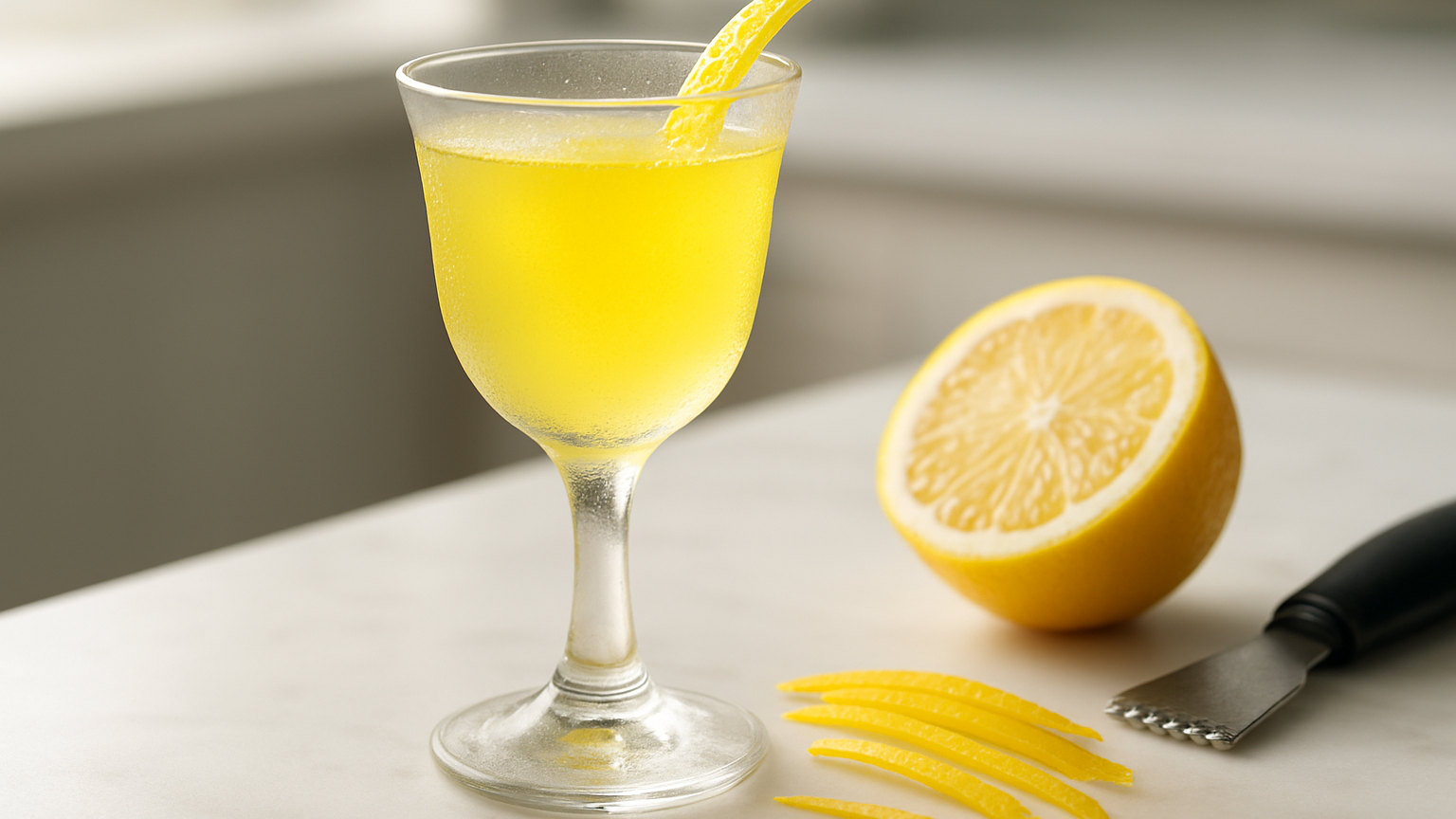
Limoncello is among the easiest liqueurs to make and among the easiest to get slightly wrong. Almost every failure comes from the same source, and it is avoidable with a vegetable peeler and a little patience.
What do you need?
- 10 unwaxed lemons.
- 1 litre of vodka or neutral spirit, ideally 40 per cent or higher.
- 600g caster sugar.
- 700ml water.
Unwaxed matters, since wax and any coating go straight into the infusion. If only waxed lemons are available, scrub them in warm water first.
Why only the zest?
Because all the aromatic oil sits in the coloured outer layer, and the white pith beneath contains bitter compounds that extract readily into alcohol.
Pith is the single commonest fault in homemade limoncello. It produces a harsh, bitter finish that no amount of sugar corrects.
Use a vegetable peeler and take thin strips. If you can see white on the underside, scrape it away with a knife before it goes in the jar.
How do you make it?
- Peel the lemons thinly, avoiding pith.
- Combine peel and spirit in a sterilised jar and seal.
- Keep somewhere dark at room temperature for two to four weeks, shaking every few days.
- The spirit will turn deep yellow and the peel will go pale and brittle.
- Make a syrup by heating the water and sugar until dissolved, then cool completely.
- Strain the spirit, discard the peel, combine with the cooled syrup.
- Rest a further week before drinking.
Why must the syrup be cold?
Because warm syrup added to a cold infusion drives off alcohol and can cause an unpleasant cooked note. It also increases the chance of a permanent haze.
How long should it steep?
Two weeks gives a good result and four gives more depth. Beyond about six weeks there is little further extraction and some risk of bitterness creeping in.
The peel going pale and papery is the visual signal that the oil has largely transferred.
How strong should it be?
Starting with a litre of 40 per cent vodka and adding 700ml of syrup gives roughly 23 per cent. Using a stronger base spirit gives a higher final strength and a fuller mouthfeel.
Traditional Italian recipes often use spirit at 95 per cent, which is not readily available in the UK. A 40 per cent vodka works perfectly well.
Why does it go cloudy?
Because lemon oils are soluble in strong alcohol and less so once water is added, so they come out of solution as a fine emulsion.
That louche is normal and expected, and it is more pronounced when chilled. It is not a fault and clear limoncello usually means very little oil got in.
How should you serve it?
Straight from the freezer in small glasses, around 40ml. It will not freeze solid at that strength and the cold thickens the texture.
At 23 per cent a 40ml measure is around 0.9 units. It also works over ice with soda, or as a modifier in a gin sour in place of some of the sugar.
How long does it keep?
A year or more, and it is best in the first six months while the lemon is bright. Keep it in the freezer once opened.
Can you use other citrus?
Readily, and the method is identical. Orange, grapefruit, lime and bergamot all work, and the sugar needs adjusting since each has a different balance.
Lime peel extracts fast and can turn bitter, so check it at ten days rather than three weeks.
What can you do with the peeled lemons?
Juice them and freeze the juice in ice cube trays, since ten lemons produce a useful quantity. The flesh itself is fine to use for anything a recipe calls for.
Does the vodka quality matter?
Mid range is right. Very cheap vodka has a harshness that lemon does not fully cover, and an expensive one is wasted under peel and sugar.
What matters more is strength. A 40 per cent vodka extracts better than a 37.5 per cent one, and the difference in the finished liqueur is noticeable.


