
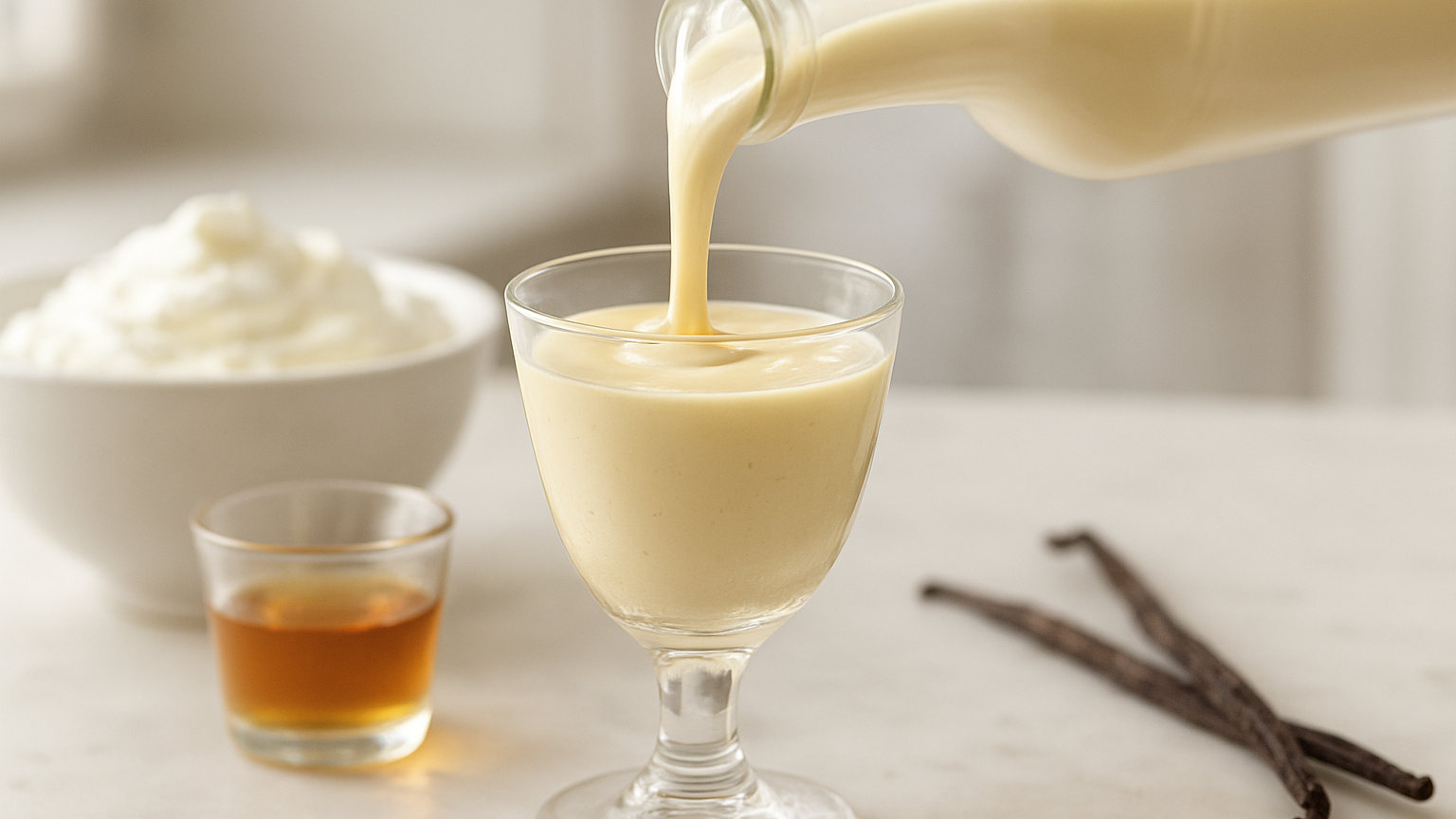
Cream liqueur is quick to make and tastes noticeably fresher than the bought version. It is also the only liqueur in this section that carries a real food safety consideration, because dairy behaves quite differently from fruit and sugar.
What do you need?
- 400g tin of sweetened condensed milk.
- 300ml double cream.
- 250ml Irish whiskey or a decent blended whisky.
- 2 teaspoons instant coffee dissolved in a little hot water, cooled.
- 1 tablespoon chocolate syrup, or cocoa dissolved in syrup.
- 1 teaspoon vanilla extract.
How do you make it?
- Combine everything in a blender.
- Blend on low for 20 to 30 seconds, no longer.
- Pour into a sterilised bottle.
- Refrigerate immediately.
Low speed and a short blend matter. Over-blending whips the cream and thickens the liqueur into something closer to a dessert.
Why must it be refrigerated?
Because it contains fresh dairy. Sugar and alcohol preserve fruit liqueurs effectively, and neither prevents dairy spoilage at room temperature.
The final strength is only around 12 to 14 per cent, which is well below what would inhibit bacterial growth. Commercial cream liqueurs are homogenised and heat treated in ways a home kitchen cannot replicate.
Keep it in the fridge from the moment it is made, and treat it as you would a carton of cream.
How long does it keep?
Two weeks refrigerated, and up to a month if the cream was very fresh and everything was scrupulously clean. Use the cream’s own date as a guide and do not exceed it by much.
Make small batches. It is quick enough that there is no advantage in making a large one.
What causes curdling?
Acid meeting dairy, usually. Adding citrus, or mixing the liqueur with anything acidic, will curdle it immediately.
Heat also does it, which is why hot coffee should be cooled before it goes in. Adding the spirit to warm cream rather than cold is another common cause.
Combine everything cold and blend gently and it will emulsify without trouble.
Why does it separate in the bottle?
Because a home blender cannot homogenise the way industrial equipment does, so the fat gradually rises. That is normal and not a sign of spoilage.
Shake well before pouring. Separation that does not recombine when shaken, or any sour smell, means it has gone and should be discarded.
Can you vary it?
Readily. Rum, bourbon or brandy all work in place of whiskey. Caramel, hazelnut, orange or mint can replace the coffee and chocolate.
Anything containing nuts should be flagged clearly if you are giving it away, since nut allergies are common and a bottle of homemade liqueur carries no label.
How strong is it?
Around 12 to 14 per cent with these proportions. A 50ml measure is roughly 0.65 units, which is low for something that drinks like a dessert.
Is it suitable as a gift?
Only with a clear label stating that it contains fresh dairy, must be refrigerated, and should be used within two weeks. Without that, it is easy for someone to leave it in a cupboard.
Can you freeze it?
Not successfully. Freezing breaks the emulsion, and it separates permanently on thawing into a grainy, unappealing texture.
Make small batches and use them within the fridge life instead.
Why not use ordinary milk?
Because the fat in double cream is what carries the flavour and gives the texture. Milk produces something thin that separates readily and spoils faster.
Condensed milk contributes sugar and stability together, which is why most recipes use both.
What can you use it in?
Over ice, in coffee, in a white russian, or poured over ice cream. It does not suit anything acidic, since citrus curdles it on contact.
How much does it cost to make?
Well under half the price of the bought equivalent, and the difference in freshness is obvious side by side.
Is it safe to make at home at all?
Yes, provided it goes straight into the fridge and is used within the fridge life. The risk is not in the making but in treating it like the other liqueurs on the shelf and leaving it in a cupboard for months.
Sterilised bottles, fresh cream and immediate refrigeration cover everything that matters.


