
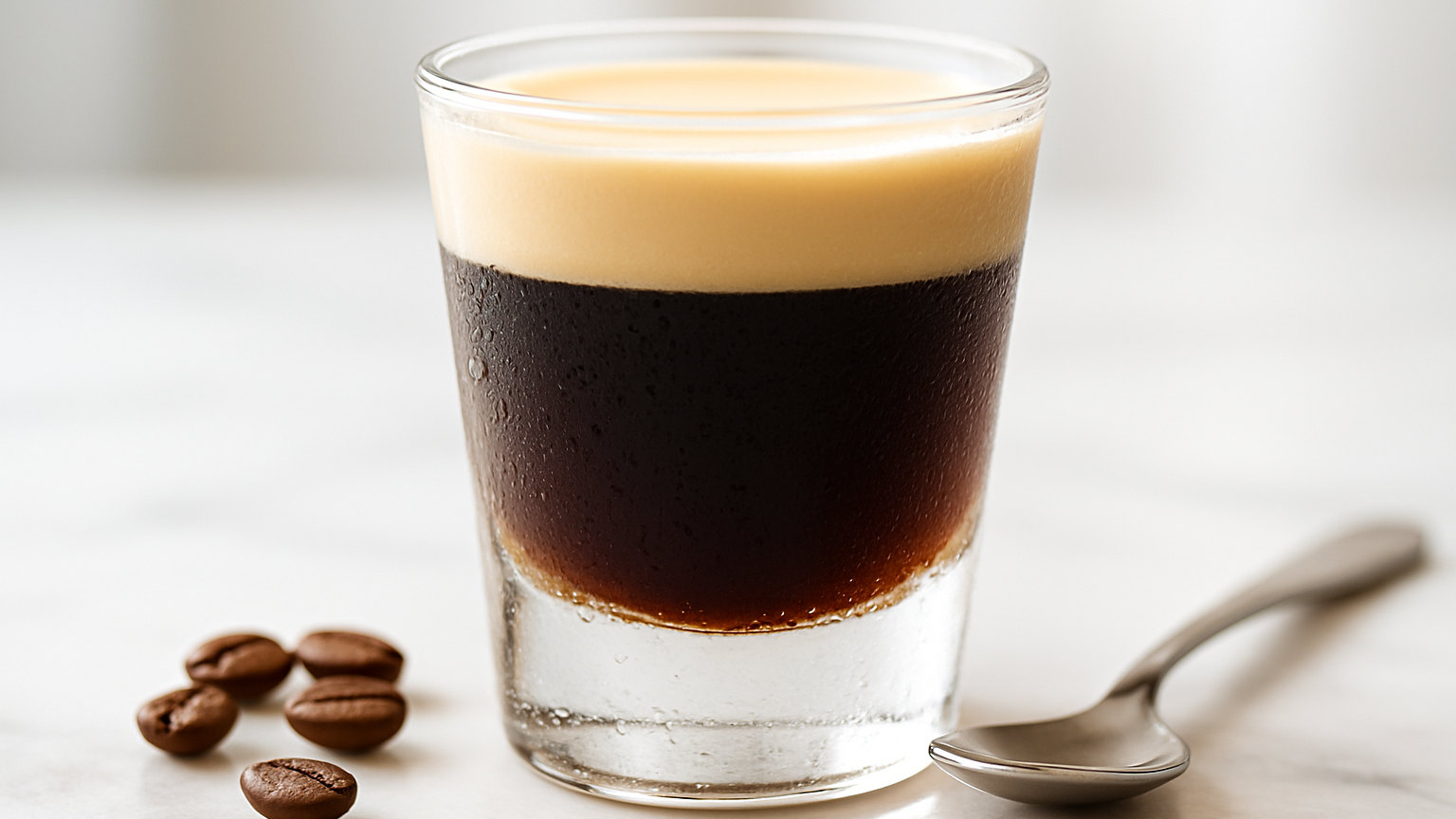
A baby guinness is coffee liqueur with Irish cream floated on top, in a shot glass. The result looks like a miniature pint of stout with a creamy head, which is the entire joke and the entire appeal.
What is the recipe?
- 35ml coffee liqueur
- 10ml Irish cream liqueur
Pour the coffee liqueur into a shot glass, filling it about three quarters. Float the Irish cream gently over the back of a bar spoon so it forms a pale head. Serve immediately.
Why does the cream float?
Because coffee liqueur is heavily sweetened and therefore denser, while Irish cream is lower in sugar and contains fat, which makes it lighter overall.
The difference is enough that a slow pour holds the layer cleanly for several minutes.
How do you float it?
Hold a bar spoon just above the surface, curved side up, and pour the cream slowly over the back of it. The spoon spreads the flow so the cream settles rather than plunging through.
Pouring down the inside wall works too. Speed is what breaks the layer, so go slowly.
How do you get a clean head?
Use a straight-sided shot glass, fill the coffee liqueur to a consistent level, and pour the cream in one continuous slow movement rather than in bursts.
Stopping and starting produces a ragged, streaky layer. A single steady pour gives the clean line the drink depends on.
How much cream?
Around 10ml, enough for a visible head and no more. Too much and the proportions look wrong, and the drink becomes creamy rather than coffee-led.
Roughly a quarter of the glass is right.
Does it contain any beer?
None at all. The name refers only to the appearance, and it has no connection to stout beyond looking like a small one.
How strong is it?
Around 0.8 units for a 45ml shot. Coffee liqueur is typically 20 per cent and Irish cream around 17, so it is weaker than a standard spirit measure despite being a shot.
Does the Irish cream keep?
Once opened, it should be refrigerated and used within about six months, since it contains dairy. Check the bottle, since manufacturers state their own guidance.
An Irish cream that has separated permanently or smells sour has gone and should be discarded.
What are the related shots?
- B52. Three layers, with orange liqueur on top.
- Slippery nipple. Sambuca with Irish cream floated.
- Springbok. Mint liqueur with cream.
- Brain haemorrhage. Peach schnapps with Irish cream, which curdles deliberately.
Can you batch it?
No. The layering happens per glass, and a pre-mixed version is a brown creamy shot rather than the drink.
For a round, line the shot glasses up, fill them all with coffee liqueur, then float the cream along the row.
Why is it so popular?
Because it looks like something and takes ten seconds. Very few shots have any visual interest at all, and this one is recognisable from across a room.
How do you serve a round of them?
Line the glasses up, fill them all with coffee liqueur first, then float the cream along the row in one continuous pass.
Doing them one at a time is slower and gives less consistent heads.
What ruins it?
Pouring the cream too fast, which sends it straight through, and using too much, which loses the proportions.
What proportion should you use?
Roughly three quarters coffee liqueur to one quarter cream. That gives the visual proportions of a pint with its head, which is the whole point of the drink.
Is it worth using a good coffee liqueur?
Moderately. It is most of the drink by volume, so a dry or homemade coffee liqueur gives a considerably better result than a heavily sweetened commercial one.
Since it is drunk in one, the difference matters less than it would in a sipping drink.
How cold should it be?
Both liqueurs from the fridge. Cold liquids are slightly denser and layer more cleanly, and the drink is more pleasant at temperature.


