
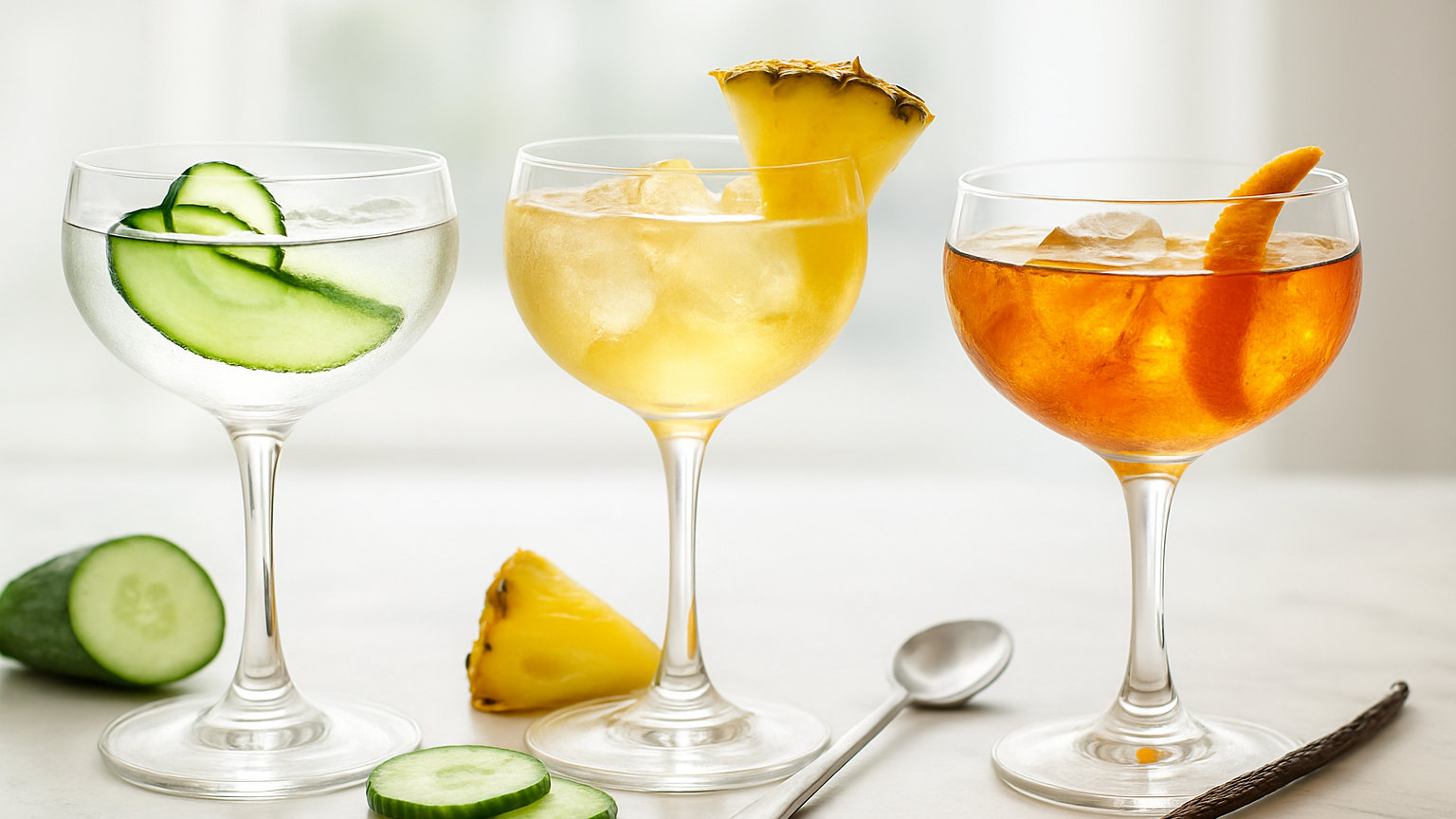
Most infusion recipes specify vodka without explaining why, and it is often the right choice. There are cases where a spirit with its own character produces a better result, and the decision is worth making deliberately.
When should you use vodka?
When the ingredient is the point and you want nothing competing with it. Fruit, tea, cucumber, floral material and anything delicate all suit a neutral base.
Vodka also gives the most predictable result, since you are tasting only what you added. That makes it the right choice when experimenting with something unfamiliar.
When should the base contribute?
- Gin. Botanicals work with rhubarb, citrus, herbs and floral material.
- White rum. Cane sweetness suits tropical fruit, coconut and vanilla.
- Aged rum. Depth for spice, coffee and dried fruit.
- Bourbon. Vanilla and oak suit coffee, cherry, bacon and warm spice.
- Tequila. Pepper and agave suit chilli, citrus and pineapple.
- Brandy. Fruit character suits stone fruit and nuts.
The test is whether the base and the ingredient share something. Bourbon and coffee both carry vanilla and roast, so they reinforce. Bourbon and cucumber do not.
Does strength matter?
For extraction, considerably. Higher alcohol dissolves more of the oil-soluble compounds and works faster, particularly on roots, barks and dried material.
It also gives headroom. Fresh fruit dilutes a spirit substantially, so starting at 50 per cent means finishing somewhere sensible rather than at 28.
For soft fruit and herbs, where the timings are short and the flavour is largely water soluble, a standard 40 per cent is perfectly adequate.
What is available at higher strength?
Overproof vodka and overproof rum at 55 to 60 per cent are the practical options in the UK. Both work well as bases and both need respecting on measures afterwards.
A 50ml pour of a 57 per cent infusion is 2.9 units, against 2 for the same measure at 40.
How much should you spend?
Mid range. Very cheap spirit has a harshness that infusing does not remove, and it shows through in the finished bottle.
Expensive spirit is wasted, since the whole point is to add a dominant flavour. An aged single malt infused with anything is money spent for no return.
Does gin work as a base?
Well, provided the botanicals point in the same direction as the ingredient. A juniper-forward London dry infused with rhubarb or grapefruit is excellent.
The same gin infused with coffee or bacon fights itself. Where the ingredient is savoury or roasted, a neutral base or a whisky is the better choice.
Can you infuse an already flavoured spirit?
Yes, and the results compound quickly. A spiced rum infused with chilli, or a flavoured vodka infused with fruit, gives a busy result that is hard to use in a drink.
One clear flavour on a clean base is almost always better than two competing ones.
What is the practical default?
A mid-priced vodka at 40 per cent for anything delicate, and an overproof vodka or the matching spirit for anything tough or savoury.
Does the base affect keeping quality?
Through its strength, yes. A higher-strength base leaves more headroom after fresh material dilutes it, which keeps the finished infusion above the point where alcohol stops preserving effectively.
Below about 20 per cent, treat an infusion as perishable and keep it in the fridge.
What if the infusion is going into one specific drink?
Match the base to that drink rather than to the ingredient. A chilli infusion destined for margaritas should be made in blanco tequila, not vodka, even though vodka would show the chilli more clearly.
Should you use the same base every time?
Consistency helps when comparing batches, since the base is one fewer variable. Once you know how an ingredient behaves in vodka, moving it to gin or rum becomes a deliberate change rather than a guess.
Does the base change the steeping time?
Modestly. A higher-strength spirit extracts faster, so an overproof base may reach the same point in two thirds of the time a 40 per cent one takes.
That is another argument for tasting rather than following a published schedule, since most recipes assume a standard bottling and do not say so.


