
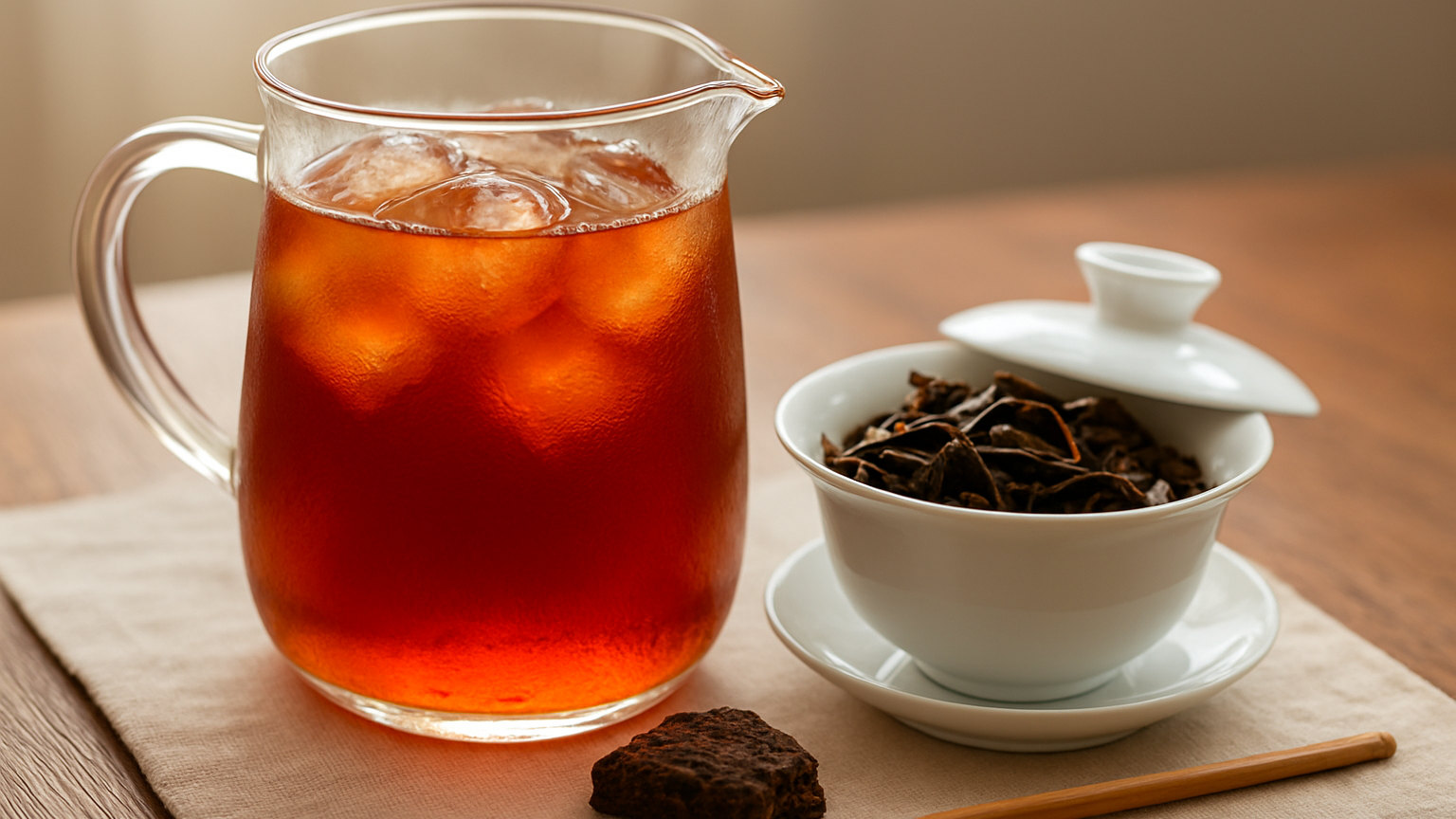
Pu-erh is unlike the rest of tea. It undergoes microbial fermentation rather than simple oxidation, it is often pressed into cakes, and it is one of very few teas that genuinely improves over decades.
What makes it different?
Microbial activity. Where black tea is oxidised by enzymes in the leaf, pu-erh is transformed by bacteria and fungi acting on the leaf over time.
That is fermentation in the proper sense, the same category of process as making cheese or sourdough, rather than the loose way the word is often applied to tea.
What are the two types?
- Raw, or sheng. Processed and pressed, then left to ferment naturally over years or decades. Young sheng is bitter and astringent; aged sheng is smooth, sweet and complex.
- Ripe, or shou. Fermentation accelerated by a controlled wet-piling process developed in the 1970s. Ready to drink immediately, earthy and mellow.
Ripe pu-erh was invented to replicate aged raw pu-erh without waiting thirty years. It is a different drink and considerably cheaper.
Which should you try first?
Ripe pu-erh, which is inexpensive, consistent and immediately approachable. Young raw pu-erh is challenging and aged raw pu-erh is expensive.
Why is it pressed into cakes?
Originally for transport, since compressed tea travelled better along trade routes. It turned out that compression also slows and evens the ageing process, so the practice persisted.
Cakes, bricks and nests are all common. Loose pu-erh exists and ages faster and less evenly.
How do you break up a cake?
With a pu-erh pick or a blunt knife, worked in along the layers rather than levered down from above. The aim is to separate whole leaves rather than shatter them.
Broken leaf extracts faster and more harshly, so a carefully separated portion brews better.
How should you brew it?
- Water at 95 to 100 degrees.
- Rinse the leaves first with a quick pour of hot water, discarded immediately.
- Around 5 grams per 150ml for gongfu style, or 3 grams per 200ml Western style.
- Short infusions of 20 to 30 seconds, repeated many times.
Why rinse it?
To wash off dust from storage and to wake the compressed leaves up. The first infusion after a rinse is noticeably better than an unrinsed one.
The rinse should be quick, a few seconds, and poured away.
What does it taste like?
Ripe pu-erh is earthy, woody and smooth, sometimes described as damp forest floor, which sounds unappealing and is not. Aged raw pu-erh is sweeter, with dried fruit, camphor and a long finish.
Young raw pu-erh is bitter, grassy and astringent, and it is generally bought to age rather than to drink.
How long does it keep?
Indefinitely, if stored properly. It needs some air circulation and stable humidity, which is the opposite of every other tea.
Keep it out of plastic, away from strong smells, and somewhere neither damp nor bone dry. Mould is the failure mode to watch for, and a cake that smells musty or sour rather than earthy should be discarded.
How much caffeine does it have?
Around 30 to 70mg per cup, comparable to black tea. Repeated short infusions spread it out rather than reducing it.
Is it worth the price?
Ripe pu-erh is inexpensive and genuinely good, which makes it excellent value. Aged raw pu-erh commands high prices and the market attracts speculation.
Start with an inexpensive ripe cake before spending anything significant.
What does the wrapper tell you?
Usually the year, the region, the producer and whether it is raw or ripe. Those four details are the main things worth checking before buying.
Raw is often labelled sheng and ripe is labelled shou or cooked, and the colour of the dry leaf gives it away: raw is greenish-brown, ripe is almost black.
Why do people age it?
Because raw pu-erh genuinely improves, softening from harsh and grassy into something sweet and complex over ten to thirty years. It is the only tea where that is reliably true.
That has created a collectors market, with older cakes trading at high prices and a corresponding problem with misrepresented age.


