Oolong sits between green and black tea, and the category is broad enough that two oolongs can have almost nothing in common. That range is what makes it interesting and what makes it hard to describe in one sentence.
What defines it?
Partial oxidation, anywhere from around 10 per cent to 80 per cent. Green tea is barely oxidised and black tea is fully oxidised; oolong occupies everything between.
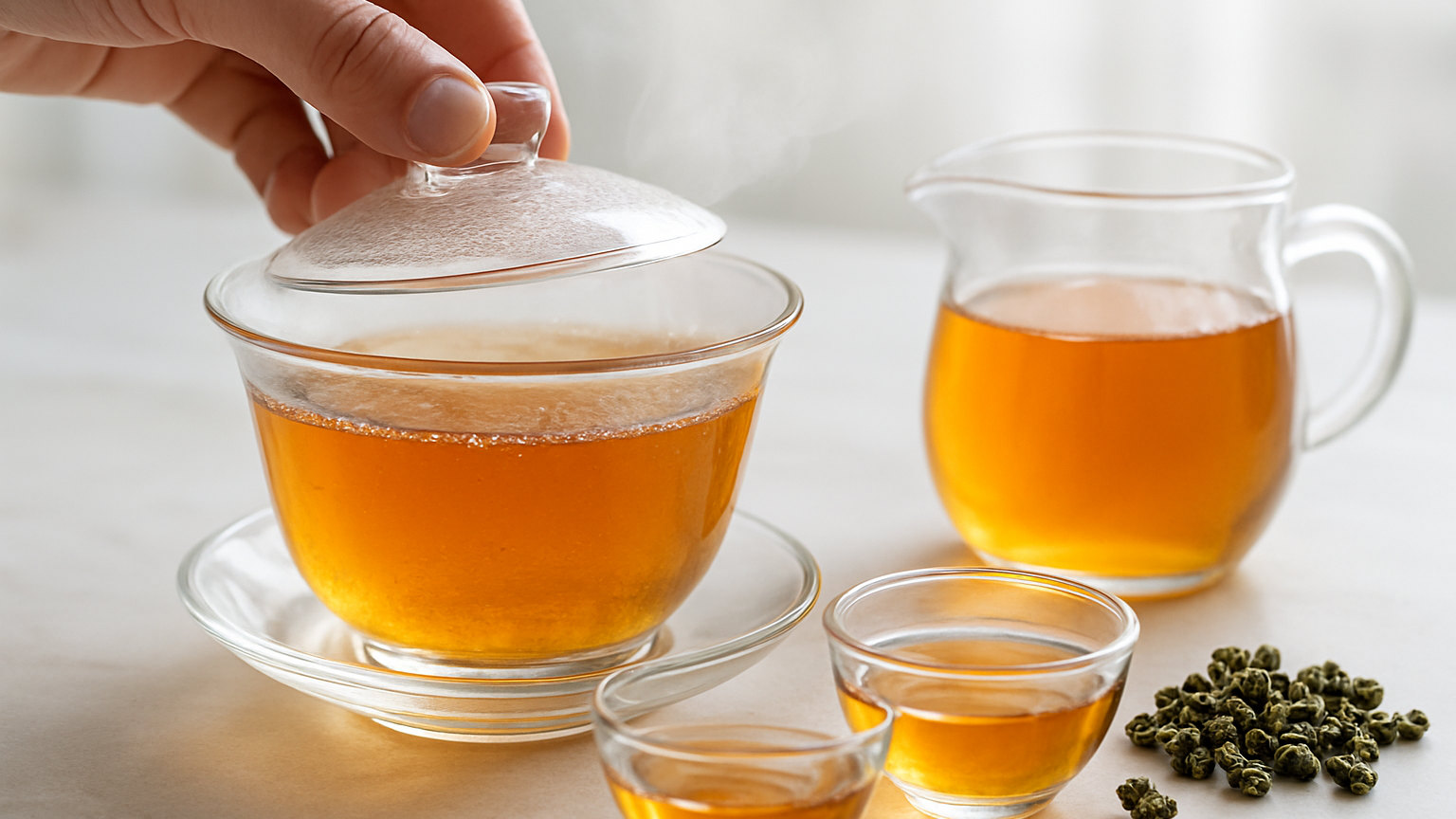
The leaves are also usually bruised at the edges and rolled, which controls how the oxidation develops and gives the characteristic tightly balled or twisted appearance.
What are the main styles?
- Light and floral. Around 10 to 30 per cent oxidised. Creamy, lilac, buttery. Often rolled into tight balls.
- Medium. Around 30 to 50 per cent. Stone fruit, honey, more body.
- Dark and roasted. Around 50 to 80 per cent, often roasted afterwards. Toasty, caramel, woody.
Taiwanese oolongs tend towards the lighter end and Chinese rock oolongs towards the darker and roasted. Both are worth trying.
Why do the leaves look like balls?
Because rolling protects the leaf and slows oxidation, and it also means the tea unfurls gradually across several infusions. A tightly rolled oolong looks like very little leaf and expands enormously.
How should you brew it?
- Water at 85 to 95 degrees, hotter for roasted styles.
- 3 grams per 200ml for Western brewing.
- 3 to 5 minutes for the first infusion.
- Or use the gongfu method for short repeated infusions.
What is gongfu brewing?
A method using a great deal of leaf in a small vessel with very short infusions. Around 5 grams in a 100ml pot, infused for 20 to 30 seconds and repeated many times.
Each infusion tastes different as the leaf opens. A good oolong will give six or eight distinct brews, which is the most interesting way to drink it and the least convenient.
Do you need special equipment?
A small teapot or a gaiwan helps and nothing is essential. A small cafetière, a strainer and a jug will do the same job.
How many times can you brew it?
Western style, two or three infusions. Gongfu style, six to ten with a good tea.
Extend each infusion slightly as the leaves tire, since the extraction slows once the easily soluble compounds have gone.
What does it taste like?
Light oolongs are floral and creamy, often described as orchid or lilac with a milky texture. Roasted oolongs are nutty, toasty and caramelised, closer to a light black tea.
The best have a long, sweet finish that persists well after swallowing, which is one of the clearest quality markers in tea.
Should you add milk?
No. Oolong is built on aromatic subtlety and milk covers it entirely. Anything worth calling oolong is better drunk without.
Milk oolong is a separate matter: it is a lightly oxidised tea with a naturally creamy character, and it contains no dairy whatsoever despite the name.
How much caffeine does it have?
Around 30 to 50mg per cup, between green and black tea. Repeated infusions extract most of it in the first two, so later brews are considerably lower.
Which should you try first?
A rolled Taiwanese high mountain oolong for the floral style, or a Chinese rock oolong for the roasted one. They are so different that trying both is the fastest way to understand the category.
How should you store it?
Airtight and dark, like most tea. Roasted oolongs keep considerably longer than light floral ones, which fade within a year.
Why is it less common in Britain?
Largely historical. The British tea trade was built on black tea from India and Sri Lanka, and oolong production stayed concentrated in China and Taiwan serving domestic markets.
It is far more widely available now, and it remains under-represented on supermarket shelves relative to how good it is.
What does it cost?
Anywhere from modest to very expensive. Everyday oolong is inexpensive and good; competition-grade high mountain teas command prices comparable to fine wine.
The mid range is where the value sits, and a moderately priced Taiwanese oolong gives most of what the category offers.