
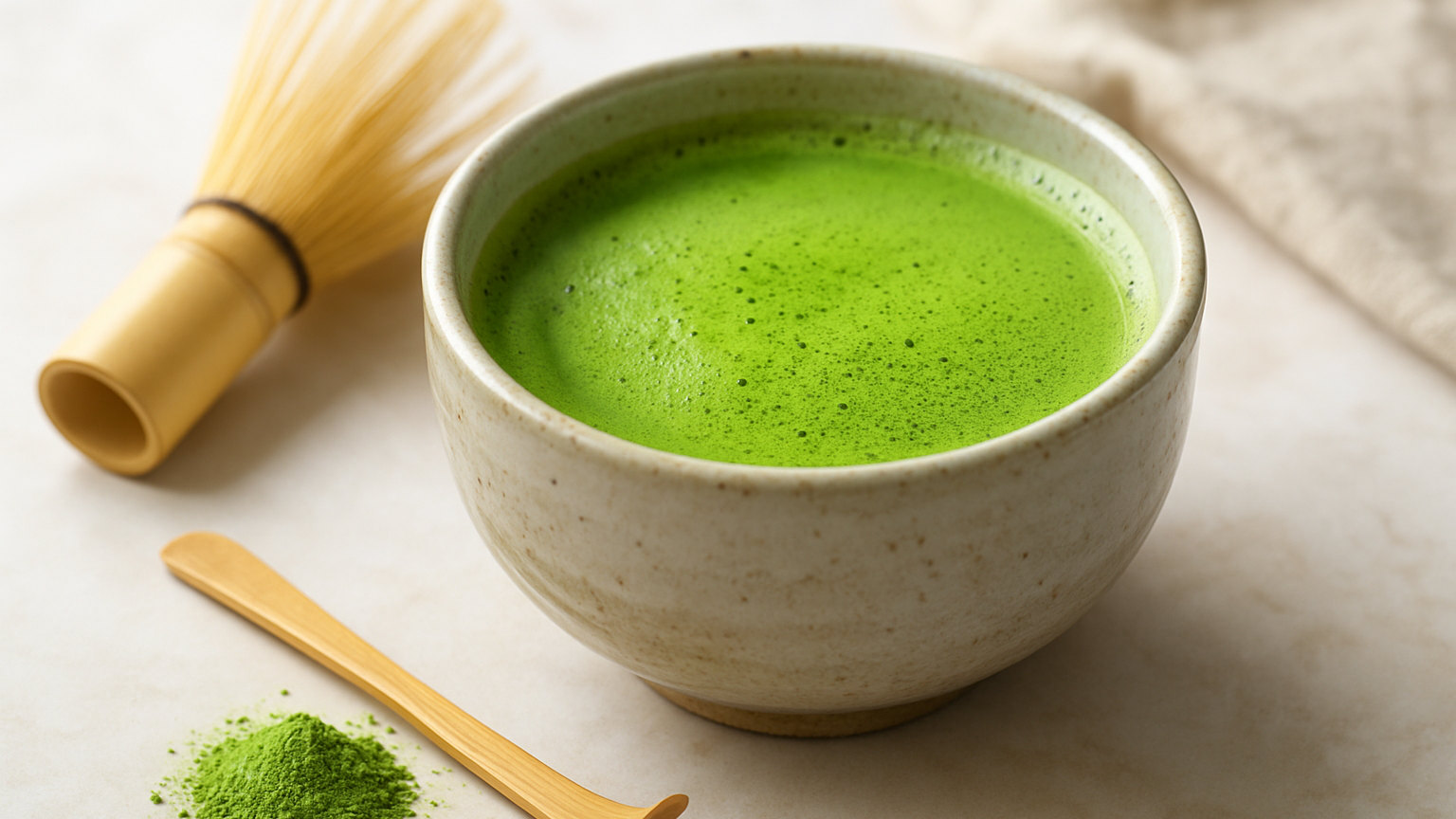
Matcha is not brewed tea. It is powdered leaf suspended in water, so you consume the entire leaf rather than an infusion of it. That single difference explains almost everything else about it.
How is it made?
The plants are shaded for three to four weeks before harvest, which increases chlorophyll and theanine and reduces bitterness. The leaves are steamed, dried, de-stemmed and de-veined, then stone ground into a very fine powder.
Stone grinding is slow, producing perhaps 40 grams an hour, which is a large part of why good matcha is expensive.
Why shade the plants?
Because reduced light increases theanine, the amino acid responsible for the savoury, sweet character, and limits its conversion into catechins, which are bitter.
That is why matcha tastes sweeter and more umami than ordinary green tea despite being far more concentrated.
What are the grades?
- Ceremonial. First harvest, youngest leaves, finest grind. For drinking with water alone.
- Premium or latte grade. Slightly later harvest. Good for lattes and cooking.
- Culinary. Later harvest, more bitter, cheaper. For baking and cooking.
The terms are not regulated, so they vary between suppliers. Colour is a reasonable guide: good matcha is vivid green, and dull or yellowish powder indicates older leaves or oxidation.
How do you prepare it?
- Sift 2 grams of matcha into a bowl to remove lumps.
- Add 70ml of water at 70 to 80 degrees.
- Whisk briskly in a W or M motion, not a circular one, for 15 to 20 seconds.
- Stop when a fine foam has formed across the surface.
Why sift it?
Because matcha clumps readily, and lumps will not whisk out. Sifting takes seconds and is the difference between a smooth drink and a gritty one.
Why the W motion?
Because circular whisking pushes the powder to the edges and creates large bubbles. A rapid back-and-forth motion suspends the powder evenly and produces the fine foam.
A bamboo whisk works best, since the many fine tines break up clumps. A small electric frother is a reasonable substitute; a metal whisk is not, since it cannot reach the fine particles.
Why not boiling water?
Because the whole leaf is present, so bitterness has nowhere to hide. Boiling water on matcha produces a harsh, astringent drink almost immediately.
Seventy to eighty degrees is right. Cooler still, around 70, suits higher grades.
How do you make a matcha latte?
Whisk 2 grams with 50ml of hot water first to make a smooth paste, then add 150 to 200ml of steamed or cold milk. Adding milk directly to the powder gives lumps.
Sweeten if wanted, and a latte-grade matcha suits this better than an expensive ceremonial one, whose subtlety disappears under milk.
How much caffeine is in it?
Around 60 to 70mg for 2 grams, comparable to a single espresso and considerably more than a cup of brewed green tea.
That is because you drink the leaf rather than an infusion. Anyone watching their intake should count matcha closer to coffee than to tea.
How should you store it?
Airtight, dark and refrigerated once opened, since matcha oxidises quickly and loses its colour and sweetness within weeks. Buy small tins and use them promptly.
Is it worth buying ceremonial grade?
For drinking with water alone, yes, since there is nowhere for bitterness to hide. For lattes and baking, a cheaper latte grade is the better choice, since milk and sugar cover the difference.
What equipment do you need?
A bamboo whisk, a small sieve and a wide bowl. A handheld electric frother substitutes for the whisk reasonably well and a jar with a lid, shaken hard, works in a pinch.
The sieve is the one thing worth not skipping, since lumps will not whisk out afterwards.
Why is good matcha expensive?
Shading, hand picking, de-stemming and stone grinding are all slow and labour intensive. A stone mill produces around 40 grams an hour, which sets a hard limit on output.
Cheap matcha is usually later-harvest leaf ground more quickly, which is why it tastes bitter and looks dull.


