
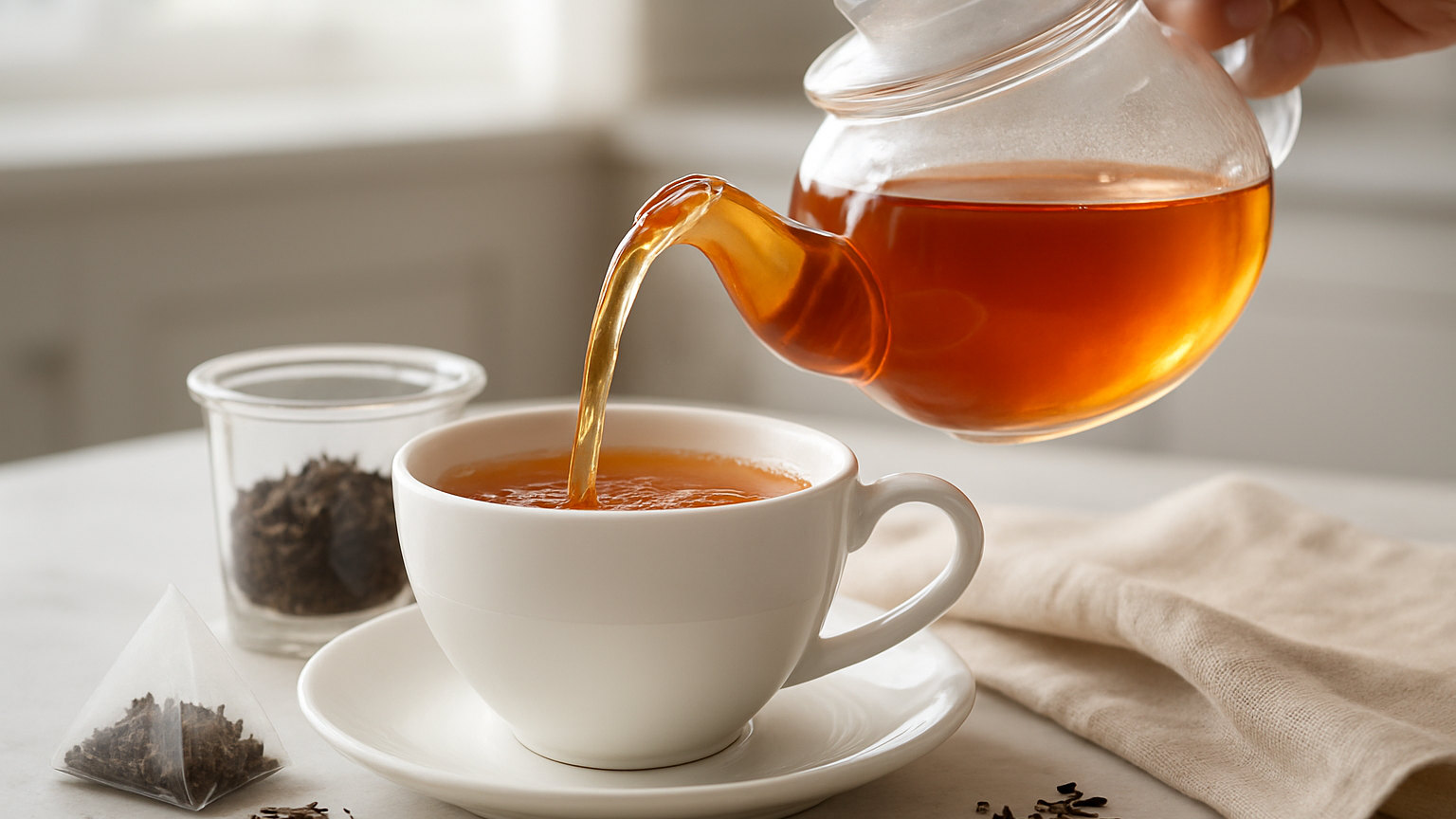
Loose leaf tea is generally better than bagged tea, and the reasons are mechanical rather than snobbery. Understanding them also explains why some bagged tea is perfectly good.
What goes into a tea bag?
Usually fannings or dust, the smallest grades left after larger leaves are sorted out. They are not waste, and they are broken small.
Small particles have a large surface area, so they extract very fast. That is why a tea bag produces a strong cup in two minutes, which is exactly what the format is designed for.
What is the drawback?
Fast extraction pulls out tannins as quickly as everything else, so bagged tea turns astringent sooner and has a narrower window before it becomes harsh.
Broken leaf also loses aromatic compounds much faster in storage, since more surface is exposed to air. A box of tea bags is noticeably flatter after a year.
Why does room to expand matter?
Because whole leaves need to unfurl to release their character properly. A leaf compressed in a small flat bag cannot open, so the water only reaches the outside.
That is the single biggest structural limitation of a traditional square bag, and it is why the same tea tastes better loose.
Do pyramid bags help?
Genuinely, yes. The extra volume lets larger leaves expand, and pyramid bags are usually filled with better grades because the format is aimed at a higher price point.
They are a reasonable middle ground and they cost considerably more per cup.
What are the leaf grades?
- Whole leaf. Best for flavour development and multiple infusions.
- Broken. Faster, stronger, less nuanced.
- Fannings. Small particles. Standard for tea bags.
- Dust. The finest grade. Very fast, very strong, used in cheap bags.
Grade describes size rather than quality. A well-made fannings tea beats a poorly grown whole leaf.
Is loose leaf cheaper?
Frequently, per cup. Loose leaf costs more per pack and uses 2 to 3 grams per cup, and good leaf can be brewed two or three times.
The gap narrows once convenience is valued, and premium pyramid bags are usually the most expensive option of the three.
What do you need to brew loose leaf?
Very little. A teapot with a built-in strainer, a basket infuser that sits in a mug, or simply a small sieve held over the cup as you pour.
Avoid tiny mesh balls, which have the same problem as a compressed bag: no room for the leaves to expand.
What about the bags themselves?
Many are sealed with a small amount of plastic, and some are made from a plastic mesh entirely. That is worth knowing for anyone composting used bags, since a paper bag with a plastic seal will not break down fully.
Several manufacturers have moved to fully compostable materials, and packaging usually states it.
When does each make sense?
Bags for speed, work and travel. Loose leaf when you have two minutes and care what it tastes like. Most households sensibly use both.
Can you put loose leaf in a bag?
Empty paper filter bags are widely sold and work well for travel. Fill them loosely rather than packing them, so the leaves still have room to expand.
Does it change how much you use?
Yes. A bag is portioned for you at around 2 grams; loose leaf needs weighing or a consistent spoon, usually 2 to 3 grams per cup.
Most people under-dose loose leaf at first and conclude it is weak, when the fix is simply more leaf.
Which gives better value?
Loose leaf, usually, once you account for re-brewing. A good oolong or green tea brewed three times costs considerably less per cup than a premium pyramid bag used once.
Cheap supermarket bags remain the cheapest option per cup, and they are also the least interesting.
What is the practical conclusion?
Neither format is inherently better. What matters is the size of the leaf and whether it has room to expand, and both of those can be good or poor in either format.
A whole-leaf pyramid bag beats a dusty loose leaf, and a good loose oolong beats almost anything in a bag.


