
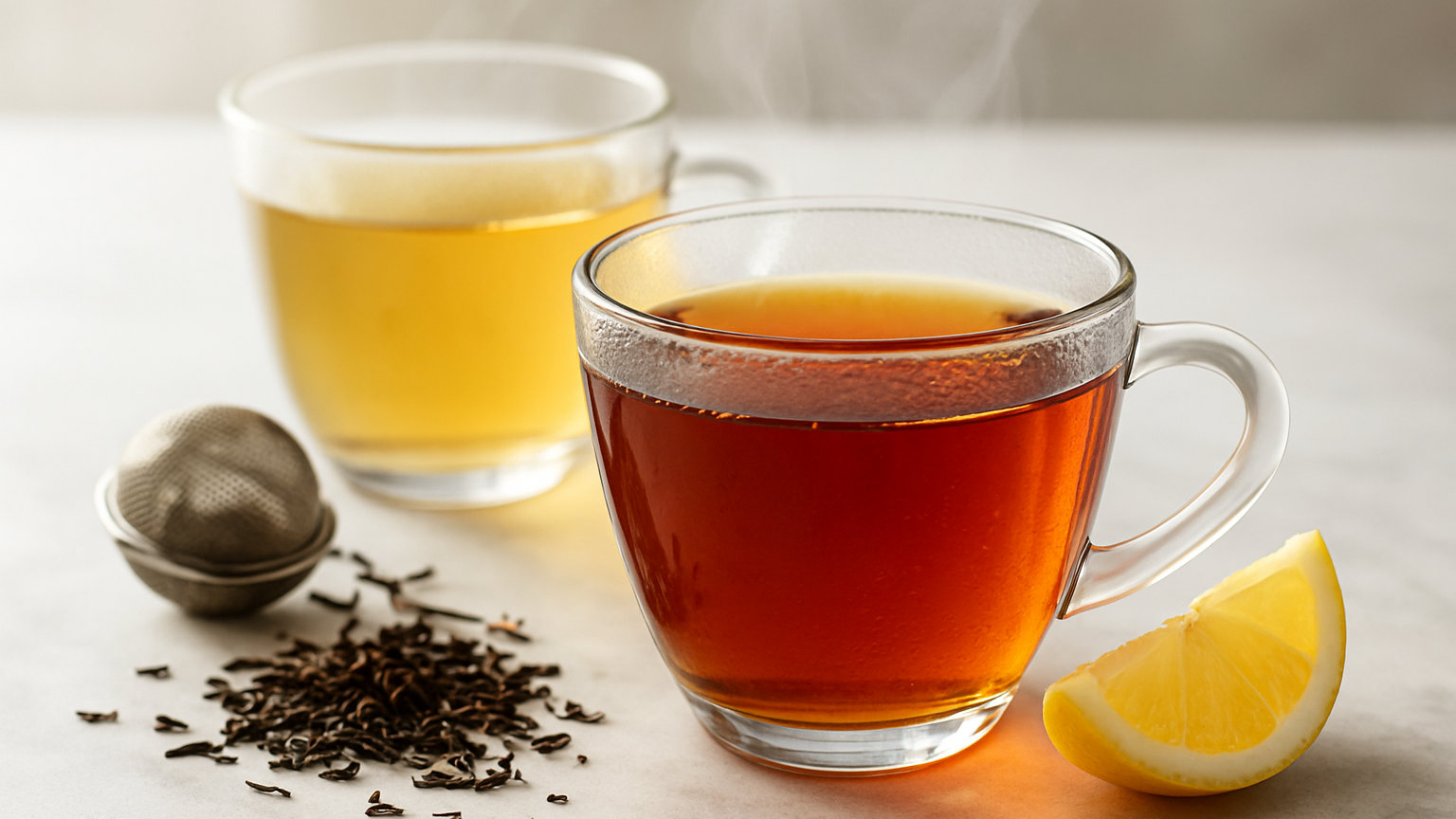
Tea caffeine is widely misreported, mostly because the figures depend more on how you brew than on which tea you choose. The commonly repeated ranking of types is far less reliable than it sounds.
How much is in each type?
- Black tea, 200ml. Around 40 to 70mg.
- Green tea, 200ml. Around 20 to 45mg.
- White tea, 200ml. Around 15 to 30mg.
- Oolong, 200ml. Around 30 to 50mg.
- Pu-erh, 200ml. Around 30 to 70mg.
- Matcha, 2 grams. Around 60 to 70mg.
- Herbal infusions. Zero.
For comparison, a mug of filter coffee is around 120 to 180mg, so even strong tea is roughly a third to a half of a coffee.
Why does brewing matter more than type?
Because caffeine extracts quickly and steadily with time and temperature. A green tea brewed for five minutes in hot water can contain more caffeine than a black tea brewed for two.
Leaf quantity matters too. Doubling the leaf roughly doubles the caffeine, regardless of which tea it is.
Does the leaf itself vary?
Considerably. Young buds contain more caffeine than mature leaves, which is why silver needle white tea can exceed some black teas despite the reputation of the category.
Why does matcha have so much?
Because you consume the whole leaf rather than an infusion of it. Two grams of matcha contains all the caffeine in two grams of leaf, where a brewed cup extracts only part of it.
Anyone counting intake should treat matcha closer to coffee than to tea.
What is theanine?
An amino acid found in tea and almost nowhere else in the diet. It is associated with a calm, focused state and appears to modify how caffeine is experienced.
That is the likely explanation for why tea feels smoother and less jittery than coffee at comparable caffeine levels. Shaded teas such as gyokuro and matcha are highest in it.
Can you remove caffeine by rinsing?
A persistent claim and largely false. A 30-second rinse removes only a small proportion, perhaps 10 per cent, and takes flavour with it.
Caffeine extracts fast but not that fast. Anyone genuinely avoiding it should choose decaffeinated tea or a herbal infusion.
How much does decaf contain?
Around 2 to 5mg per cup, not zero. Decaffeination removes roughly 97 per cent.
What are the daily limits?
European guidance suggests up to 400mg a day is not a safety concern for most healthy adults, which is a great deal of tea.
UK guidance for pregnancy is a maximum of 200mg a day from all sources, including tea, coffee, cola and chocolate. That is roughly three to four cups of black tea, and anyone pregnant should discuss their own intake with a midwife or GP.
Does tea affect iron absorption?
Yes. Tannins in tea bind non-haem iron, the form found in plant foods, and reduce how much is absorbed.
Anyone managing low iron is generally advised to drink tea between meals rather than with them. This is worth raising with a GP rather than self-managing.
How long does it stay in the system?
The half-life is around five to six hours in most adults, so a cup at 5pm leaves a meaningful quantity at bedtime. That varies considerably between individuals.
Anyone sleeping poorly is often surprised how much an afternoon cut-off helps, and herbal infusions cover the evening without any.
Who should take particular care?
Anyone with anxiety, sleep difficulties, heart rhythm problems or acid reflux, and anyone taking medication that interacts with caffeine.
Sensitivity varies genuinely between people, so a quantity that suits one person can be too much for another. Anyone unsure should raise it with a GP or pharmacist rather than working from general figures.
Does adding milk change it?
Not the caffeine content. Milk binds tannins and softens astringency, and it has no effect on how much caffeine is in the cup or how quickly it is absorbed.
Does it accumulate across the day?
Substantially, and it is easy to lose track when counting only coffee. Five cups of black tea comes to around 250mg, which is most of a pregnancy limit and well over half the general guidance on its own.


