
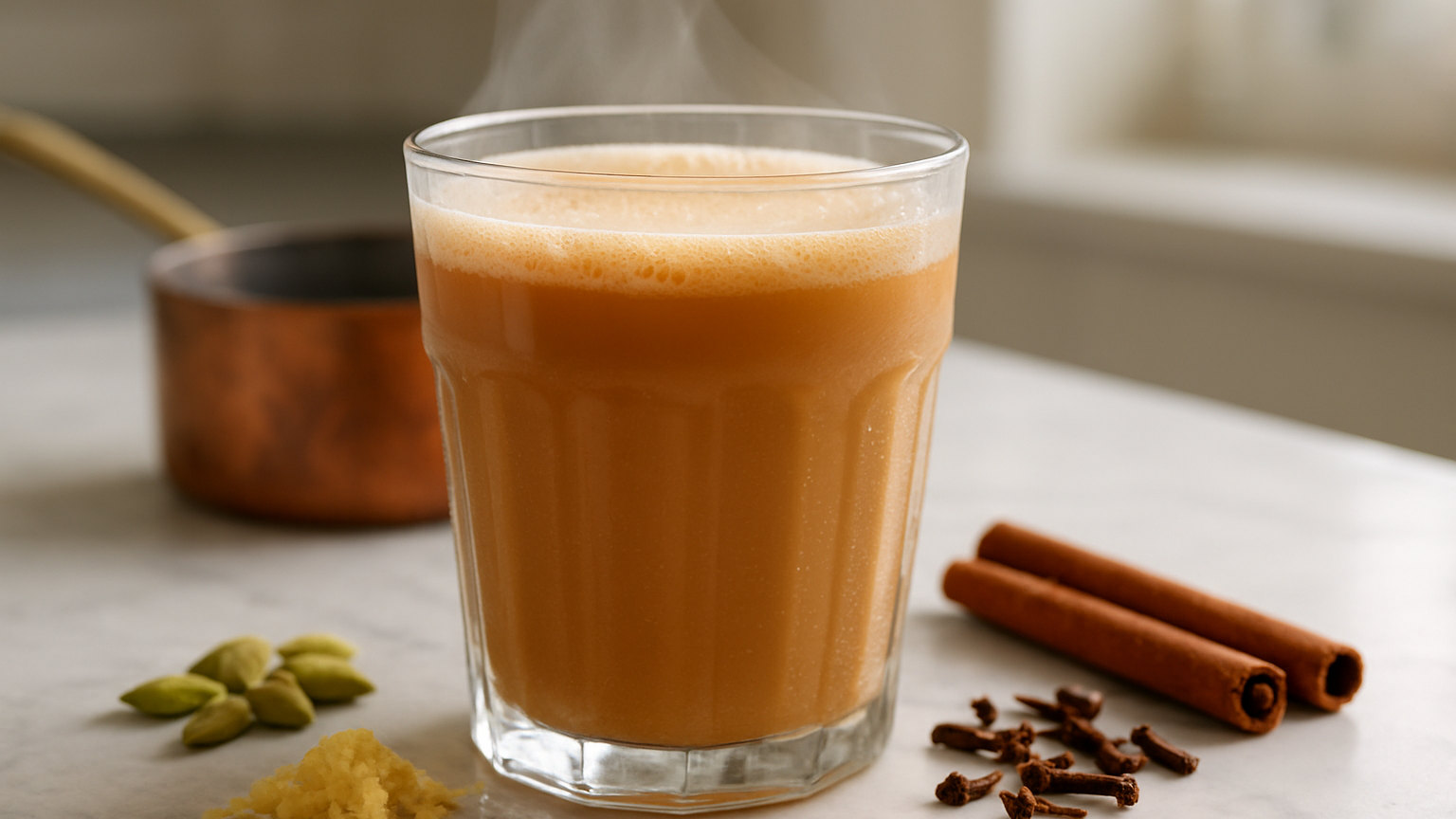
Chai simply means tea. What most people mean by it is masala chai, spiced tea simmered with milk, and the simmering is what separates it from a tea bag dropped into warm milk.
What is the recipe?
For two cups:
- 250ml water.
- 250ml whole milk.
- 2 teaspoons strong black tea, such as Assam.
- 4 green cardamom pods, crushed.
- 2cm fresh ginger, sliced.
- 1 small cinnamon stick.
- 2 cloves.
- 2 black peppercorns.
- Sugar to taste, usually 2 teaspoons.
What is the method?
- Crush the whole spices lightly in a mortar.
- Bring the water to the boil with the spices and simmer 3 to 5 minutes.
- Add the tea and simmer 2 minutes more.
- Add the milk and sugar and bring back to a simmer.
- Simmer 2 to 3 minutes, watching it does not boil over.
- Strain into cups.
Why simmer rather than steep?
Because whole spices need heat and time to release their oils, and milk extracts fat-soluble compounds that water alone cannot.
Steeping tea and spices in hot water and adding milk afterwards gives a thin, separate-tasting drink. Simmering everything together is what integrates it.
Does the tea get bitter?
It would if simmered for long. Adding the tea after the spices, and keeping the total tea time to four or five minutes, avoids it.
A strong Assam is used precisely because it stands up to milk and sugar. A delicate tea would disappear entirely.
Which spices are essential?
Cardamom and ginger are the backbone and appear in almost every version. Cinnamon, clove and black pepper are common. Star anise, fennel and nutmeg appear regionally.
Use whole spices rather than ground. Ground spice makes the chai muddy and gritty, and it cannot be strained out.
What is the right milk ratio?
Half milk and half water is standard. More milk gives a richer, sweeter drink; more water gives a stronger, more tea-forward one.
Whole milk works best, since fat carries the spice flavours. Plant milks work and oat is the most reliable, since it will not split when simmered with tea.
Should it be sweet?
Traditionally yes, and the sweetness balances the tannin and the spice. Jaggery or brown sugar suit it better than white.
Reducing the sugar is entirely reasonable and it will taste sharper, so consider reducing the tea slightly too.
What about chai concentrate?
Make a strong batch without milk, using double the tea and spices, and keep it in the fridge for up to five days. Heat with an equal quantity of milk to serve.
That makes weekday chai a two-minute job rather than a fifteen-minute one.
How much caffeine is in it?
Around 40 to 70mg per cup, since it uses a strong black tea. The long simmer extracts more than a normal brew, so it sits at the higher end.
Can you use a tea bag?
Yes, and use two strong ones per two cups and open them if you want faster extraction. Loose Assam gives a better result and the difference is smaller than with plain tea, since spice and milk cover a good deal.
What is chai latte?
Usually a syrup or powder mixed with steamed milk, which is a quite different drink. It is sweeter, thinner and rarely simmered, and it is worth knowing they are not the same thing when ordering.
Why is it simmered with milk rather than water alone?
Because many of the aromatic compounds in cardamom, cinnamon and clove are fat soluble, so milk extracts what water cannot. That is the same principle behind blooming spices in oil when cooking.
It is also why chai made with skimmed milk tastes noticeably thinner than the same recipe made with whole.
How do you stop it boiling over?
Use a pan considerably larger than the volume suggests, and keep it at a bare simmer once the milk goes in. Milk foams up suddenly and without much warning.
Stirring occasionally and lifting the pan off the heat for a moment when it rises both work.


