
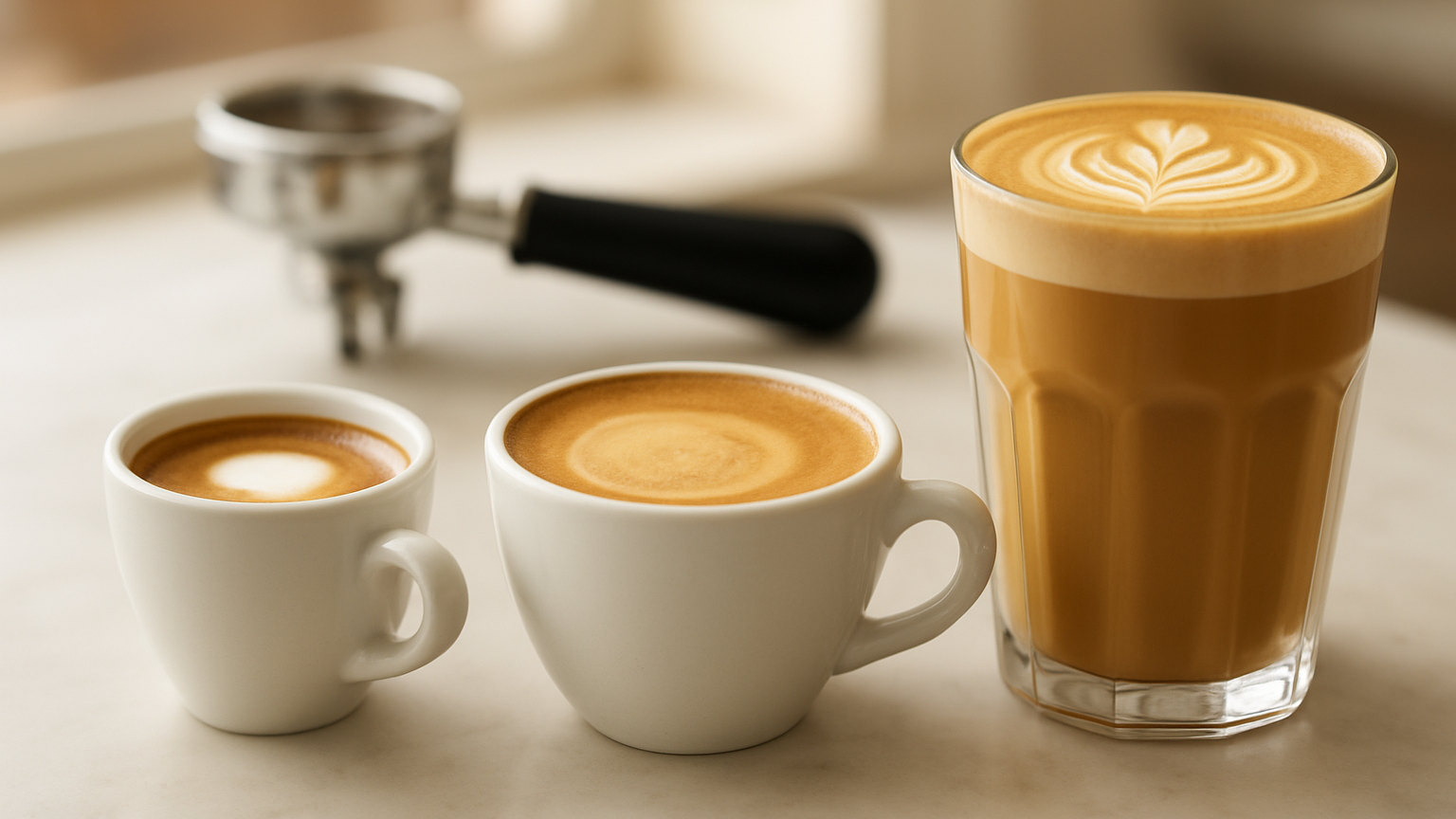
Every drink on a coffee shop menu is espresso plus milk in different proportions and textures. Once you know the ratios, the names become straightforward, even though they vary between countries and shops.
What is espresso?
Coffee brewed by forcing hot water through finely ground coffee under pressure, usually around 9 bar. A double shot is roughly 18 grams of coffee producing 36 grams of liquid in 25 to 30 seconds.
It is a method rather than a roast, so any bean can be used for it. The concentration is what makes it the base for milk drinks.
What are the main drinks?
- Espresso. Just the shot, 30 to 40ml.
- Macchiato. Espresso marked with a small spoon of foam.
- Cortado. Equal parts espresso and warm milk, around 60ml each.
- Flat white. Double espresso with around 130ml of steamed milk, thin foam.
- Cappuccino. Equal thirds espresso, steamed milk and foam, around 150 to 180ml.
- Latte. Double espresso with 200 to 300ml steamed milk, a thin layer of foam.
- Americano. Espresso topped with hot water.
- Mocha. Latte with chocolate.
What is the real difference between a flat white and a latte?
Milk quantity and texture. A flat white uses less milk and a thinner, more velvety microfoam, so the coffee is more prominent. A latte uses more milk and is softer and milder.
The distinction is genuine and it is applied inconsistently. Many shops serve a flat white that is simply a small latte.
What is microfoam?
Milk textured with very fine bubbles, giving a glossy, paint-like consistency rather than stiff foam. It is what allows latte art and it changes the mouthfeel substantially.
What does macchiato mean?
Marked or stained. Traditionally an espresso with a small spot of milk foam, served in a small cup.
The word has been borrowed for large sweetened milk drinks that bear no relation to the original, which causes regular confusion when ordering.
What about ristretto and lungo?
Ristretto is a shorter shot, the same coffee with less water, giving a more concentrated and often sweeter result. Lungo is a longer shot with more water, which extracts further and tends to be more bitter.
Is an americano the same as filter coffee?
No. An americano is espresso diluted with water, so it keeps the character of espresso extraction. Filter coffee is brewed differently and tastes cleaner and lighter.
Adding the water first and the espresso after preserves more of the crema, which some prefer.
Do the names matter?
Only for ordering. What determines the drink is the ratio of espresso to milk and how the milk was textured, and knowing that lets you ask for what you actually want.
How much caffeine is in each?
Whatever the espresso contains, since the milk adds none. A drink made with a single shot is around 60 to 80mg and a double is 120 to 160, regardless of the size of the cup.
A large latte is therefore not necessarily stronger in caffeine than a small flat white, which depends entirely on the number of shots.
Which should you order if you want to taste the coffee?
A cortado or a flat white, where the milk supports rather than buries the espresso. A latte is milk-led by design, which is the point of it rather than a fault.
An americano or a filter coffee shows the beans most clearly of all.
Why do the names vary between shops?
Because most of them have no legal or industry definition. Cup sizes differ, shot counts differ, and the same word can mean noticeably different drinks in two shops on the same street.
Asking for a specific number of shots and a specific amount of milk gets you what you want more reliably than any name.
Can you make these at home without a machine?
Approximately. A moka pot or a concentrated aeropress gives a strong enough base, and milk can be textured with a French press or a handheld frother.
The result is not espresso and it is a genuinely good milk coffee, which is what most people actually want.


