
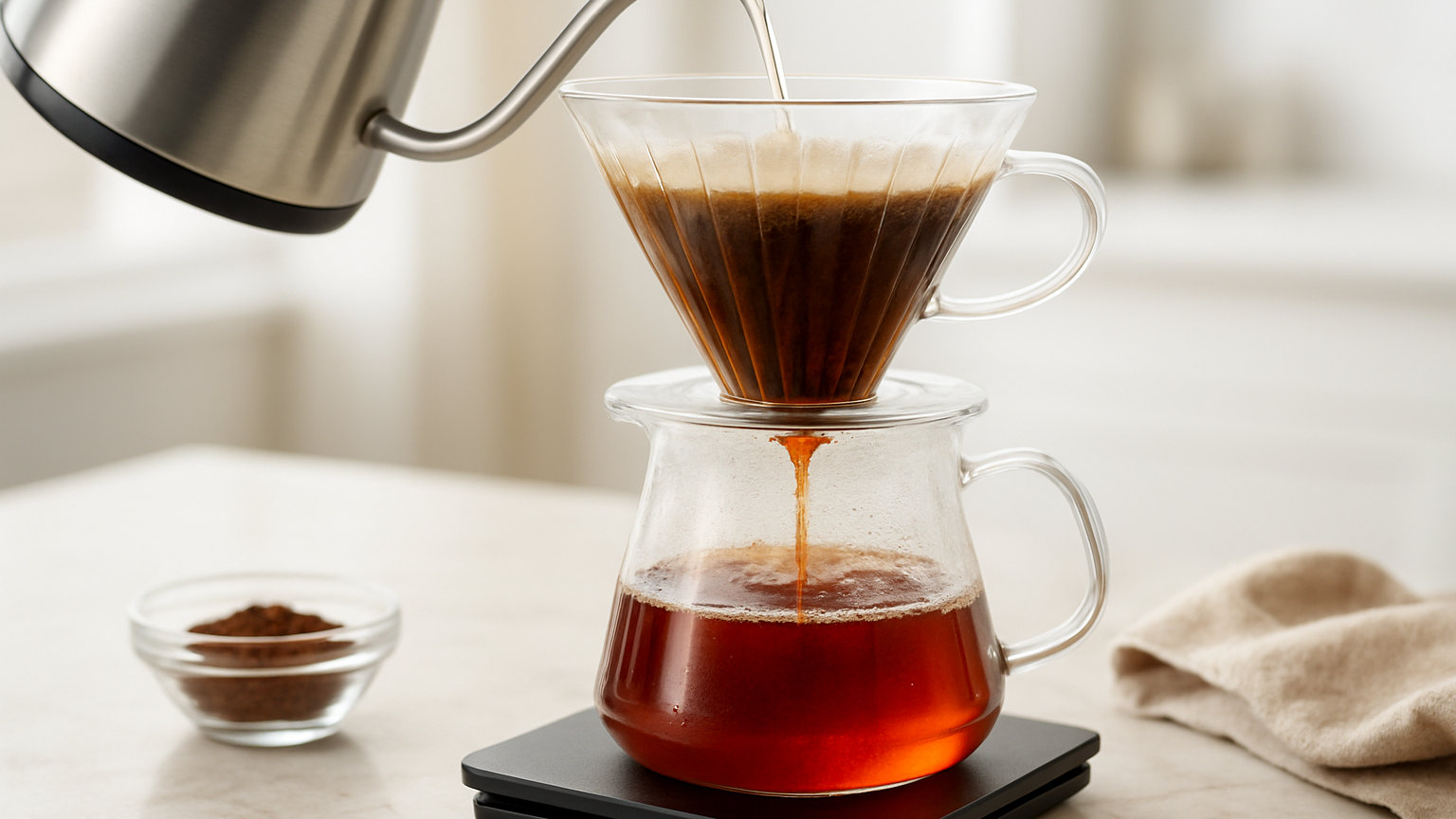
Almost every complaint about home coffee, that it is weak, bitter or inconsistent, comes back to the same thing. The ratio of coffee to water is the single most important variable and the one most people never measure.
What is the standard ratio?
Around 60 grams of coffee per litre of water, which works out at roughly 1 to 16 by weight.
For a single mug of 250ml, that is about 15 grams of coffee. For a cafetière holding 1 litre, around 60 grams.
Why weigh rather than scoop?
Because coffee varies enormously in density. A scoop of finely ground dark roast weighs considerably more than the same scoop of coarse light roast, so the same measure gives quite different strengths.
A cheap kitchen scale is the most effective coffee purchase most people can make. It costs less than a bag of beans and it removes the largest source of inconsistency.
Should you weigh the water too?
It is easier than measuring volume, since 1 gram of water is 1 millilitre. Putting the whole brewer on the scale and pouring to a target weight takes no extra effort.
How does the ratio vary by method?
- Cafetière. 1 to 15 or 1 to 16.
- Pour over and filter. 1 to 16 or 1 to 17.
- Aeropress. 1 to 12 to 1 to 15, depending on style.
- Moka pot. Roughly 1 to 10, filling the basket level.
- Espresso. 1 to 2, so 18 grams in for 36 grams out.
- Cold brew. 1 to 8 for concentrate, 1 to 15 for ready to drink.
Espresso is a different process rather than a stronger version of the same one, which is why its ratio looks so different.
What does adjusting the ratio do?
Changes strength, meaning how much dissolved coffee is in the cup. More coffee to the same water gives a stronger brew; less gives a weaker one.
It does not directly change bitterness or sourness, which are governed by extraction. That distinction matters and it is covered separately.
What if it tastes bad?
Diagnose before adjusting. If the coffee is strong but harsh and bitter, the problem is over-extraction, so grind coarser or brew shorter.
If it is sharp, sour and thin, the problem is under-extraction, so grind finer or brew longer.
If it simply tastes weak or watery without being sour, the ratio is wrong and more coffee is the answer.
Does the ratio depend on the beans?
Slightly. Lighter roasts are denser and can take a little more coffee; darker roasts extract faster and often suit slightly less.
Start at 1 to 16, adjust in small steps, and change one thing at a time. Changing ratio and grind together makes it impossible to tell what helped.
What is the practical starting point?
Fifteen grams of coffee to 250 grams of water for a mug, and scale from there. Write down what you did, since the whole point is being able to repeat a cup you enjoyed.
Does the ratio change for milk drinks?
Not the brewing ratio, and the perception does. Milk dilutes and softens coffee, so a brew that tastes balanced black can seem weak once milk is added.
The usual answer is a stronger brew rather than more coffee in the cup: a 1 to 14 ratio for filter coffee destined for milk works better than 1 to 16.
How do you scale it up?
Multiply, and keep the proportions. Sixty grams of coffee to a litre works whether you are making one mug or four, and weighing removes the arithmetic errors that scooping introduces.
What about instant coffee?
The same logic applies and the numbers are different. Around 2 grams per 200ml is standard, and most people use considerably more than the jar suggests.
Weighing is unnecessary here, and a level teaspoon rather than a heaped one is closer to what the manufacturer intended.
Why is it worth bothering?
Because it makes a cup repeatable. Without measuring, a good coffee is an accident you cannot reproduce and a bad one is a mystery you cannot diagnose.
Thirty seconds with a scale turns coffee from guesswork into something you can adjust deliberately, which is the whole reason the ratio matters.


