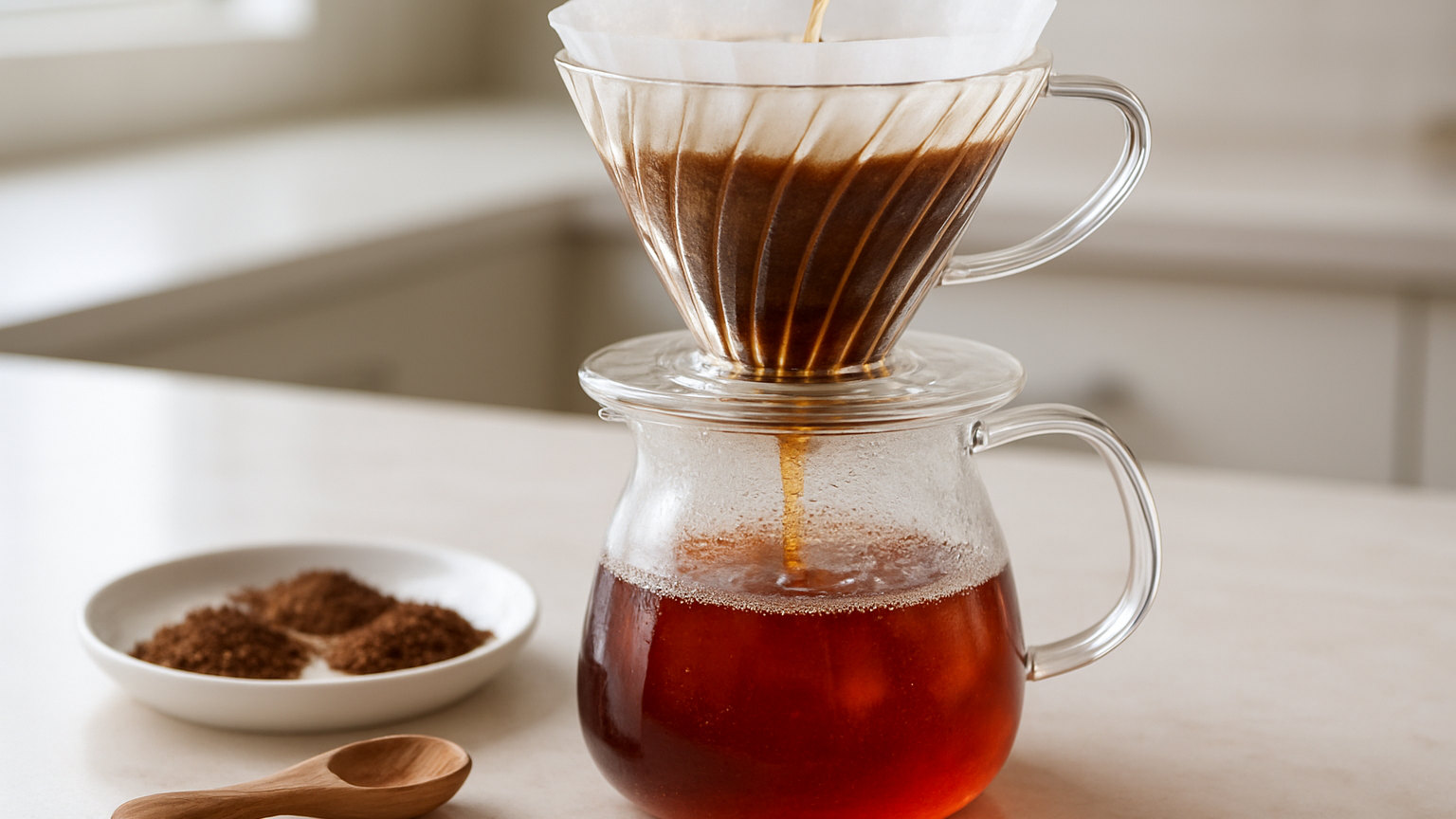
Grind size is the variable most people never touch and the one that fixes most problems. It controls how quickly water can dissolve compounds out of the coffee, which decides whether a cup tastes sour, balanced or bitter.
How does it work?
Finer grinding creates more surface area, so water extracts faster. Coarser grinding creates less, so extraction is slower.
Every brewing method has a contact time, and the grind has to match it. Long contact needs coarse; short contact needs fine.
What grind suits each method?
- Cold brew. Very coarse, like rough sea salt. 12 to 18 hours.
- Cafetière. Coarse, like sea salt. 4 minutes.
- Filter and pour over. Medium, like sand. 3 to 4 minutes.
- Aeropress. Medium to fine, depending on recipe. 1 to 2 minutes.
- Moka pot. Fine, finer than filter. Around 5 minutes.
- Espresso. Very fine, like flour. 25 to 30 seconds.
What is over-extraction?
Too much dissolved out of the coffee, producing bitterness, harshness and a drying, hollow finish.
Causes: grind too fine, contact time too long, water too hot. The fix is to grind coarser or shorten the brew.
What is under-extraction?
Too little dissolved out, producing sourness, thinness and a sharp, salty edge. It often reads as weak even when the ratio is correct.
Causes: grind too coarse, contact too short, water too cool. The fix is to grind finer or extend the brew.
How do you tell them apart?
Bitter and drying means over. Sour and thin means under. Weak but not sour usually means the ratio needs more coffee rather than a grind change.
Why does consistency matter?
Because uneven grounds extract unevenly. Fine particles over-extract while coarse ones under-extract, so the same cup contains both faults at once.
That produces coffee that is simultaneously bitter and sour, which is the signature of a poor grinder rather than a poor recipe.
What about blade grinders?
They chop rather than grind, producing a wide range of particle sizes including a lot of dust. That is why they are limited.
A hand burr grinder costs modestly and produces far more consistent grounds. For anyone brewing at home regularly, it improves the cup more than a better brewer would.
Does pre-ground coffee work?
Yes, and it is a compromise on two fronts. It is ground to a general-purpose medium that suits filter reasonably and nothing else exactly.
It also loses aroma quickly, since grinding exposes an enormous surface area to air. A bag of pre-ground coffee is noticeably duller after a fortnight.
How should you adjust?
One variable at a time, in small steps. Change the grind, brew again, taste, and note what happened.
Changing grind and ratio together is the fastest way to learn nothing.
Does the same grind work across a bag?
Roughly, and it may need adjusting as the beans age. Coffee becomes easier to extract as it degasses over the first week or two, so a grind that worked on day three can over-extract by day fourteen.
Going one step coarser as a bag ages is a small adjustment that keeps the cup consistent.
Can you grind for espresso at home?
Only with a grinder capable of very fine, very consistent output, which is a considerably higher requirement than filter. Most inexpensive grinders cannot manage it.
That is the practical reason espresso is the expensive method rather than the machine itself.
What should you change first?
Grind, before anything else. It has the largest effect on how the coffee tastes and it is the variable most people leave alone while adjusting everything around it.
Two clicks coarser or finer, brewed and tasted, teaches more than any amount of reading.
Does it interact with the ratio?
Yes, and it helps to hold one steady. Fix the ratio at 1 to 16, adjust the grind until the taste is balanced, and only then change the ratio if the coffee is too strong or too weak overall.
Adjusting both at once is why so many people never find a recipe they can repeat.