
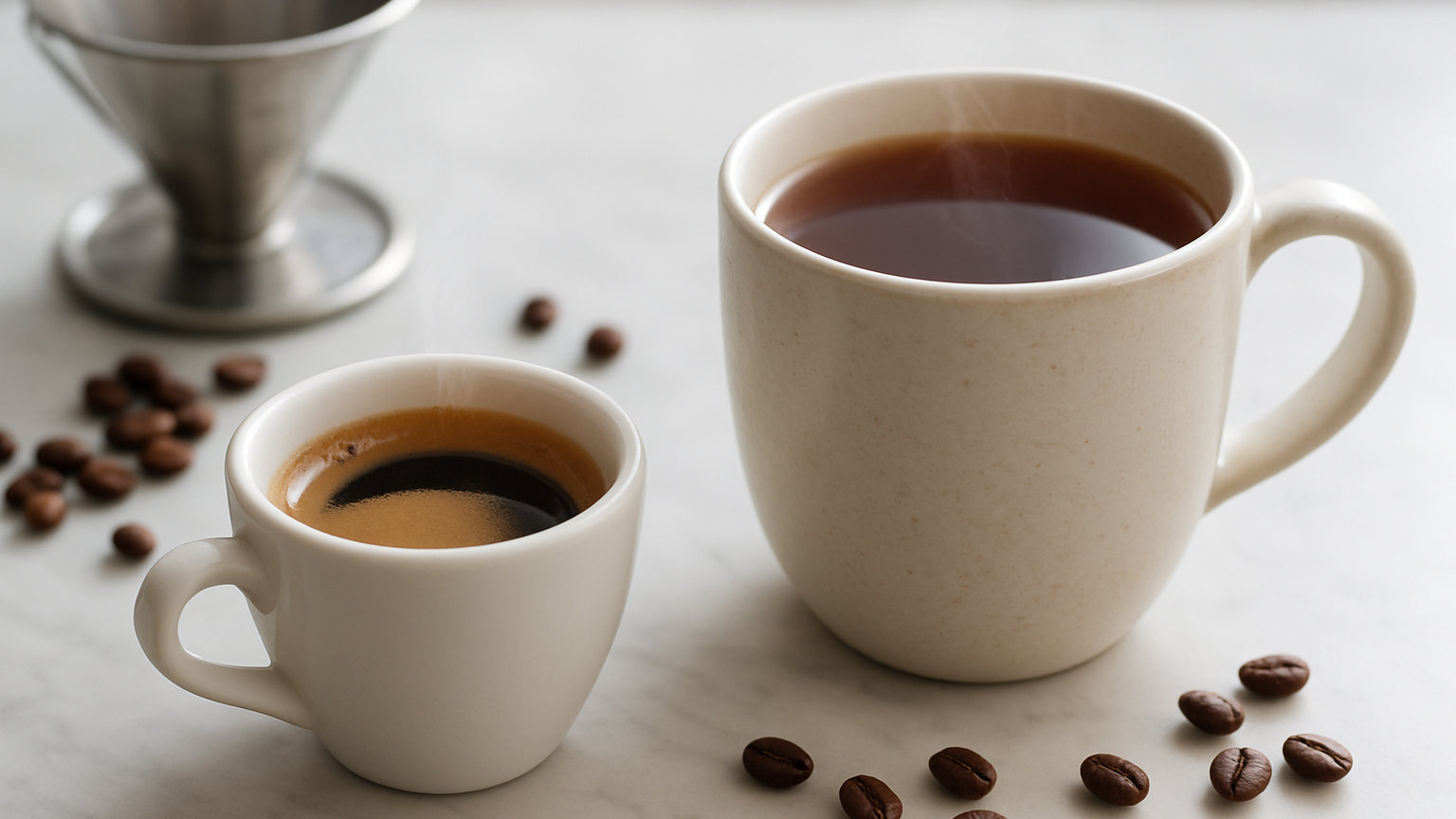
Caffeine content varies far more than people expect, and the intuition that stronger-tasting coffee contains more is frequently wrong. The numbers are worth knowing, particularly for anyone watching their intake.
How much is in each drink?
- Single espresso, 30ml. Around 60 to 80mg.
- Double espresso. Around 120 to 160mg.
- Filter coffee, 250ml mug. Around 120 to 180mg.
- Cafetière, 250ml. Around 100 to 160mg.
- Instant, 250ml. Around 60 to 80mg.
- Cold brew, 250ml diluted. Around 100 to 200mg.
- Latte or cappuccino. Whatever the espresso contains, usually 60 to 160mg.
- Decaf. Around 2 to 5mg, not zero.
Why does espresso have less than filter?
Because the serving is much smaller. Espresso is far more concentrated per millilitre and a single shot is 30ml against a 250ml mug.
A single espresso therefore contains roughly half the caffeine of a mug of filter coffee, despite tasting far stronger. Strength of flavour and caffeine content are separate things.
What about robusta?
Robusta beans contain roughly twice the caffeine of arabica. Most speciality coffee is arabica; many supermarket blends and instant coffees include robusta, which raises the figure.
What are the daily limits?
European food safety guidance suggests up to 400mg a day is not a safety concern for most healthy adults, and single doses up to 200mg are fine.
Four hundred milligrams is roughly three mugs of filter coffee or four double espressos, depending on the numbers above.
What about pregnancy?
UK guidance is a maximum of 200mg a day during pregnancy, which is roughly one to two mugs of filter coffee or two single espressos.
That includes caffeine from tea, chocolate, cola and energy drinks, which adds up faster than people expect. Anyone pregnant should discuss their own intake with a midwife or GP rather than relying on a general figure.
How long does it last?
The half-life is around 5 to 6 hours in most adults, meaning half remains that long after drinking. A coffee at 4pm leaves a meaningful quantity in the system at bedtime.
That varies enormously between individuals, driven partly by genetics and affected by medication, smoking and pregnancy, which roughly doubles it.
Who should be careful?
Anyone with anxiety, sleep difficulties, heart rhythm problems or acid reflux, and anyone on medication that interacts with caffeine. Sensitivity also varies genuinely between people, so a dose that suits one person can be too much for another.
Anyone unsure about their own intake should raise it with a GP or pharmacist rather than working from general figures.
Does decaf have none?
No. Decaffeination removes around 97 per cent, leaving a few milligrams per cup. That is negligible for most people and not zero for anyone highly sensitive.
Does brewing method change it?
Contact time and ratio both matter. Cold brew concentrate is high because the ratio is strong; instant is low because the dose is small. The grind and the water temperature make far less difference than the amount of coffee used.
Does the cup size on a menu tell you anything?
Very little, since the caffeine comes from the number of espresso shots rather than the volume of milk. A large latte with one shot contains less than a small flat white with two.
Asking how many shots are in a drink is the only reliable way to know.
Does it add up with other drinks?
Substantially, and it is easy to lose track. Tea, cola, energy drinks and chocolate all contribute, and a day with two coffees, three teas and a cola reaches several hundred milligrams without anything feeling excessive.
Anyone counting towards a limit should count everything rather than coffee alone.
Does it affect sleep even when you cannot feel it?
Frequently. Research consistently finds caffeine reduces deep sleep and total sleep time even in people who report no difficulty falling asleep after it.
Anyone sleeping poorly is often surprised how much an afternoon cut-off helps, and switching to decaf after midday is a straightforward experiment.


