
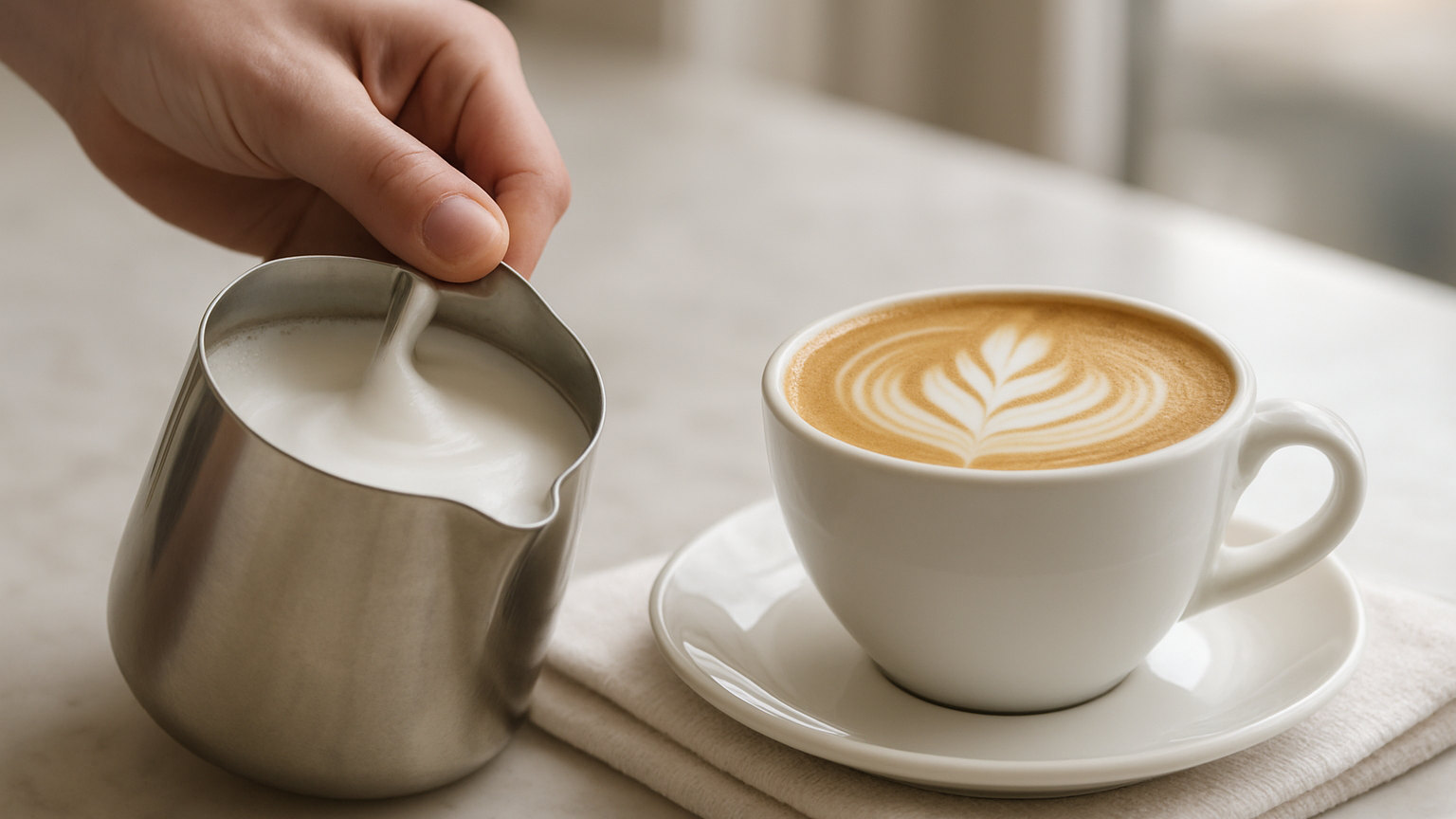
Well-textured milk is what separates a good milk coffee from a mediocre one, and the technique is less complicated than it looks. It has two phases and the first is very short.
What are the two phases?
- Stretching. Introducing air into the milk, in the first few seconds only.
- Texturing. Spinning the milk to break the bubbles down into microfoam and mix it through.
Air goes in early or not at all. Adding air late produces large bubbles that sit on top as stiff foam rather than integrating.
What is microfoam?
Milk with bubbles so fine they are invisible, giving a glossy, paint-like texture that pours smoothly. It should look like wet paint rather than washing-up foam.
The difference is not decorative. Microfoam changes the mouthfeel and blends with the espresso, where stiff foam sits separately on top.
What temperature should it reach?
Around 60 to 65 degrees. Hot enough to feel properly hot and cool enough to keep the milk sweet.
Above about 70 degrees, milk proteins denature and the natural sweetness turns to a cooked, slightly eggy flavour. Above 75 it scalds and cannot be recovered.
Without a thermometer, stop when the jug becomes uncomfortably hot to hold. That is roughly the right point.
Can you re-steam milk?
Not successfully. The proteins have already been altered, so it will not texture again and it tastes flat. Steam only what you need.
How do you do it with a wand?
- Fill a cold jug about a third full with cold milk.
- Purge the wand before starting.
- Place the tip just under the surface and turn it on fully.
- Listen for a gentle tearing sound for two to four seconds. That is the air going in.
- Submerge the tip slightly deeper to stop the air and create a whirlpool.
- Stop at 60 to 65 degrees.
- Tap the jug on the counter and swirl until glossy.
What if you have no steam wand?
- French press. Warm the milk, then pump the plunger 20 to 30 times. Genuinely effective.
- Jar. Half fill, shake hard for 30 seconds, microwave 30 seconds to stabilise the foam.
- Handheld frother. Cheap and works well for a mug.
- Whisk. Warm the milk and whisk briskly.
None gives true microfoam, and all give something considerably better than flat hot milk.
Which milk textures best?
Whole milk, because fat and protein together give stability and sweetness. Semi-skimmed foams more easily and tastes thinner.
Among plant milks, oat designed for baristas performs best, since it is formulated with added protein and fat for exactly this. Almond and rice milk struggle and can split against hot espresso.
Why does milk sometimes split?
Because espresso is acidic and some plant milks curdle on contact, particularly when very hot. Pouring the milk into the coffee rather than the reverse, and keeping the temperature down, both reduce it.
What is the commonest mistake?
Overheating. Milk taken to 75 degrees loses its sweetness entirely, and no amount of technique afterwards brings it back.
How much milk should you steam?
Slightly more than the drink needs, and no more. Milk expands as air goes in, so a jug filled beyond a third will overflow, and leftover steamed milk cannot be reused.
A jug that matches your usual cup size is more useful than a large one.
How do you pour it?
Swirl the jug until the milk is glossy and uniform, then pour from a height into the centre of the cup to combine, dropping the spout closer at the end.
Milk that has separated in the jug should be swirled rather than stirred, and a milk that will not recombine was over-aerated.
How do you clean the wand?
Wipe it immediately with a damp cloth and purge it. Milk dries onto a hot wand within seconds and becomes very difficult to remove afterwards.
A blocked wand steams poorly and is the usual reason a machine seems to have stopped texturing well.


