
Coffee equipment is sold as though it were necessary. What actually matters is the ratio, the grind, the water temperature and the time, and all four can be controlled with a jug and a sieve.
What does any method need to do?
- Get hot water into contact with ground coffee.
- Hold them together for the right length of time.
- Separate the liquid from the grounds.
Everything sold as a brewer is one of these three things made more convenient.
How do you make it in a jug?
The simplest method there is, sometimes called cupping or the immersion method.
- Grind 15 grams of coffee coarsely per 250 grams of water.
- Put the grounds in a jug or mug.
- Pour water just off the boil over them.
- Stir once and leave 4 minutes.
- Break the crust that forms and skim off the foam.
- Leave another 4 minutes so the grounds settle.
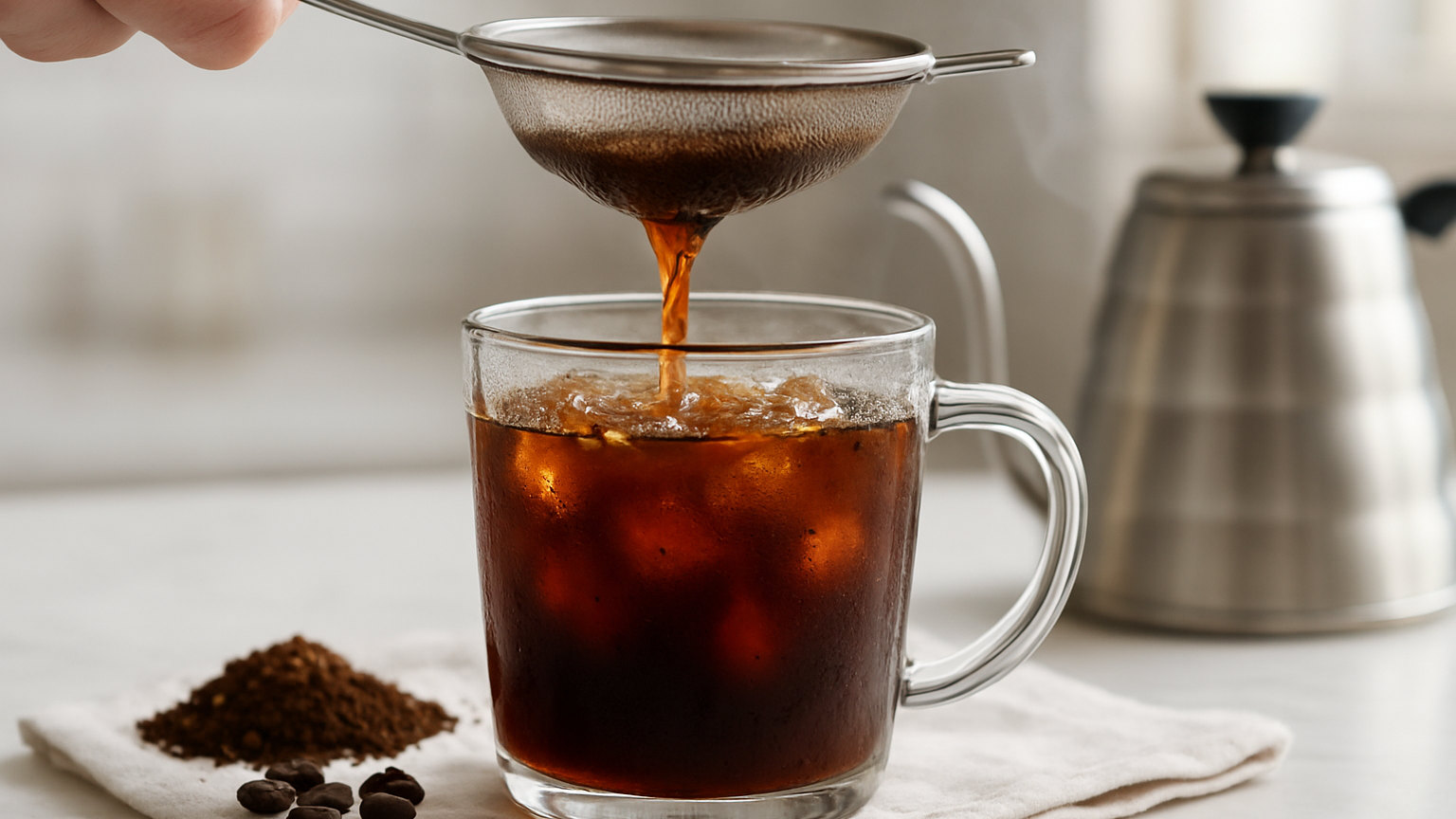
- Pour carefully, leaving the sediment behind, or strain through a sieve.
Does it taste worse than a machine?
No, and it is closer to a cafetière than most people expect. The main difference is sediment, which settles if you wait.
How do you use a cafetière properly?
Coarse grind, 60 grams per litre, water just off the boil. Pour, stir, leave 4 minutes, then plunge slowly.
Plunging hard forces fines through the mesh and makes the coffee muddy. Pour it out immediately afterwards, since coffee left sitting on the grounds continues extracting and turns bitter.
What about a saucepan?
Bring water to the boil, take it off the heat for thirty seconds, add coarsely ground coffee, stir, cover and leave 4 minutes.
Strain through a fine sieve, or add a splash of cold water to help the grounds sink and pour carefully.
Never boil the coffee itself. Boiling extracts harsh compounds quickly and produces something bitter.
Can you use a tea strainer or muslin?
Yes. Put grounds in a muslin square, tie it, and steep like a tea bag. It works well and gives clean coffee with no sediment at all.
A reusable tea infuser ball does the same job if the mesh is fine enough.
What water temperature is right?
Around 92 to 96 degrees, which is water brought to the boil and left for thirty seconds. Boiling water poured straight on scalds the coffee and adds bitterness.
Below about 88 degrees, extraction is poor and the coffee tastes sour and thin.
Does the grind matter without a machine?
Considerably. Coarse for anything steeped, since the contact time is long. Pre-ground supermarket coffee is usually medium, which is a reasonable compromise and slightly fine for immersion.
If you can grind at home, a hand grinder costs little and improves every method here more than any brewer would.
What is the minimum that actually matters?
Weighing the coffee, water off the boil rather than boiling, and separating the grounds when the time is up. Those three cost nothing and account for most of the difference between a good cup and a poor one.
What is the best method with no equipment at all?
The jug method with a long settle. Four minutes of steeping, four minutes of settling, then pour carefully leaving the last centimetre behind.
It produces a cup very close to a cafetière and requires nothing beyond a mug and hot water.
Does the mug matter?
Only in that a wide shallow mug loses heat quickly. A taller narrower mug keeps coffee hot longer, which matters more with methods that involve a four-minute settle.
Warming the mug with hot water first makes a noticeable difference to the temperature of the first few mouthfuls.
Is any of it worse than a machine?
Not in flavour. What machines provide is convenience, repeatability and temperature stability, all of which matter for volume and none of which changes what the coffee can taste like.
A carefully made jug of coffee will beat a carelessly used machine every time.


