
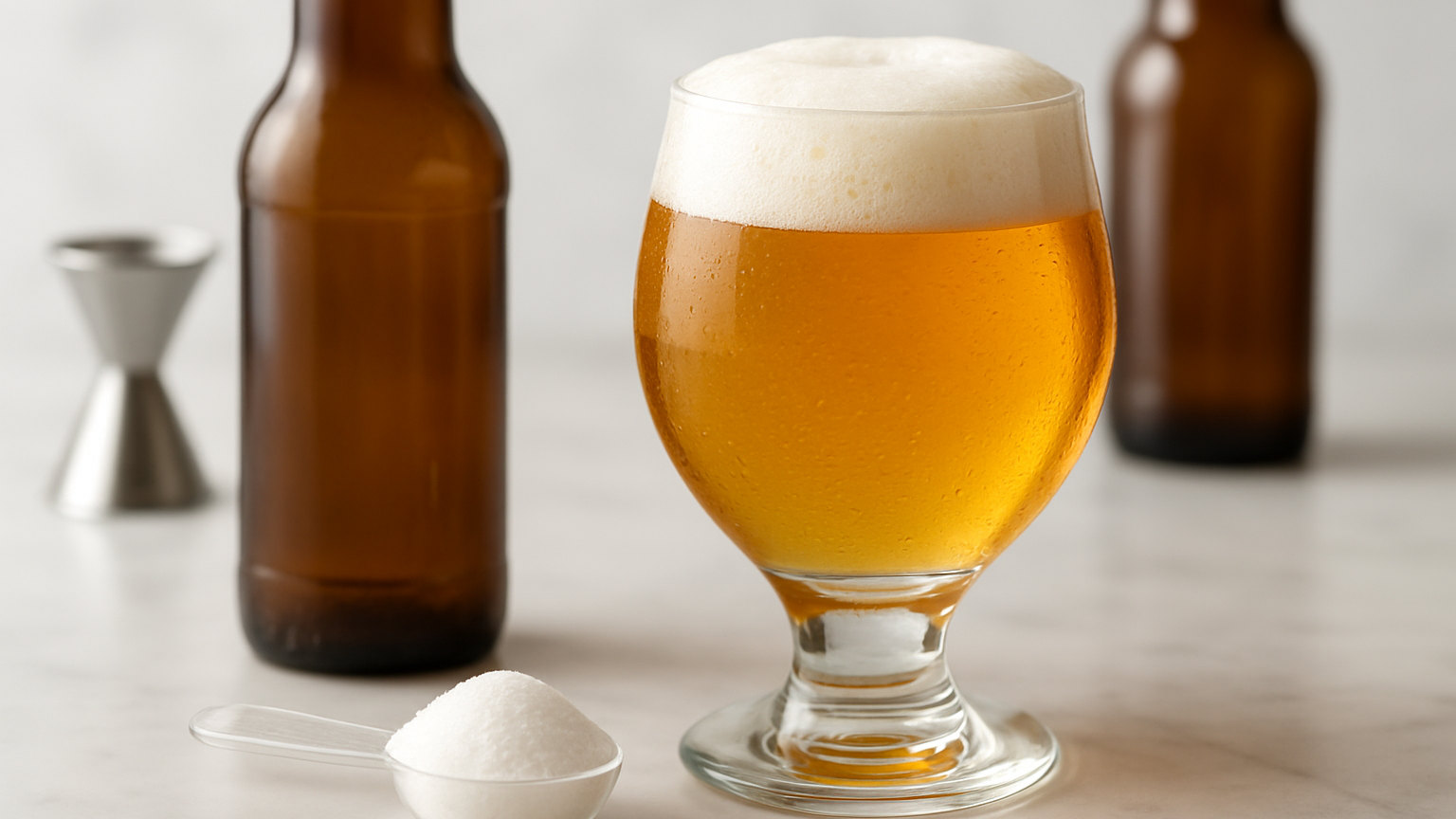
Beer leaves the fermenter flat, because the carbon dioxide produced during fermentation escaped through the airlock. Priming sugar creates a second, small fermentation in a sealed bottle, and the gas produced this time has nowhere to go but into the beer.
How much do you need?
For a 23 litre batch of standard ale, around 120g of granulated sugar dissolved in 200ml of boiled water and cooled.
- Bitter, mild, cask-style ales: 80 to 90g. Low carbonation.
- Pale ale, brown ale, porter: 110 to 130g.
- Stout: 90 to 100g. Softer mouthfeel.
- Wheat beer: 150 to 170g. Lively.
- Belgian styles: 150 to 170g, using bottles rated for it.
Weigh it. Estimating by eye is the most common cause of over-carbonated bottles, and the top of that range is already near what standard crown-capped bottles are designed to hold.
Why does the style change the figure?
Because carbonation is part of how a beer is meant to feel. A bitter served at pale ale carbonation tastes sharp and prickly, and loses the soft mouthfeel the style depends on. A wheat beer at bitter carbonation feels flat and heavy.
Carbonation also affects perceived bitterness and aroma. More gas carries more aroma to the nose and makes bitterness feel crisper.
Does residual carbon dioxide matter?
Slightly. Beer that finished fermenting at a cold temperature retains more dissolved gas than beer that finished warm, so a cold-conditioned beer needs marginally less priming sugar. For home brewing at ale temperatures the difference is small enough to ignore.
Which sugars can you use?
- Granulated white sugar. Ferments completely, contributes no flavour. The default.
- Dextrose or corn sugar. Ferments slightly faster. Use around 10 per cent more by weight.
- Dry malt extract. Use around 50 per cent more by weight. Adds a little malt character and more sediment.
- Honey or demerara. Work, and contribute flavour. Harder to calculate.
Artificial sweeteners do not work at all, since yeast cannot ferment them. This matters if you were thinking of sweetening a beer before bottling.
How should you add it?
Batch priming rather than per bottle. Dissolve the sugar in boiled water, cool it, put it in a sanitised bottling bucket, then siphon the beer on top so the incoming flow mixes it.
Adding sugar to individual bottles by spoon varies enough across forty bottles to produce some that are flat and some that gush. Carbonation drops or measured tablets are consistent and more expensive.
Why not stir it in vigorously?
Because stirring introduces oxygen, which stales beer within weeks. One gentle turn from the bottom is enough if the siphon has not mixed it adequately.
What happens if you use too much?
Over-carbonation, ranging from bottles that gush on opening to glass failing under pressure. This is the one genuinely hazardous mistake in home brewing.
If you suspect a batch is over-primed, move it all somewhere cold immediately, which slows the yeast and dissolves more gas back into the beer. Open the bottles over a sink, and store the rest in a sealed crate rather than on an open shelf.
What if you use too little?
Flat beer, which is disappointing and harmless. It cannot be fixed once bottled, since opening to add more sugar introduces oxygen and undoes the seal.
Given that the two failure modes are flat beer and broken glass, erring slightly low is the sensible bias.
Does the beer volume matter?
Yes, and it is the figure most often guessed. Priming quantities assume 23 litres, and a batch that finished at 20 litres will be over-carbonated at 120g. Measure the volume going into the bottling bucket and scale the sugar accordingly.
What about kegging instead?
A pressure barrel or a keg with forced carbonation removes the priming question entirely, since the gas is supplied rather than fermented. It also removes the pressure risk, which is the main safety argument for it.
The trade-off is cost and the fact that a keg is opened once and drunk over weeks, where bottles can be shared and stored individually.


