
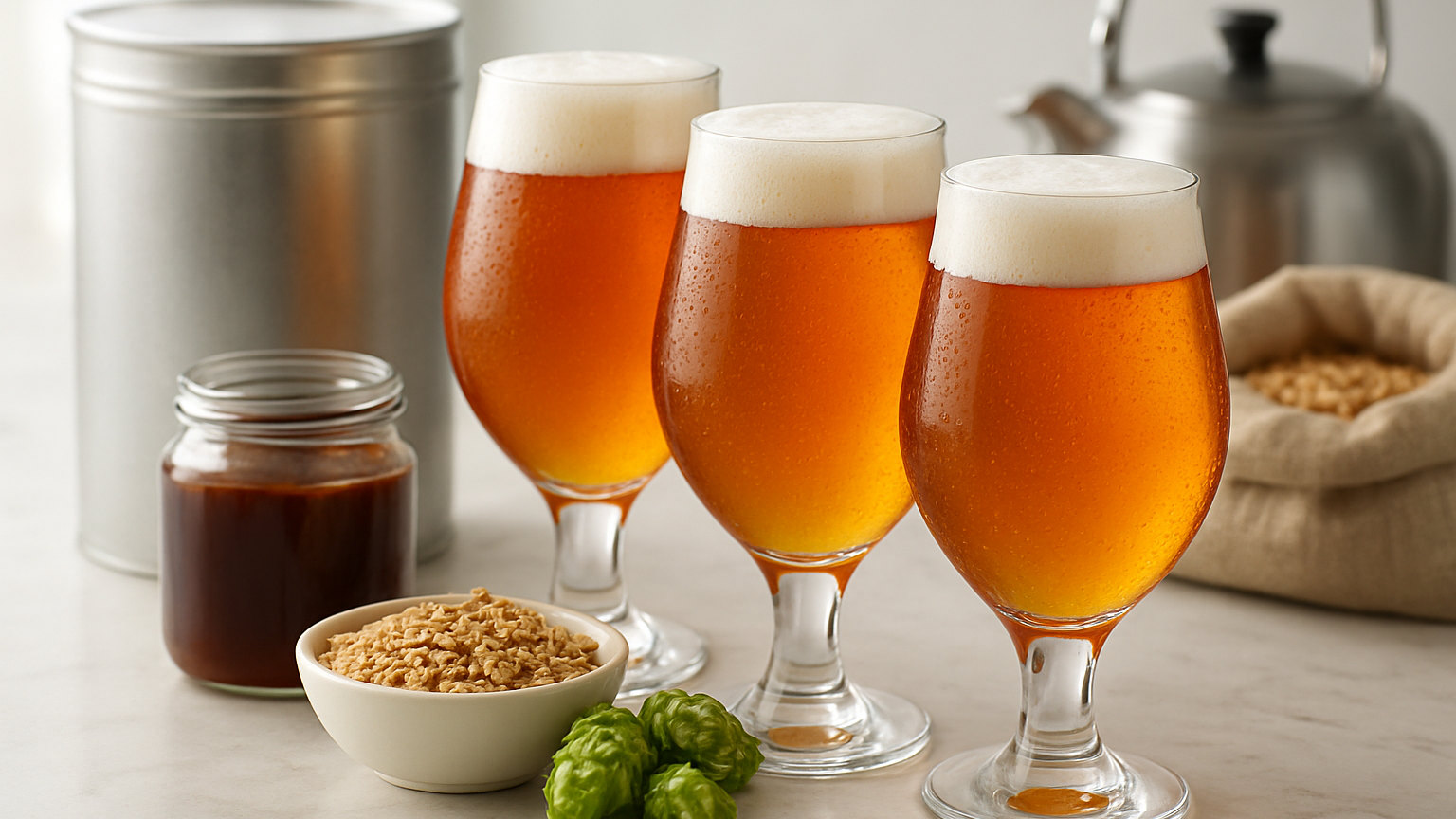
Beer is made by converting starch to sugar, boiling that sugar with hops, and fermenting the result. The three approaches to home brewing differ only in how many of those stages you do yourself and how many arrive already done in a tin.
What is kit brewing?
A tin of hopped malt extract. The mashing and boiling have been done at a factory, and your job is to dissolve it, top up to volume, pitch yeast and ferment.
- Brew day: 60 to 90 minutes.
- Equipment: bucket, airlock, hydrometer, siphon.
- Control: fermentation only.
Kits have a poor reputation from the 1970s that modern ones do not deserve. A good kit fermented at the right temperature makes genuinely good beer, and the limiting factor is almost always the brewer rather than the tin.
What is extract brewing?
Unhopped malt extract, either dry powder or liquid, which you boil yourself with hops of your choosing. Speciality grains can be steeped beforehand for colour and flavour.
- Brew day: 2 to 3 hours.
- Equipment: adds a large pan, ideally 15 litres or more.
- Control: hop schedule, some grain character, fermentation.
This is where most brewers spend a long time, and reasonably so. You choose the hops and the bitterness, which is most of what distinguishes one beer from another, without a five-hour brew day.
Is dry or liquid extract better?
Dry keeps longer and is easier to measure. Liquid is slightly cheaper by weight and darkens with age, so an old tin will make a browner beer than intended. For most purposes dry is the more reliable choice.
What is all grain brewing?
Starting from malted barley and doing the conversion yourself. You steep crushed grain in water at a controlled temperature so its enzymes convert starch to sugar, then rinse the grain, boil the liquid with hops and ferment.
- Brew day: 4 to 6 hours.
- Equipment: mash tun, 30 litre kettle, chiller, larger burner.
- Control: everything, including body through mash temperature.
The main gain is control over the grain bill and over how fermentable the wort is, which decides body and dryness. It is also considerably cheaper per batch once the equipment is bought.
Which should you start with?
A kit, then extract. Kit brewing teaches sanitation, fermentation temperature control and bottling without adding mashing and boiling to the same afternoon.
Those three skills are what actually determine beer quality, and they transfer entirely. Someone who has made three good kit beers will make good all grain beer immediately; someone who starts at all grain often makes five poor batches while learning the same lessons more expensively.
Does the method change the quality?
Less than people assume. Blind tastings routinely fail to separate a well-made extract beer from an all grain one, particularly in darker styles where the speciality grains are steeped either way.
Where all grain wins clearly is in pale, delicate styles and in anything where mash temperature is being used deliberately to control body.
What does each cost?
Per batch, all grain is cheapest and kits are dearest, with extract in between. The equipment gap runs the other way, so all grain takes many batches to pay back.
The honest calculation is that home brewing rarely saves money against supermarket beer. It saves money against craft beer, and the real return is control and the process itself.
What about brew in a bag?
A simplified all grain method where the crushed grain sits in a large mesh bag inside the kettle, so mashing and boiling happen in one vessel. Lift the bag out, let it drain, and boil.
It removes the mash tun and the sparging equipment, which is most of the cost and complexity of going all grain. For anyone wanting full control without a garage full of kit, it is the sensible route.
Can you move between them freely?
Yes, and many brewers do depending on how much time they have. An extract batch on a weeknight and an all grain one at the weekend is a perfectly normal pattern, and the fermentation and bottling stages are identical whichever you choose.


