
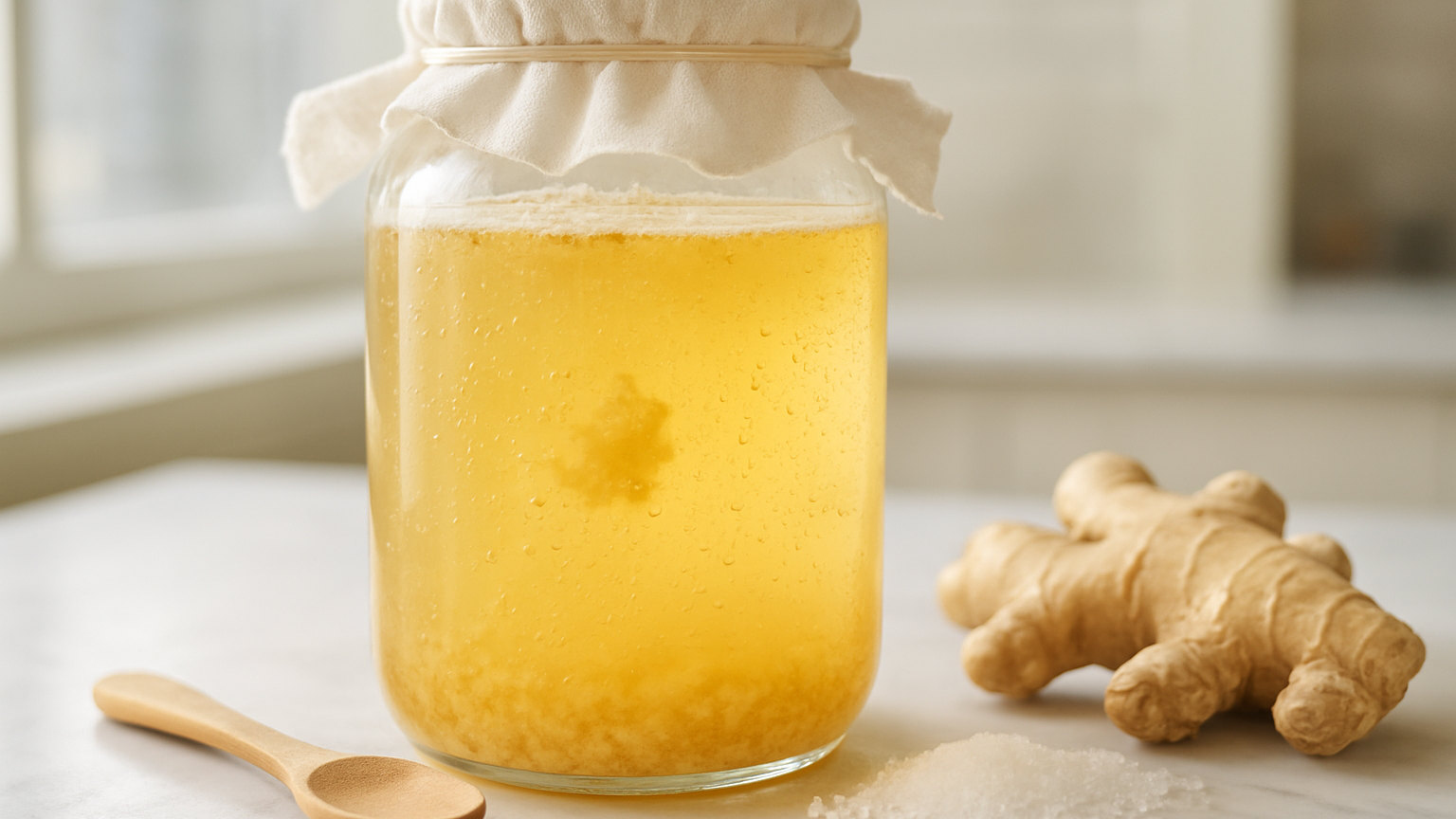
A ginger bug is a live culture of wild yeast and bacteria grown from fresh ginger, sugar and water. It is what traditional ginger beer is fermented with, and it is the same principle as a sourdough starter: capture what is already present on the ingredient and feed it until it dominates.
How do you start one?
- Put 2 tablespoons of grated unpeeled fresh ginger into a clean jar.
- Add 2 tablespoons of sugar and 250ml of unchlorinated water.
- Stir, cover with cloth secured with a band, and leave at room temperature.
- Each day, add a further tablespoon of grated ginger and a tablespoon of sugar, and stir.
- After five to seven days it should be visibly bubbly and smell yeasty.
Use unpeeled ginger, since the wild yeast lives on the skin. Organic ginger is often recommended on the grounds that it is less likely to have been treated, and conventional ginger usually works.
Why unchlorinated water?
Because chlorine and chloramine are added to tap water specifically to kill microorganisms, which is the opposite of what you want here. Treat the water with half a crushed Campden tablet, or use filtered or bottled water.
Boiling removes chlorine and not chloramine, which most UK suppliers now use, so it is an unreliable fix on its own.
Why cloth rather than a lid?
Because the culture produces carbon dioxide and a sealed jar builds pressure. Cloth lets gas out and keeps insects and dust out, which is all that is needed at this stage.
How do you know it is working?
Bubbles rising when you stir, a fizzy hiss, and a smell that is yeasty and gingery rather than sour or unpleasant. Grated ginger floating at the surface with bubbles clinging to it is a good sign.
It usually takes five to seven days in a warm kitchen and longer in a cold one. Somewhere around 20 to 24 degrees is ideal.
What if it grows mould?
Discard it and start again. Fuzzy growth in any colour, or a slimy film, means something unwanted has taken hold, and there is no safe way to salvage it.
A thin layer of foam or a slight film of yeast is different and normal. If you are uncertain, the cost of starting over is a piece of ginger and a week.
Mould usually means the culture was too cold, was not fed often enough, or the jar was not clean. Feed it daily without fail during the first week.
How do you keep it going?
Once active, use it and feed it. Take out what you need for a batch of ginger beer, top the jar back up with water, and add a tablespoon each of ginger and sugar.
To pause it, refrigerate and feed it once a week. It slows almost to a stop and revives in a couple of days at room temperature.
Is it alcoholic?
The bug itself contains a small amount of alcohol, since yeast produces it. Ginger beer made from it typically finishes between 0.5 and 2 per cent depending on how long it ferments and how much sugar it had, which is worth knowing if you are making it for children.
It is not a controlled fermentation, so the figure varies between batches. A hydrometer reading before and after is the only way to know.
How much do you need for a batch?
Around 200ml of the liquid for 2 litres of ginger beer, which is roughly a tenth by volume. Strain it rather than tipping the ginger solids in.
Top the jar back up with water and feed it, and it will be ready to use again within a couple of days.
What if it slows down?
Usually temperature. A kitchen at 15 degrees will produce a sluggish bug where one at 22 produces a lively one. Move it somewhere warmer and feed it daily.
A bug that has been refrigerated takes two or three days of daily feeding at room temperature to come fully back to life. Do not use it for a batch until it is visibly bubbling again, since an underpowered bug gives a flat ginger beer that then keeps fermenting unpredictably in the bottle.
Can you use ground ginger?
No. The wild yeast lives on the skin of fresh root, and dried ground ginger has neither the organisms nor the moisture. It is the one ingredient in the process that cannot be substituted.


