
Getting juice out of apples is genuinely hard work, which is why cider presses exist. For a single gallon it is entirely achievable with kitchen equipment, provided you break the fruit down properly first. That preparation matters more than the pressing.
Why does the fruit need breaking down?
Because apple flesh holds juice in intact cells, and pressing whole or quartered fruit simply crushes it without releasing much. Traditional cider making uses a scratter, a mill that shreds apples into a coarse pulp called pomace, before any pressing happens.
Skip that step and you will extract perhaps a third of what is available while working twice as hard.
What is the freezer method?
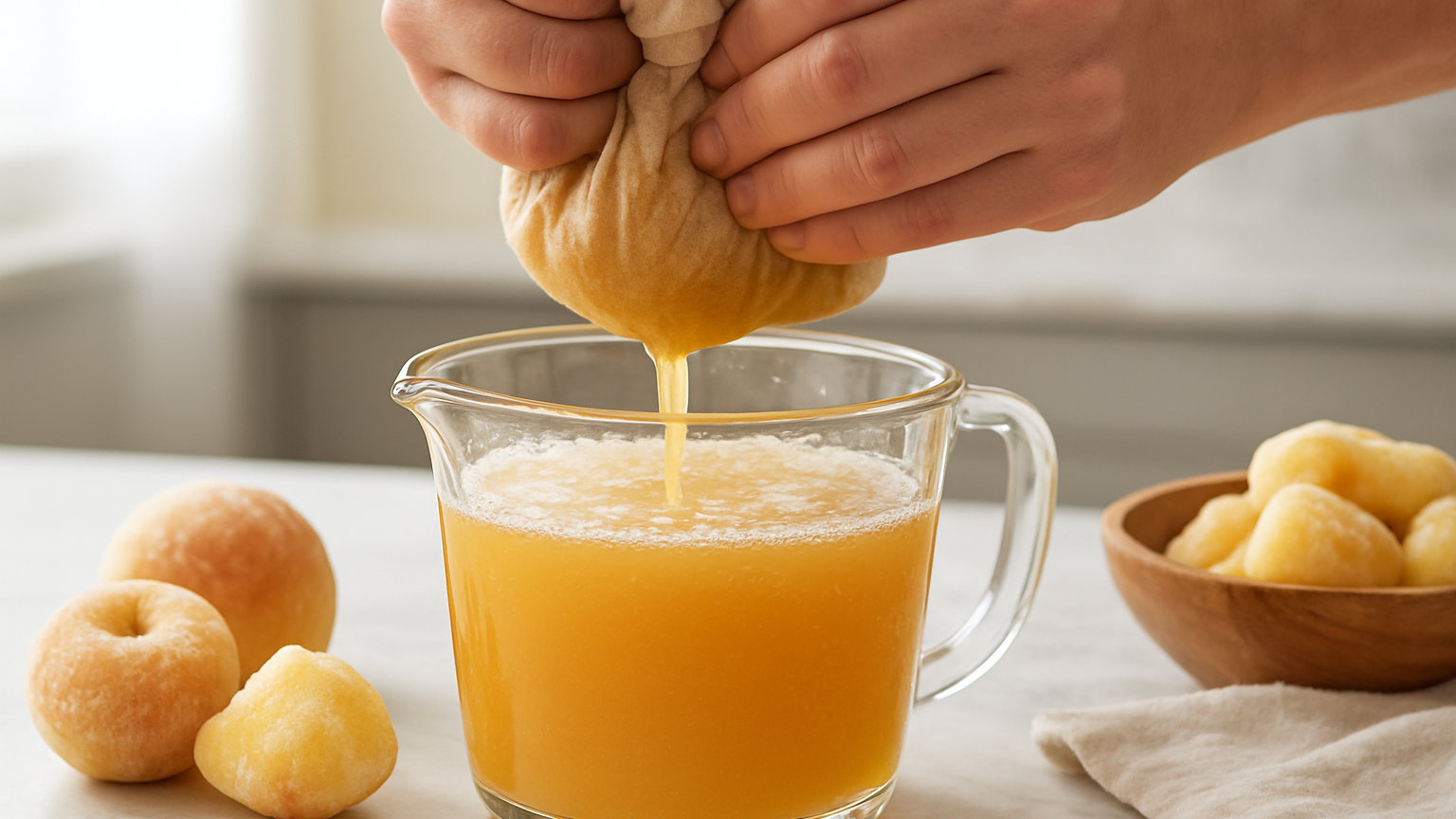
The single most useful domestic trick. Freeze the apples solid, then thaw them completely.
Ice crystals rupture the cell walls, so thawed apples release juice readily under modest pressure. It replaces the scratter almost entirely and costs nothing but freezer space and time.
- Wash, quarter and core the apples. No need to peel.
- Freeze for at least 24 hours.
- Thaw fully, which takes most of a day.
- Press or squeeze. The fruit will be soft and dripping already.
Does it affect the flavour?
Not detectably. Freezing is used commercially for exactly this reason in some fruit processing, and the cider tastes the same.
What if you cannot freeze them?
Break the fruit down mechanically:
- Food processor. Pulse in batches to a coarse pulp, not a purée.
- Coarse grater. Hard work and effective for small quantities.
- Bag and mallet. Quartered apples in a strong bag, hit firmly. Crude and works.
Avoid reducing the fruit to a fine purée, which clogs any straining material and makes extraction harder rather than easier.
How do you extract the juice?
Put the pulp into a straining bag, jelly bag or a pillowcase of unbleached cotton, and squeeze. For larger quantities, sandwich the bag between two boards and stand a heavy weight on top.
A car jack against a sturdy frame is the classic improvised press and it works. So does a bucket with a drilled base sitting inside another bucket, with a plate and weights on the pulp.
How much juice will you get?
From frozen and thawed fruit squeezed by hand, expect around 500 to 600ml per kilogram of apples. So a gallon of juice needs roughly 8kg of fruit.
A proper press extracts nearer 700ml per kilogram, which is why anyone making more than a couple of gallons a year buys or borrows one.
Can you use a juicer?
A centrifugal juicer works for small quantities and is slow and messy at scale, and it introduces a great deal of air, which encourages browning and oxidation.
It is a reasonable route for a demijohn. For anything larger it will overheat and clog.
What about the pomace afterwards?
Spent pulp composts well. It can also be soaked in water and pressed again for a weak second juice, traditionally fermented into a light drink called ciderkin, though it makes a thin result.
Should you wash the fruit?
Yes, particularly windfalls. A rinse in clean water removes soil, grass and whatever has been on the ground with them.
Do not scrub hard enough to remove everything from the skin if you intend a wild fermentation, since the yeast lives there. If you are pitching a cultured yeast, wash thoroughly and add a Campden tablet afterwards.
Do you need to core them?
For a press, no. Whole fruit goes through a scratter, pips and all, and traditional cider making does not core anything.
Do not crush the pips deliberately, since apple pips contain compounds that release cyanide when broken down. In practice a press does not break them and the quantity involved would be trivial, and there is no reason to grind them intentionally.
How quickly should you use the juice?
Immediately, or within a few hours. Fresh apple juice browns rapidly through oxidation and starts fermenting on its own within a day at room temperature.
Add a Campden tablet as soon as it is collected if you are not pitching straight away, which holds it for 24 hours and knocks back the wild population.


