
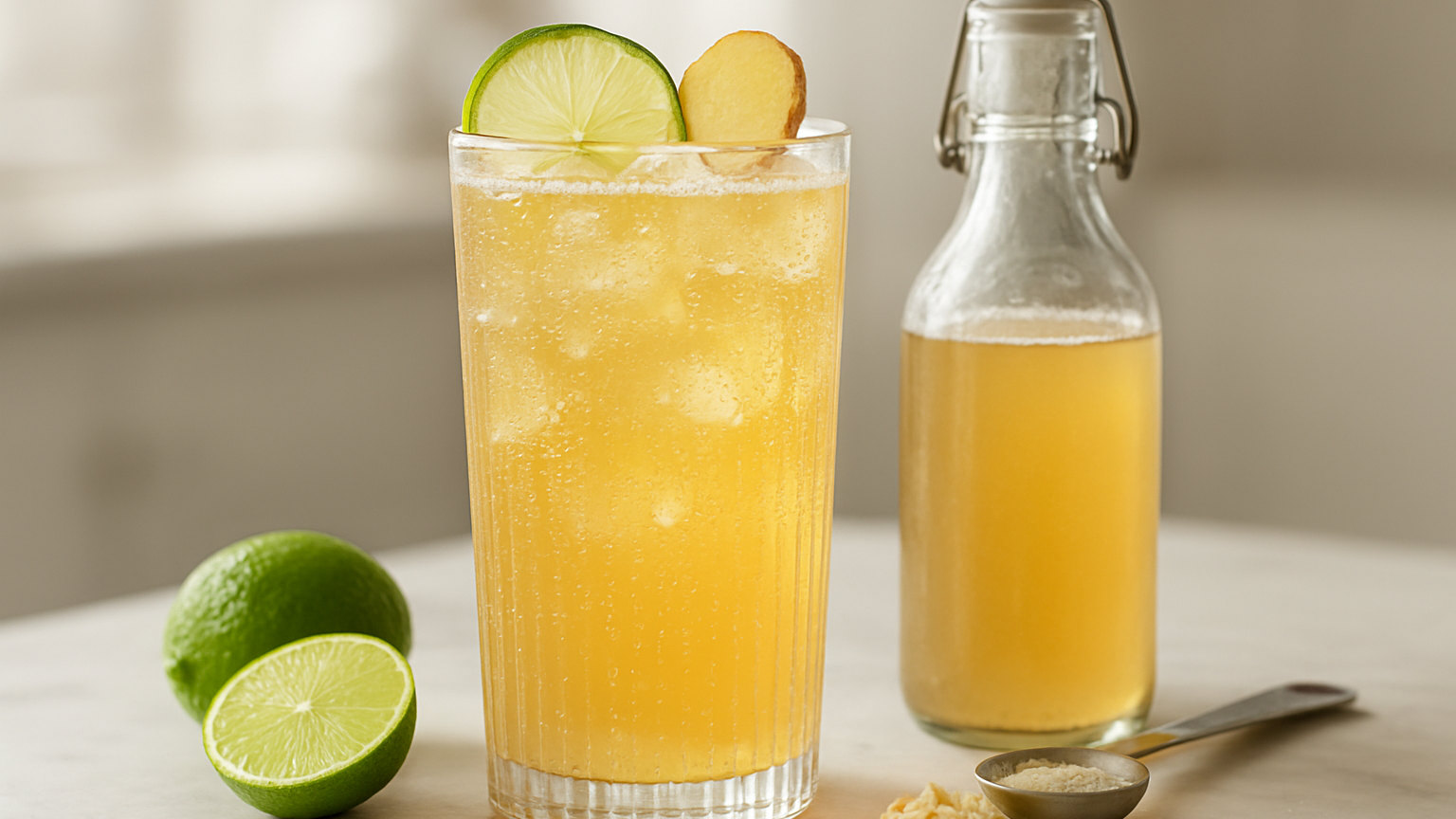
Traditional ginger beer ferments faster than almost anything else made at home, going from mixture to fizzy drink in three or four days. That speed is exactly why it is the classic cause of burst bottles, and why the precautions below are not optional.
What is the recipe?
For 2 litres:
- 1.8 litres unchlorinated water
- 150g sugar
- 60g fresh ginger, grated, unpeeled
- Juice of 1 lemon
- 200ml active ginger bug liquid, strained
What is the method?
- Simmer the ginger in 500ml of the water for fifteen minutes.
- Take off the heat, stir in the sugar until dissolved.
- Add the remaining water and the lemon juice.
- Cool to below 30 degrees. This matters, since hot liquid kills the culture.
- Strain in the ginger bug liquid and stir.
- Bottle, leaving 4cm of headspace.
What bottles must you use?
PET plastic bottles from carbonated soft drinks, for a first batch and ideally always. This is the single most important instruction on this page.
Plastic does not shatter, and squeezing the bottle tells you exactly how much pressure has built. Glass gives no warning and fails by fragmenting.
If you use glass, it must be crown-capped beer bottles or swing-tops rated for pressure. Never wine bottles, spirit bottles or preserving jars.
Why is ginger beer riskier than beer?
Because a wild culture is unpredictable and there is a great deal of residual sugar. A brewing yeast in beer has a known attenuation and a measured amount of priming sugar. A ginger bug will keep working on whatever sugar remains, for as long as it is warm, with no natural stopping point.
How do you control the pressure?
- Use plastic and squeeze test daily. When the bottle is firm and does not give, it is ready.
- Burp the bottles. Loosen the cap briefly once a day to release gas.
- Refrigerate as soon as they are firm, usually 2 to 4 days.
- Keep them out of living areas while fermenting.
Cold does not stop the culture, it slows it dramatically. Bottles must go in the fridge once carbonated and stay there.
How long does it take?
Two to four days at room temperature, depending on how warm the room is and how vigorous the bug is. In a warm kitchen in summer it can be ready in 36 hours, which catches people out.
Check daily from day two rather than waiting for a set time.
How strong is it?
Typically 0.5 to 2 per cent, and it varies between batches because the fermentation is not controlled. That is worth knowing if you are serving it to children or to anyone avoiding alcohol.
Longer fermentation and more sugar both raise it. For a genuinely alcohol-free version, a carbonated syrup approach is the reliable route.
How should you open a bottle?
Chilled, over a sink, slowly, with the bottle pointing away from you and anyone else. If it foams, stop and let it settle rather than continuing to open.
Why simmer the ginger first?
To extract the flavour compounds, which come out far more readily in hot water than cold. Fifteen minutes covered is enough, and covering matters because the aromatic compounds are volatile and boil off in an open pan.
Cooling before adding the bug is equally important. Liquid above about 40 degrees will kill the culture, and pouring an active bug into hot ginger tea is the commonest reason a batch never carbonates.
What if it does not carbonate?
- The bug was not active enough. Feed it for two more days before using.
- The liquid was too hot. Kills the culture on contact.
- The room is too cold. Below 18 degrees it will be very slow.
- Chlorinated water. Suppresses the culture.
A batch that has not moved after five days is unlikely to. Start again rather than leaving it, since a slow batch that suddenly wakes up later is exactly the situation that bursts bottles.
Two or three days in the fridge after carbonating also improves the flavour, letting the ginger heat settle and the drink integrate.


