
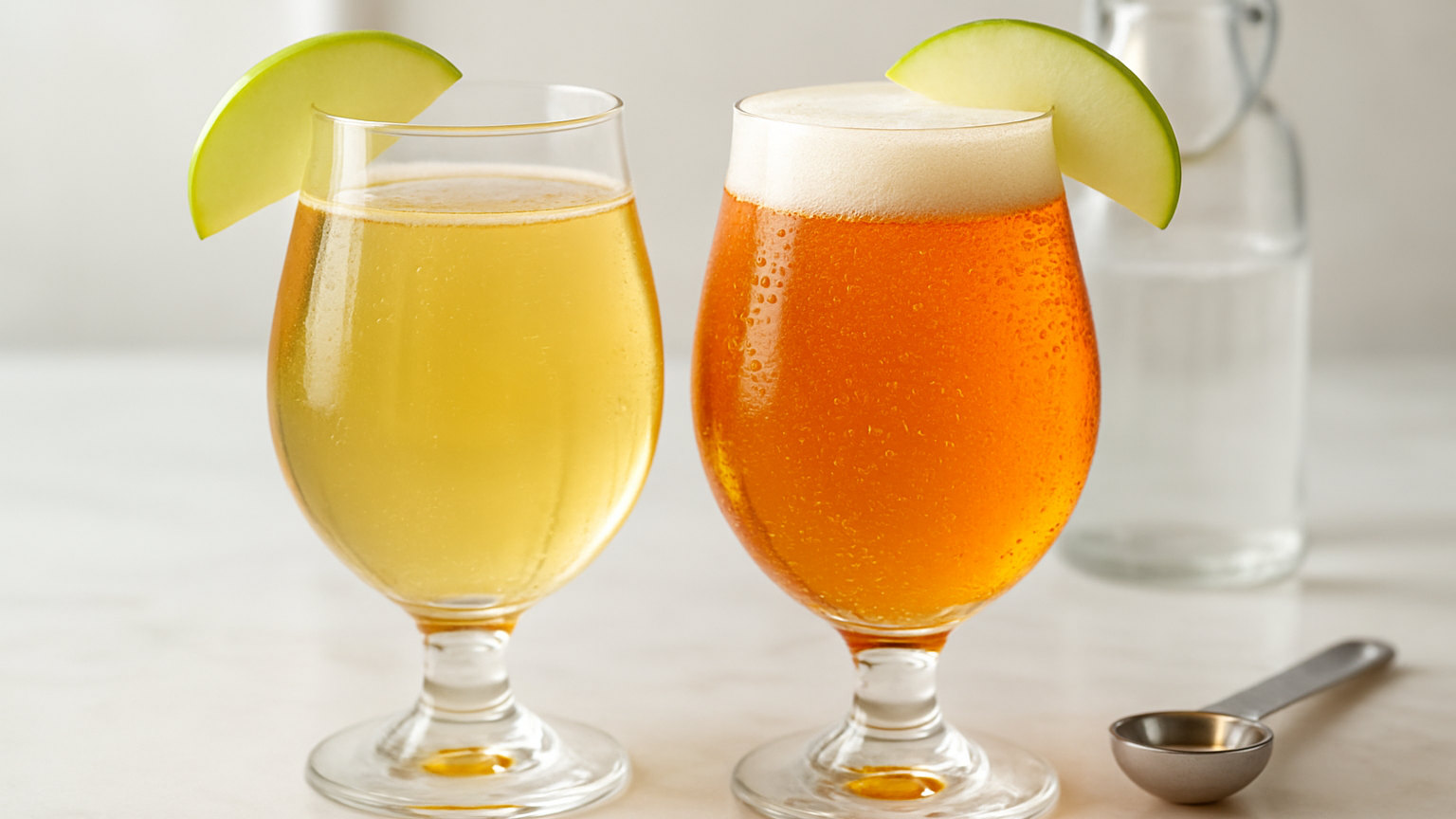
Cider leaves the demijohn still, because the carbon dioxide from fermentation escaped through the airlock. Making it sparkling means creating a second, controlled fermentation inside a sealed bottle, and the word controlled is doing a great deal of work in that sentence.
How do you make still cider?
Simply bottle it once fermentation has genuinely finished, with no added sugar. Three identical hydrometer readings on consecutive days, then rack and bottle.
Still cider is the traditional West Country style and it is by some distance the safest thing to make, since there is no pressure involved at all. Any bottle will do.
How do you make it sparkling?
Bottle condition it, exactly as you would beer. Once fermentation has finished:
- Dissolve 80 to 100g of sugar in 200ml of boiled water per 23 litres, or roughly 20g per gallon.
- Cool it and add it to a bottling bucket.
- Siphon the cider on top so the flow mixes it.
- Bottle in pressure-rated bottles and cap.
- Leave two weeks at room temperature, then refrigerate.
Which bottles are safe?
Crown-capped beer bottles, swing-tops in good condition, champagne bottles, or PET plastic bottles. Never wine bottles, spirit bottles or anything made for still liquid, since those fail by shattering.
Why is measuring so important?
Because cider yeasts are vigorous and cider is usually fermented very dry, so there is nothing to slow a second fermentation down. Twenty grams of sugar per gallon produces a pleasant sparkle; forty produces something that gushes; eighty produces a hazard.
Weigh it on scales. This is not a place for estimating by eye, and the failure mode is broken glass rather than flat cider.
What is the safest way to sweeten?
Sweetening and carbonating together is where most accidents happen, because added sugar plus live yeast in a sealed bottle has no natural stopping point.
The safe sequence is:
- Confirm fermentation has finished with three stable readings.
- Add potassium sorbate and a crushed Campden tablet.
- Wait at least three days.
- Sweeten to taste and bottle.
That produces a sweet still cider. To have both sweet and sparkling safely at home, either use an artificial sweetener that yeast cannot ferment, or keg it and force carbonate with gas.
What is keeving?
A traditional French method that produces naturally sweet sparkling cider by deliberately starving the fermentation of nutrients, so it stalls before the sugar runs out.
It requires very specific juice, careful timing and considerable experience, and an incompletely stalled keeve is precisely the situation that bursts bottles. It is not a beginner technique.
How do you store bottles safely?
Upright in a sealed crate at room temperature for two weeks, then refrigerate, which slows the yeast almost to a stop.
Keep them out of living areas during carbonation. Open the first one over a sink after a fortnight to check, and if it gushes, chill the whole batch immediately and open the rest carefully with eye protection.
What carbonation level should you aim for?
Lower than beer. Traditional cider is served with a gentle spritz rather than a fizz, and 20g of sugar per gallon delivers roughly that.
Commercial ciders are considerably more carbonated because they are force carbonated with gas, which allows a level that would be unsafe to achieve by bottle conditioning.
How long does carbonation take?
Two weeks at room temperature, sometimes less. Cider yeast is vigorous and works through priming sugar faster than beer yeast does, which is another reason to check early rather than leaving bottles for a month.
Bottle one PET plastic bottle alongside the glass ones. When it is firm to squeeze, refrigerate the whole batch.
What about kegging?
It removes the pressure risk entirely, since the gas is supplied rather than fermented, and it lets you have cider both sweet and sparkling without stabilising anything.
For anyone making cider regularly and drinking it at home, it is the answer to the sweetening problem that bottle conditioning cannot solve safely.


