
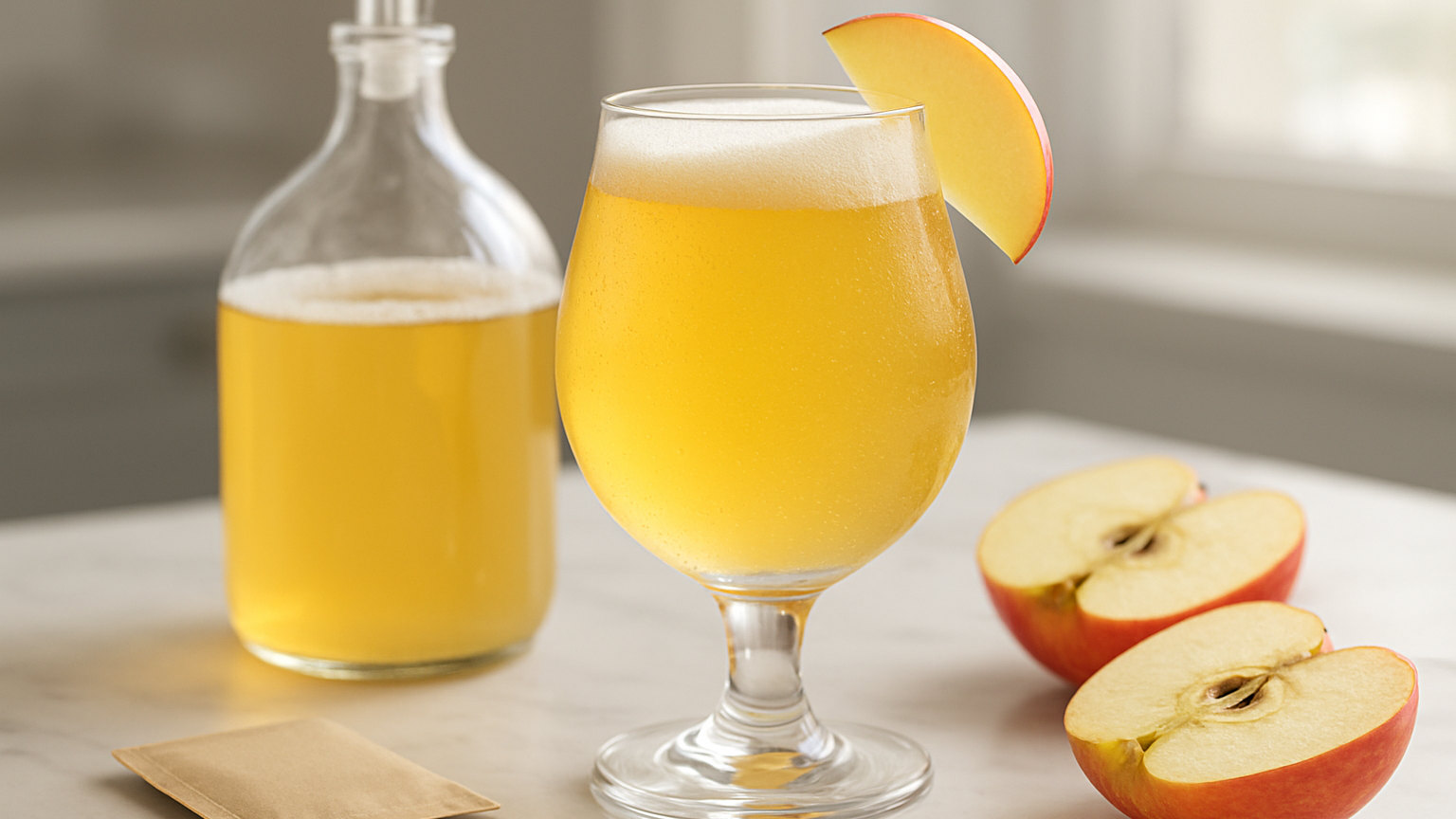
Cider from bought juice is the simplest fermentation anyone can attempt. There is no mash, no boil and no cooling. You need juice, yeast, a vessel and an airlock, and the result is considerably better than the process suggests it should be.
Which juice can you use?
This is the one decision that matters. Check the ingredients for preservatives, specifically potassium sorbate and sodium benzoate. Both are added to stop fermentation, which is exactly what you are trying to start.
Look for juice listing only apple juice, or apple juice from concentrate, with nothing else. Ascorbic acid, vitamin C, is fine and does not inhibit yeast.
Cloudy pressed juice makes a fuller cider than clear concentrate-based juice, and both work. Supermarket own-brand pressed apple juice is frequently ideal and cheap.
What about pasteurisation?
Pasteurised is fine and arguably better, since it has no wild yeast competing with the strain you pitch. Almost all shop juice is pasteurised.
What is the method?
- Sanitise a demijohn, bung and airlock.
- Pour in 4.5 litres of apple juice, leaving headspace.
- Take a hydrometer reading. Most juice reads around 1.045 to 1.050.
- Add a teaspoon of yeast nutrient.
- Pitch a sachet of cider or wine yeast.
- Fit the airlock and leave somewhere at 18 to 20 degrees.
That is the whole brew day, and it takes about fifteen minutes.
What strength will it be?
Around 5 to 6 per cent from typical juice fermented dry. Apple juice at 1.048 fermenting down to 1.000 gives roughly 6.5 per cent.
Adding sugar raises it and thins the result. Most people find bought juice needs no additions at all, which is part of the appeal.
What is the timeline?
- Days 1 to 3. Fermentation starts, sometimes vigorously.
- Weeks 1 to 2. Steady activity, then slowing.
- Week 3. Take hydrometer readings on three consecutive days.
- Week 3 to 4. Rack off the sediment.
- Months 2 to 3. Clear, then bottle.
It is drinkable at two months and noticeably better at four. Young cider tastes harsh and thin in a way that resolves with time.
Will it be dry?
Very. Cider yeast ferments apple sugar almost completely, so the result is bone dry and often a surprise to anyone expecting supermarket sweet cider.
To sweeten, stabilise first with potassium sorbate and a Campden tablet, wait several days, then add sugar or apple juice to taste. Sweetening without stabilising restarts fermentation in the bottle, which builds pressure.
How do you know it has finished?
Three identical hydrometer readings on consecutive days, ideally below 1.000. A quiet airlock proves nothing, and cider bottled with sugar remaining is a genuine hazard rather than merely a disappointment.
What can go wrong?
- Nothing happens. The juice contains preservatives. Check the label.
- Vinegar smell. Acetobacter infection, usually from air exposure.
- Rotten egg smell. Yeast nutrient deficiency. Add nutrient and rouse.
- Stops early. Too cold. Move somewhere warmer.
Should you add anything to the juice?
Usually not. Bought apple juice arrives at roughly the right gravity, acidity and sugar level for cider, which is a large part of why the method works so well.
Two optional additions are worth knowing about. A cup of strong cold black tea per gallon adds tannin, which gives body and structure that dessert apple juice lacks. And a teaspoon of pectic enzyme helps a cloudy juice clear, though most ciders clear on their own given time.
Resist adding sugar unless you specifically want a stronger cider. Raising it to 8 or 9 per cent thins the apple character and makes a harsher drink that needs far longer to come round.
How does it compare to cider from real fruit?
Cleaner and simpler. Juice-based cider is bright and straightforward; cider pressed from a proper blend of cider apples has depth and tannic grip that no supermarket juice can provide.
That is not an argument against starting here. It is the fastest way to learn the fermentation, the racking and the bottling, all of which transfer directly to a batch made from real fruit in the autumn.


