
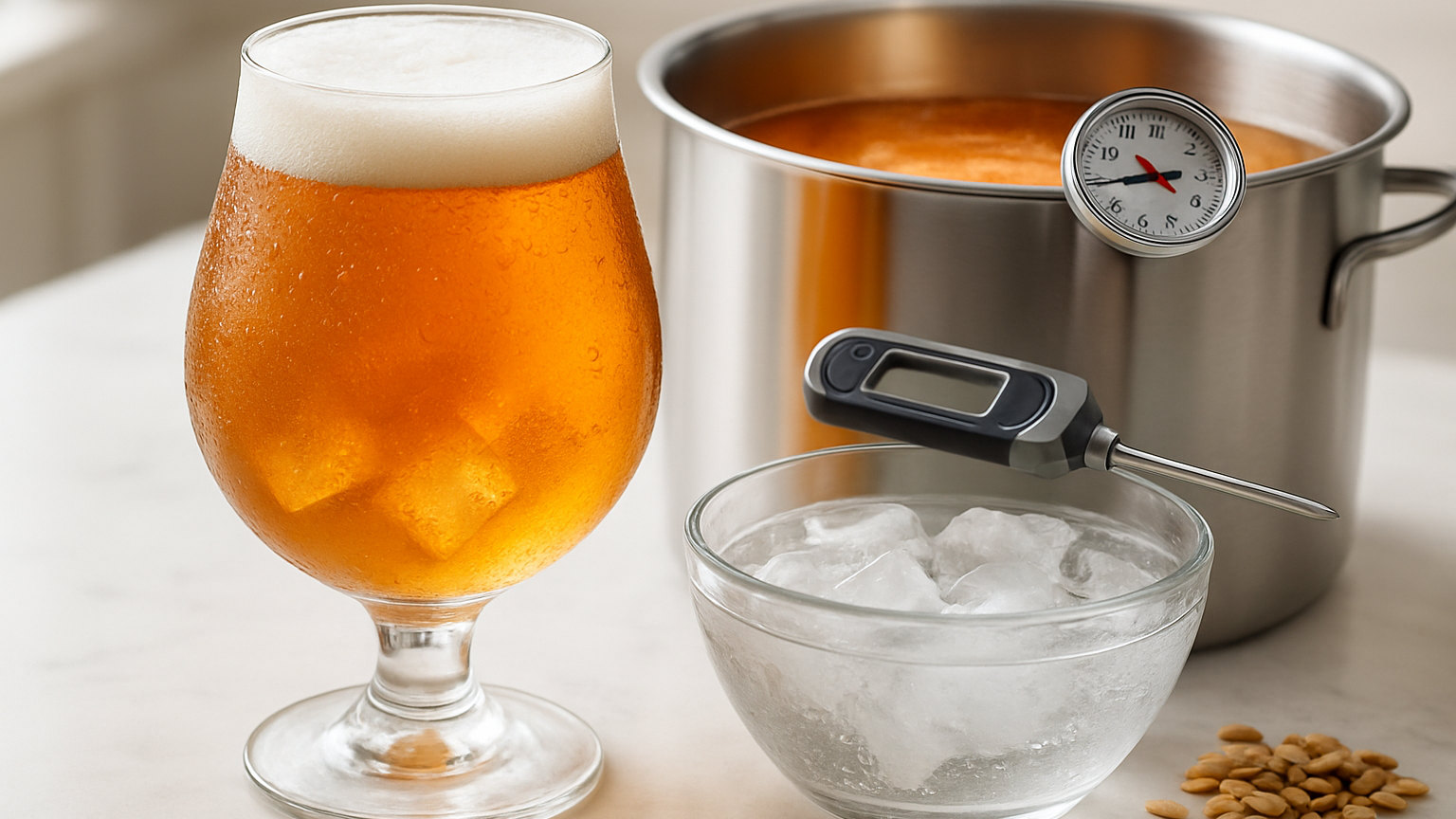
Temperature matters at three points in brewing: the mash, the pitch, and the fermentation. Each has different accuracy requirements, and two inexpensive instruments cover all three comfortably.
What do you need?
- Stick-on liquid crystal strip. Attached to the fermenter, reads the beer continuously.
- Digital probe thermometer. For wort, mash water and pitching temperature.
Between them those two cost very little and cover everything. A kit brewer only strictly needs the strip and something to check pitching temperature.
Why is the stick-on strip so useful?
Because it reads the fermenter rather than the room. Fermentation generates heat, so the beer can sit two to four degrees above the surrounding air during the vigorous phase, and a room thermometer will not show that.
Place it on the side rather than near the top, since the temperature is highest in the middle of the liquid. It is accurate to about a degree, which is entirely adequate for fermentation.
Do they wear out?
They fade over a year or two and become harder to read. They are cheap enough to replace annually, and it is worth doing rather than squinting at one that has gone dull.
Where does accuracy actually matter?
The mash, and only the mash. A degree either way changes which enzymes dominate and therefore how fermentable the wort is, which decides body and dryness in the finished beer.
Pitching temperature needs to be right within a couple of degrees, which any working thermometer manages. Fermentation temperature needs to be right within one or two degrees, which the strip handles.
How do you check a thermometer?
Two fixed points, both free:
- Ice water. A glass packed with crushed ice and a little water, stirred, should read 0 degrees.
- Boiling water. Should read 100 degrees at sea level, a fraction lower at altitude.
Check both. A thermometer accurate at 0 and 2 degrees out at 100 is telling you something useful about the middle of its range.
Many digital probes have a calibration offset function. If yours does not, write the error on a label and apply it mentally.
What should you look for in a probe?
- Fast response. Under ten seconds. A slow thermometer read too early gives a false number.
- A long enough stem to reach into a mash tun without your hand near the steam.
- Waterproof. Brewing is a wet activity.
- A stated accuracy figure, ideally within half a degree.
What should you avoid?
Glass spirit thermometers with a metal case, which are slow and break. Infrared thermometers, which read surface temperature only and are useless for a mash, since the surface of the grain bed and the middle of it are different temperatures.
Also avoid relying on a single instrument for years without checking it. Probes drift, and a mash thermometer reading two degrees high will quietly produce thin beer for months before anyone suspects it.
How many should you own?
Two probes eventually, so one can be checked against the other. When they disagree, the ice water test settles it in a minute.
Where should you take the mash reading?
In the middle of the grain bed rather than at the surface or against the wall. A mash has genuine temperature gradients, and a reading taken at the top can be two degrees off what the bulk of the grain is experiencing.
Stir gently before reading, then take two readings at different depths if the figure matters.
Do you need one for the fridge as well?
The controller has its own probe, which reads whatever you attach it to. A separate strip on the fermenter is still worth having as a cross-check, since a controller probe that has slipped will hold the wrong temperature without telling you.
How often should you check calibration?
Every few months for anything used at mash temperature, and immediately if a batch comes out unexpectedly thin or full. Probes drift slowly and a two degree error will quietly change every beer you make.


