
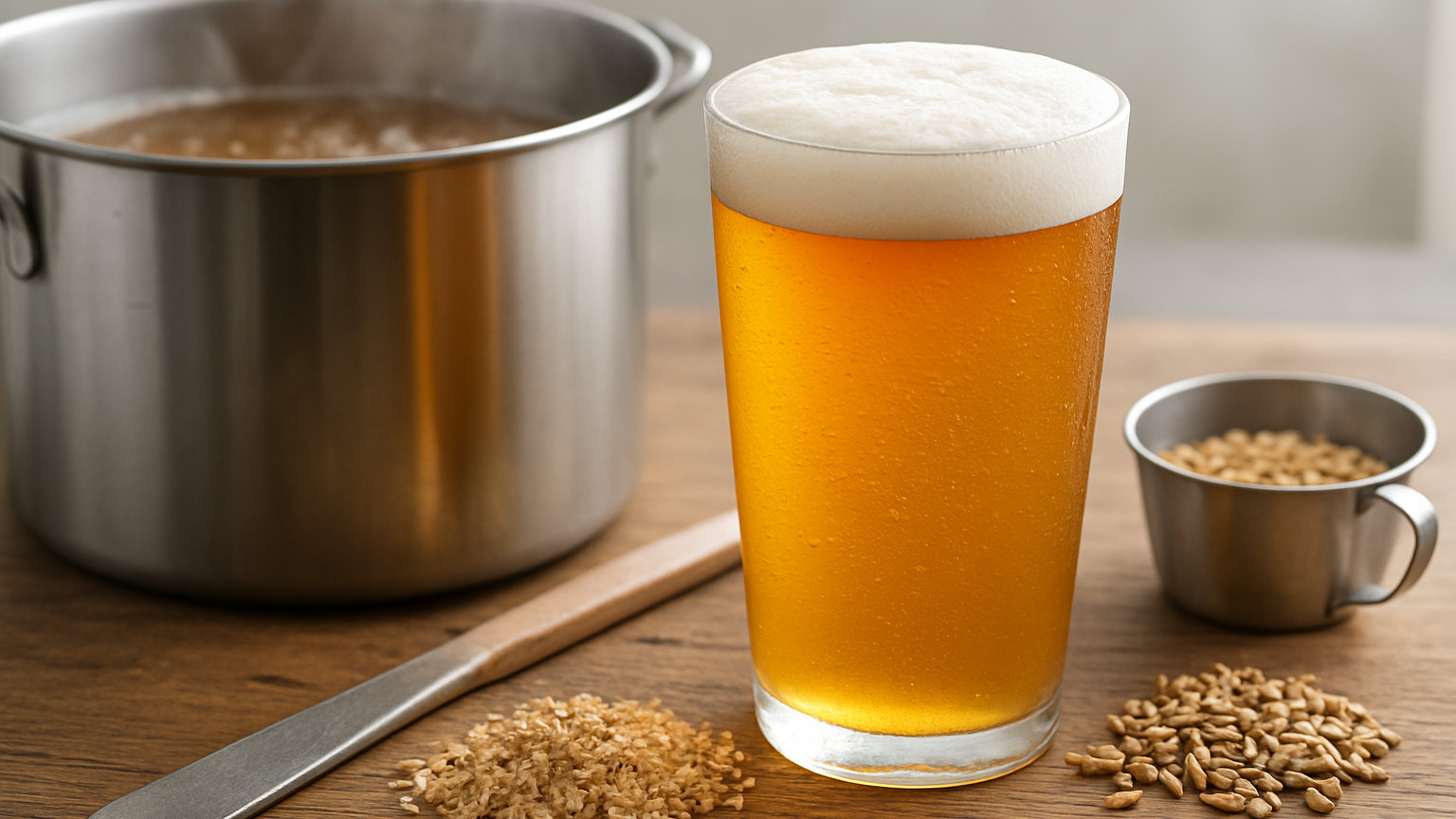
The kettle is the item that most often blocks a move from extract to all grain, because the pan that handled a partial boil is not close to large enough. The arithmetic is straightforward and worth doing before buying anything.
What volume do you need to boil?
For a 23 litre finished batch, work backwards:
- 23 litres into the fermenter.
- Plus 2 litres lost to trub and hop material in the kettle.
- Plus 4 litres lost to evaporation over a 60 minute boil.
- Total pre-boil volume: around 29 litres.
Add headroom so it does not boil over, and the minimum practical kettle is 32 litres. Thirty-five to forty is more comfortable.
Why does it boil over so readily?
Because wort foams heavily as it reaches the boil, particularly in the first few minutes when the hot break forms. A kettle filled to within a few centimetres of the rim will overflow, and boiling sugary liquid on a hob is both dangerous and extremely difficult to clean.
Keep at least 8cm of clear space above the liquid. Watch it closely as it approaches the boil, and have a spray bottle of water to knock the foam down.
What about a boil-over on an induction hob?
Worse than on gas, since sugar bakes onto the glass surface. A large kettle on a domestic hob is genuinely worth watching rather than walking away from.
What is the boil off rate?
Between 3 and 5 litres per hour for a typical setup, and it depends on surface area and vigour rather than volume. A wide kettle evaporates faster than a tall narrow one.
Measure yours once. Boil a known volume of water hard for sixty minutes and see what is left. That single figure lets you calculate pre-boil volume for any batch size, and it is more useful than any published estimate.
What material should it be?
Stainless steel. Aluminium works and is cheaper and lighter, and it reacts with strongly alkaline cleaners and can pit. Avoid anything with a non-stick coating, which will not survive.
A thicker base distributes heat better and is less likely to scorch, which matters when boiling something with sugar in it.
What heat source will manage it?
This is the constraint people hit second. Thirty litres of wort takes a long time to reach the boil on a domestic hob, often 45 minutes or more, and some hobs cannot hold a rolling boil at that volume at all.
- Domestic gas hob: workable for 30 litres, slow.
- Electric or induction hob: variable. Test before committing.
- Electric brewing kettle with built-in element: reliable, and the usual answer.
- Propane burner: powerful, and outdoor use only.
What is the safety point on propane?
Propane burners must never be used indoors or in a garage with the door shut. They produce carbon monoxide, which is colourless and odourless, and enclosed use has killed people.
Use them outdoors on a level surface, away from anything flammable, and be aware you are handling 30 litres of boiling liquid at waist height.
Is a built-in element kettle worth it?
For anyone brewing all grain regularly in a UK house, yes. It removes the hob limitation entirely, holds a controlled boil, and many models handle the mash as well, which replaces the mash tun.
What other features are worth having?
- Volume markings inside. Removes guesswork on boil-off and top-up.
- A tap. Makes transferring far easier than tipping 30 litres.
- A lid. Speeds heating to the boil considerably.
Do not boil with the lid on, though. Trapping steam prevents dimethyl sulphide escaping, which gives a cooked-corn flavour in pale beers.
Can you brew smaller batches instead?
Yes, and it is the sensible answer if a 35 litre kettle is impossible. An 11 litre batch needs a 15 litre kettle, fits on any hob, and produces around twenty pints, which is plenty for testing a recipe.
What about the weight?
Thirty litres of wort weighs around 30kg before the kettle is counted. Plan how it will be moved and where it will be cooled before brew day, since lifting that at chest height is how brewers hurt themselves.


