
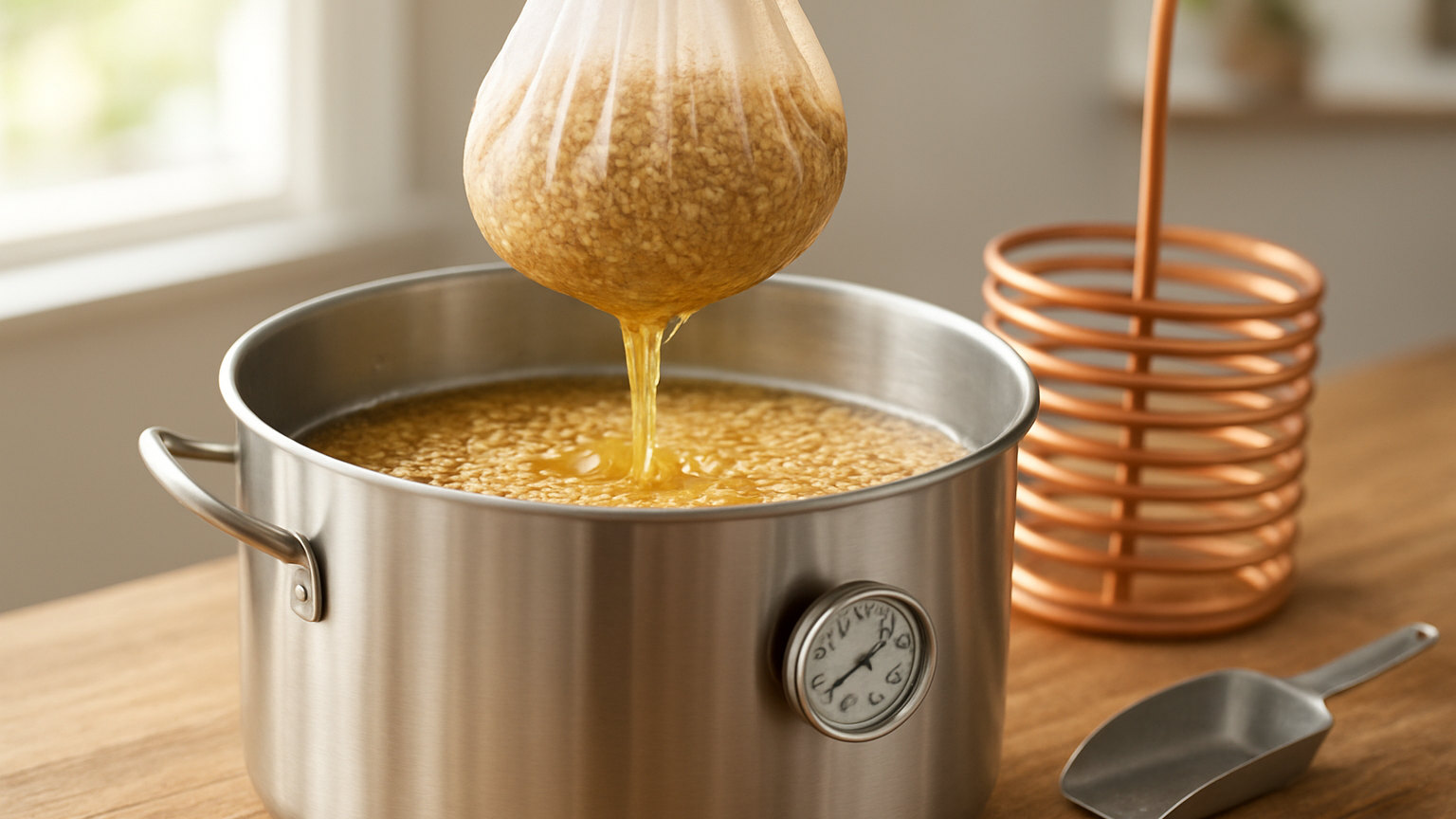
Brew in a bag does the mash and the boil in the same vessel, with the crushed grain held in a large mesh bag that is lifted out when the mash is done. It removed most of the equipment barrier to all grain brewing and is now how a large proportion of home brewers work.
What do you need?
- A kettle of 35 litres or more. The main requirement.
- A mesh bag sized to the kettle, in food-grade voile or nylon.
- A way to lift and drain the bag. A pulley, a hook, or strong arms.
- A heat source capable of a rolling boil at that volume.
No mash tun, no sparge arm, no false bottom, no second vessel. That is the appeal.
How does the method work?
- Heat the full water volume to a few degrees above mash temperature.
- Line the kettle with the bag and add the crushed grain, stirring to avoid clumps.
- Hold at mash temperature for sixty minutes, insulated.
- Lift the bag out and let it drain over the kettle.
- Bring to the boil and continue as normal.
Because the full water volume is in the kettle from the start, there is no separate sparge, which is the step that traditional setups need extra equipment for.
Why does the kettle need to be so large?
Because the mash water and the grain occupy it together. Around 5kg of grain displaces roughly 3.5 litres, so a mash of 29 litres plus grain needs a 35 litre kettle to work comfortably without risking a spill.
How do you hold temperature?
A kettle is not insulated, so the mash will lose several degrees over an hour if left alone. Two solutions:
- Insulate it. Wrap in a blanket, sleeping bag or reflective camping mat. Loses about a degree.
- Apply gentle heat. Brief bursts on the lowest setting, stirring each time to avoid scorching the bag on the base.
Insulating is safer, since direct heat on a bag resting on the element can melt it. A false bottom or a trivet under the bag prevents that if you do apply heat.
How much lifting is involved?
A wet grain bag from a 23 litre batch weighs around 10kg and is hot and dripping. That is the main practical limitation of the method.
A pulley over a beam, a hook on a shelf bracket, or a simple frame makes it manageable. Let it drain over the kettle for several minutes rather than squeezing hard, since heavy squeezing can extract tannins.
What about efficiency?
Slightly lower than a traditional sparged mash, typically by five percentage points, because rinsing the grain is less thorough.
A finer crush largely compensates, since the bag filters rather than the grain bed. Many brew in a bag brewers mill at 0.7mm rather than 1mm for this reason and reach comparable efficiency.
Which bag should you buy?
A purpose-made one in food-grade polyester voile, sized to your kettle with a drawstring. They cost little and last for many batches if washed and dried properly.
Check the temperature rating. A cheap nylon bag can soften near a heating element, and a bag failing mid-mash spills 5kg of grain into the kettle.
Is the beer as good?
Yes. Blind comparisons routinely fail to separate brew in a bag from traditional all grain, and the method is used by commercial brewers on small systems. The differences are in efficiency and effort rather than in the glass.
How do you look after the bag?
Rinse it immediately, wash without detergent, and dry it fully before storing. A damp bag left folded grows mould, and detergent residue affects head retention.
Check the seams periodically. A bag that fails while holding 5kg of hot wet grain over a kettle is an unpleasant thing to deal with.
Can you sparge with it?
Yes, in a simplified form. Hold the lifted bag over a second pot and pour a few litres of hot water through it, then add that to the kettle. It recovers some of the efficiency lost to the method and adds a step.


