
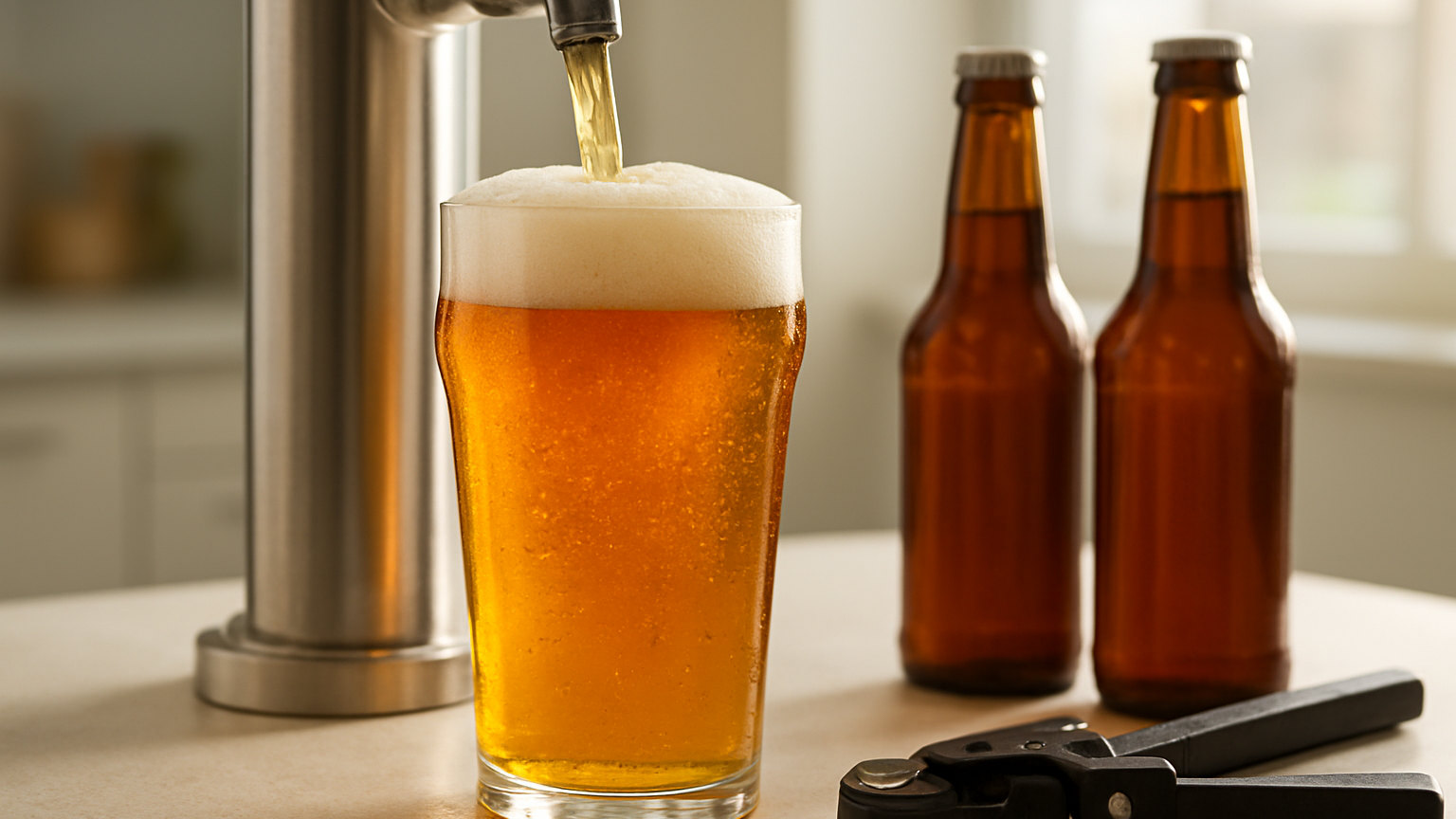
Every batch has to go somewhere once fermentation finishes, and the choice between bottles and a keg shapes how much work each batch is and how the beer gets drunk. Neither is obviously better.
What does bottling involve?
Sanitising around forty bottles, mixing priming sugar into the beer, filling each bottle, capping it, and waiting two weeks for carbonation to develop.
- Time per batch: 90 minutes to two hours.
- Cost: very low. Bottles are free from drinking, caps cost pennies.
- Wait: two weeks minimum.
What does kegging involve?
Transferring the beer to a keg, sealing it, connecting gas and either force-carbonating over a few days or letting it condition naturally.
- Time per batch: 20 to 30 minutes.
- Cost: substantial up front for keg, regulator, cylinder and fittings.
- Wait: two days with forced carbonation.
What is a pressure barrel?
The cheaper middle ground. A 25 litre plastic barrel with a screw lid and a tap, primed with sugar like a bottle. It carbonates naturally and dispenses under its own pressure until that runs low, at which point a small gas cartridge tops it up.
It costs a fraction of a proper keg setup and it does not hold pressure as reliably or as long. Perfectly good for beer drunk within a few weeks.
What is a cornelius keg?
A 19 litre stainless steel keg originally made for soft drink syrup, now the standard home brewing vessel. It seals properly, holds pressure indefinitely, and connects to a CO2 cylinder through a regulator.
Second-hand ones are widely available. You will also need a regulator, a gas cylinder, gas and liquid disconnects, and tubing, which is where the cost accumulates.
What are the safety points with gas?
A CO2 cylinder is a pressure vessel and deserves respect. Secure it upright so it cannot fall, since a damaged valve on a falling cylinder turns it into a projectile.
Never exceed the pressure rating of any component, and use a regulator rather than connecting a cylinder directly. Carbon dioxide is heavier than air and displaces oxygen, so store and use it in a ventilated space rather than a sealed cupboard.
Check for leaks with soapy water after any change. A slow leak empties a cylinder overnight and is expensive rather than dangerous, but a large one in a confined space is not.
Which suits how you drink?
Bottles suit sharing, taking beer to other people’s houses, keeping several different beers at once, and ageing. A bottle opened is a bottle drunk.
A keg suits drinking at home over a few weeks, having beer on tap, and avoiding the bottling session entirely. Once tapped it is a single beer until it is finished.
What about the sediment?
Bottle-conditioned beer carries a yeast layer that must be left behind when pouring. Kegged beer, particularly if cold crashed and force carbonated, arrives clear.
That is a genuine advantage of kegging and a matter of taste. Bottle conditioning also gives a softer carbonation that suits British styles.
Is there a sensible progression?
Bottle for the first year, then decide. Many brewers end up doing both: kegging the batch they will drink at home and bottling a dozen from each batch for sharing and for keeping.
Can you do both from one batch?
Yes, and many people do. Keg the majority and bottle a dozen off the same batch using a counter-pressure filler or by priming a few bottles separately. That gives beer on tap at home and bottles to take elsewhere.
What does a keg setup need beyond the keg?
A CO2 cylinder, a regulator, gas and liquid disconnects, tubing and a tap or picnic tap. Buying a bundled kit is usually cheaper than assembling the parts individually.
Which is better for competitions or sharing?
Bottles, straightforwardly. A keg cannot be posted, handed to a friend or entered into anything, and even a committed kegger usually bottles a few from each batch for that reason.


